







Question: For Problems .consider the following model: The linear-quadratic (LQ) model for the percent S of cancer cells surviving radiation treat. ment states that S =
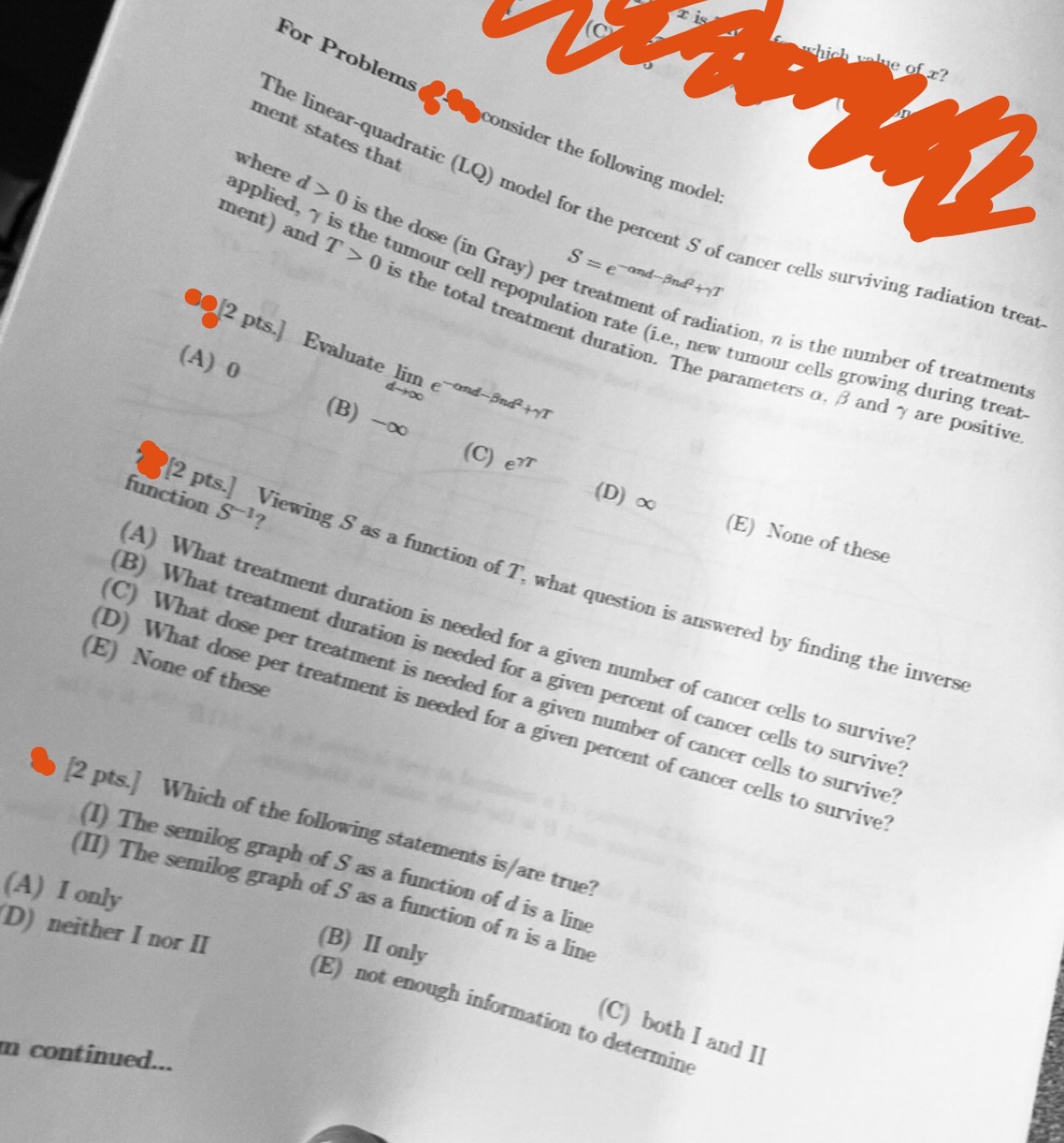
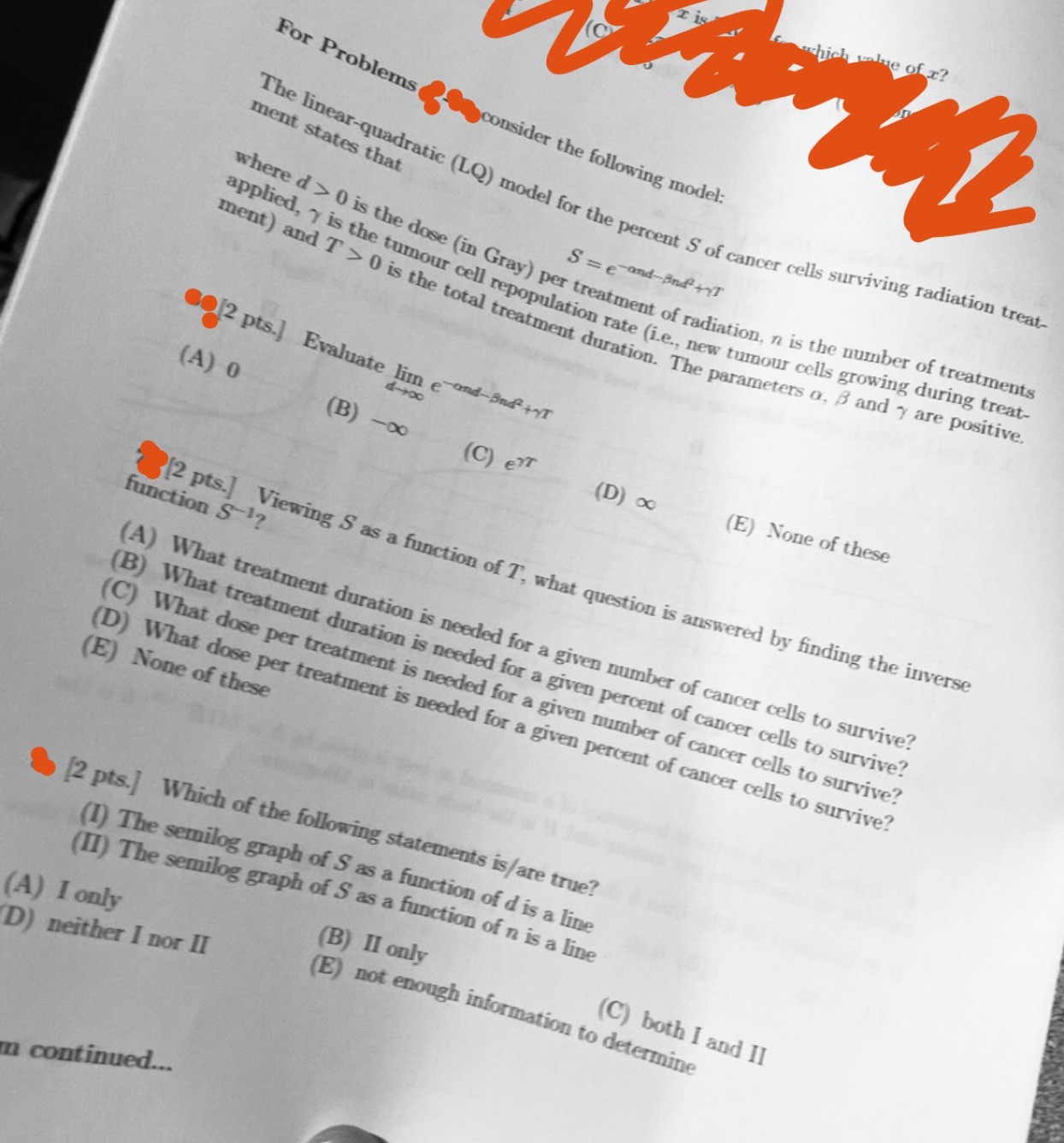
For Problems .consider the following model: The linear-quadratic (LQ) model for the percent S of cancer cells surviving radiation treat. ment states that S = e- and -BuffyT where d > 0 is the dose (in Gray) per treatment of radiation, n is the number of treatments applied, y is the tumour cell repopulation rate (i.e., new tumour cells growing during treat- ment) and T > 0 is the total treatment duration. The parameters o, B and y are positive. 0912 pts.] Evaluate lim e-and-BnftyT 1-too (A) O (B) -00 (C) em (D) 0 (E) None of these 12 pts.] Viewing S as a function of T', what question is answered by finding the inverse function S !? (A) What treatment duration is needed for a given number of cancer cells to survive? (B) What treatment duration is needed for a given percent of cancer cells to survive? C) What dose per treatment is needed for a given number of cancer cells to survive? (D) What dose per treatment is needed for a given percent of cancer cells to survive? (E) None of these [2 pts.] Which of the following statements is/are true? (1) The semilog graph of S as a function of d is a line (II) The semilog graph of S as a function of n is a line (B) II only (C) both I and II (A) I only (E) not enough information to determine D) neither I nor II m continued
Step by Step Solution
There are 3 Steps involved in it

Get step-by-step solutions from verified subject matter experts
 Study Help