







Question: For Question 1, each 'no' needs an accompanying example. For Question 2 , full justifications are required. (1) Let E be the binary relation on
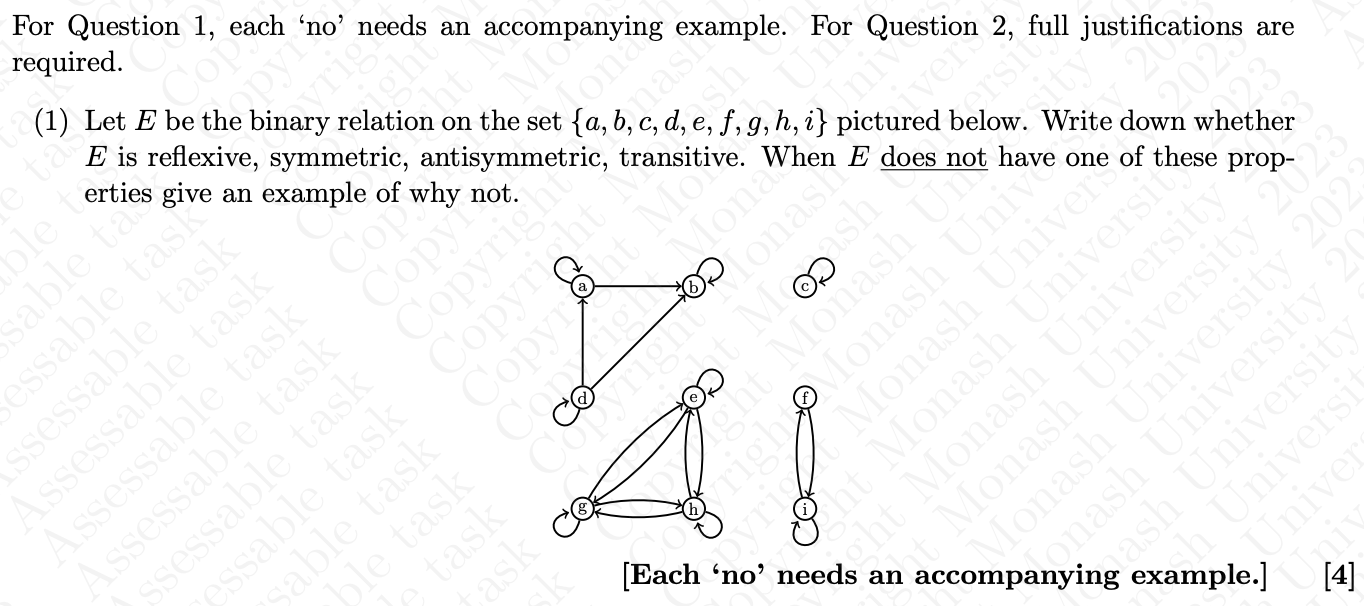
For Question 1, each 'no' needs an accompanying example. For Question 2 , full justifications are required. (1) Let E be the binary relation on the set {a,b,c,d,e,f,g,h,i} pictured below. Write down whether E is reflexive, symmetric, antisymmetric, transitive. When E does not have one of these properties give an example of why not. [Each 'no' needs an accompanying example.] [4]
Step by Step Solution
There are 3 Steps involved in it
1 Expert Approved Answer
Step: 1 Unlock

Question Has Been Solved by an Expert!
Get step-by-step solutions from verified subject matter experts
Step: 2 Unlock
Step: 3 Unlock
 Study Help