







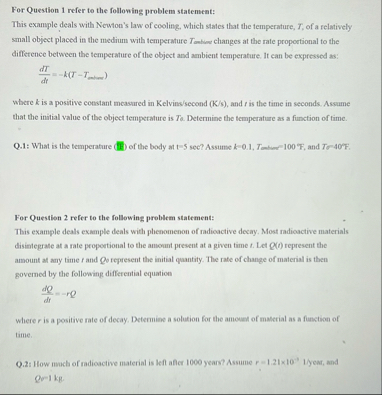
Question: For Question 1 refer to the following problem statement: This example deals with Newton's law of cooling, which states that the temperature, T , of
For Question refer to the following problem statement:
This example deals with Newton's law of cooling, which states that the temperature, of a relatively small object placed in the medium with temperature Tomer changes at the rate proportional to the difference between the temperature of the object and ambient temperature. It can be expressed as:
where is a positive constant measured in Kelvinssecond and is the time in seconds. Assume that the initial value of the object temperature is Determine the temperature as a function of time.
Q: What is the temperature of the body at Assume and
For Question refer to the following problem statement:
This example deals example deals with phenomenon of radioactive decry. Most radioactive materials disintegrate at a rate propertional to the amount present at a given time Let represent the amount at any time and represent the initial quantity. The rate of change of material is then governed by the following differential equation
where is a positive rate of decay. Determine a solution for the amount of material as a function of time.
Q: How much of radioactive material is left affer years? Assume year, and
Step by Step Solution
There are 3 Steps involved in it
1 Expert Approved Answer
Step: 1 Unlock

Question Has Been Solved by an Expert!
Get step-by-step solutions from verified subject matter experts
Step: 2 Unlock
Step: 3 Unlock
 Study Help