







Question: For question 2, you may find supplemental data to support your answer, but it is not necessary. The Paris Agreement, adopted by 196 parties (i.e.
For question 2, you may find supplemental data to support your answer, but it is not necessary. The Paris Agreement, adopted by 196 parties (i.e. countries and territories) at the 2015 UN Conference of the Parties (COP21), commits all signatories to take action to curtail global warming to below 2 degrees Celsius. Parties are required to submit Nationally-Determined Contributions (NDCs) which detail the steps they will take to curb greenhouse gas emissions and explain why the planned actions are realistic and appropriate to the partys national context. Below are excerpts from two example NDCs related to clean energy.
From the United States:
The United States has set a goal to reach 100 percent carbon pollution-free electricity by 2035, which could be achieved through multiple cost-effective technology and investment pathways, each resulting in meaningful emissions reductions in this decade.
From India:
To achieve about 40 percent cumulative electric power installed capacity from non fossil fuel based energy resources by 2030 with the help of transfer of technology and low cost international finance including from Green Climate Fund (GCF). India accounts for 2.4% of the world surface area, but supports around 17.5% of the world population. It houses the largest proportion of global poor (30%), around 24% of the global population without access to electricity (304 million), about 30% of the global population relying on solid biomass for cooking and 92 million without access to safe drinking water. The average annual energy consumption in India in 2011 was only 0.6 tonnes of oil equivalent (toe) per capita as compared to the global average of 1.88 toe per capita. It may also be noted that no country in the world has been able to achieve a Human Development Index of 0.9 or more without an annual energy availability of at least 4 toe per capita. With a Human Development Index (HDI) of 0.586 and global rank of 135, India has a lot to do to provide a dignified life to its population and meet their rightful aspirations.
A. Do you think the proposed actions from the US and India are sensible and appropriately ambitious? Why or why not?
B. The following chart from the US Energy Information Administration shows the decrease in construction prices for renewables in the United States from 2013-2019, along with the capacity added each year in gigawatts. How might declining costs be related to research/development and education? Will declining costs in the US necessarily correspond to declining costs elsewhere? Why or why not?
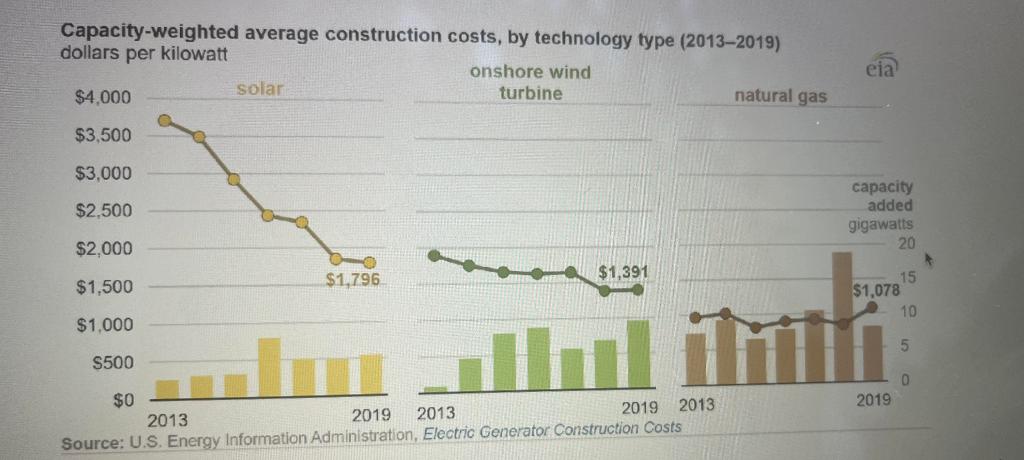
C. Now, lets consider some highly simplified scenarios for Indias low-carbon development. According to Indias NDC, the country may require about 630 GW of electric generation capacity in 2030 to meet its development goals; as of 2012, India had 200 GW installed capacity, of which a negligible amount came from carbon-free sources. In order to comply with the NDCs specified 40 percent carbon-free electricity generation by 2030, how much generation capacity installed between 2012 and 2030 must come from carbon-free sources? What percent of total new generation capacity does this represent? Lets say that India wants to meet 100 percent of this proposed carbon-free capacity through solar PV, since solar radiation is an abundant resource throughout much of the country. How much would this cost if the current cost to install in India is similar to the 2013 cost to install in the US? What about if it is similar instead to the 2019 cost to install? How much cheaper would it be if natural gas generation were installed instead of carbon-free solar (you can use the price from any year, since the differences are not significant)? What are these three prices as a percentage of Indias current GDP of 2.62 trillion (2.62e12) USD?
D. According to the EIA, the USA had 1,143,757MW of installed electricity generation capacity by the end of 2021, 27% of which came from renewables. Since the US will not require the same increase in installed capacity as a rapidly developing country like India, the primary cost associated with decarbonizing the electricity sector will come from replacing non-renewables with renewables. How much money would it hypothetically cost for the US to replace the remaining 73% of its generating capacity with 2019 solar PV technology? What is this quantity as a percentage of the USAs current GDP of 20.94 trillion (2.09e13) USD?
Capacity-weighted average construction costs, by technology type (2013-2019) inllare nar kilautatt Capacity-weighted average construction costs, by technology type (2013-2019) inllare nar kilautatt
Step by Step Solution
There are 3 Steps involved in it

Get step-by-step solutions from verified subject matter experts
 Study Help