







Question: For question 3b, follow induction format. Big Oh notation O(n), Omega notation (n), Theta notation (n). The following code computes an entry in Pascal's Triangle.
For question 3b, follow induction format. Big Oh notation O(n), Omega notation (n), Theta notation (n).
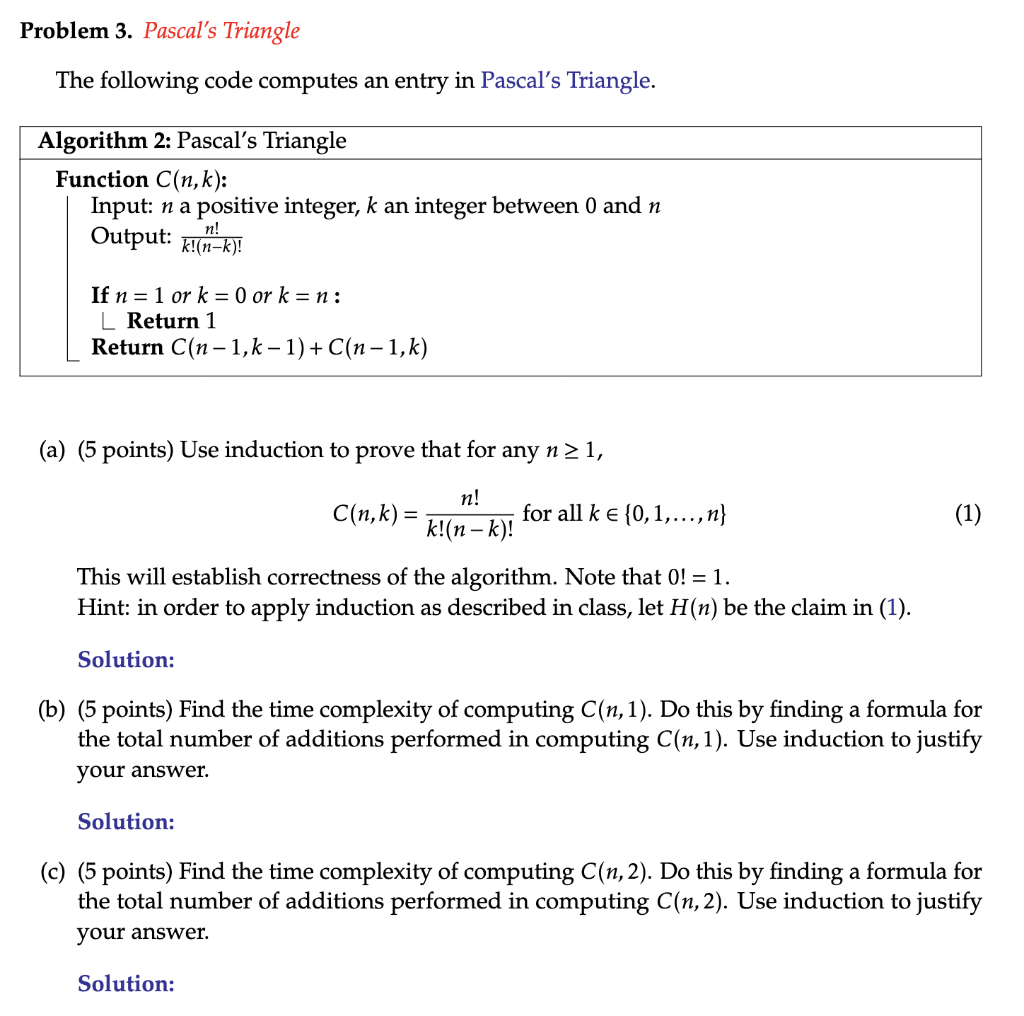
The following code computes an entry in Pascal's Triangle. Algorithm 2: Pascal's Triangle Function C(n,k) : Input: n a positive integer, k an integer between 0 and n Output: k!(nk)!n! If n=1 or k=0 or k=n : L Return 1 Return C(n1,k1)+C(n1,k) (a) (5 points) Use induction to prove that for any n1, C(n,k)=k!(nk)!n!forallk{0,1,,n} This will establish correctness of the algorithm. Note that 0!=1. Hint: in order to apply induction as described in class, let H(n) be the claim in (1). Solution: (b) (5 points) Find the time complexity of computing C(n,1). Do this by finding a formula for the total number of additions performed in computing C(n,1). Use induction to justify your answer. Solution: (c) (5 points) Find the time complexity of computing C(n,2). Do this by finding a formula for the total number of additions performed in computing C(n,2). Use induction to justify your answer. Solution
Step by Step Solution
There are 3 Steps involved in it

Get step-by-step solutions from verified subject matter experts
 Study Help