



Question: For question b.ii , which formula is used to get the calculation of (4.7/3.4 * 6.0) and why is it used? I'm really not sure
For question b.ii, which formula is used to get the calculation of (4.7/3.4 * 6.0) and why is it used? I'm really not sure which formula to use in this situation, so it would be appreciated if you can explain this!
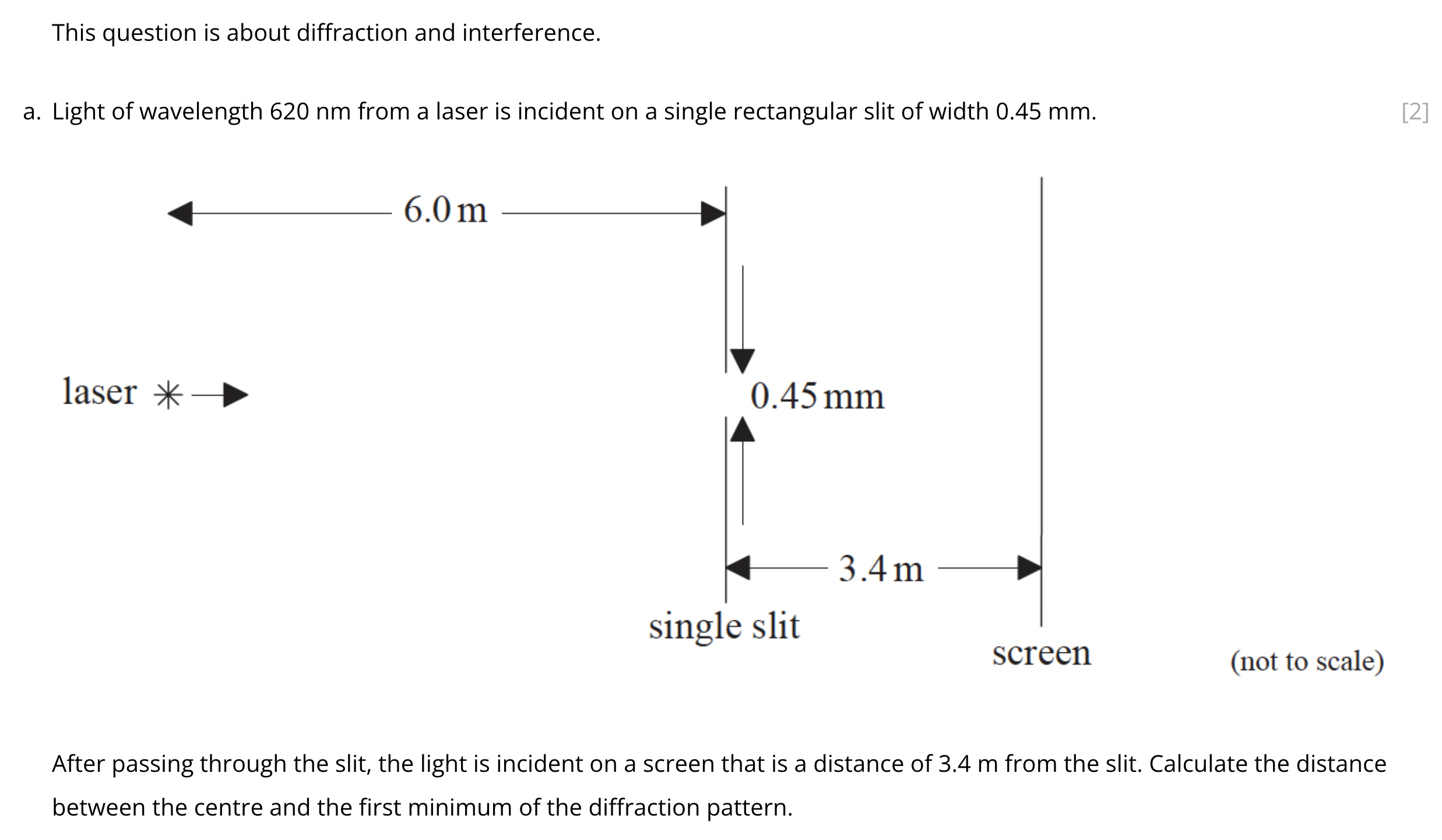
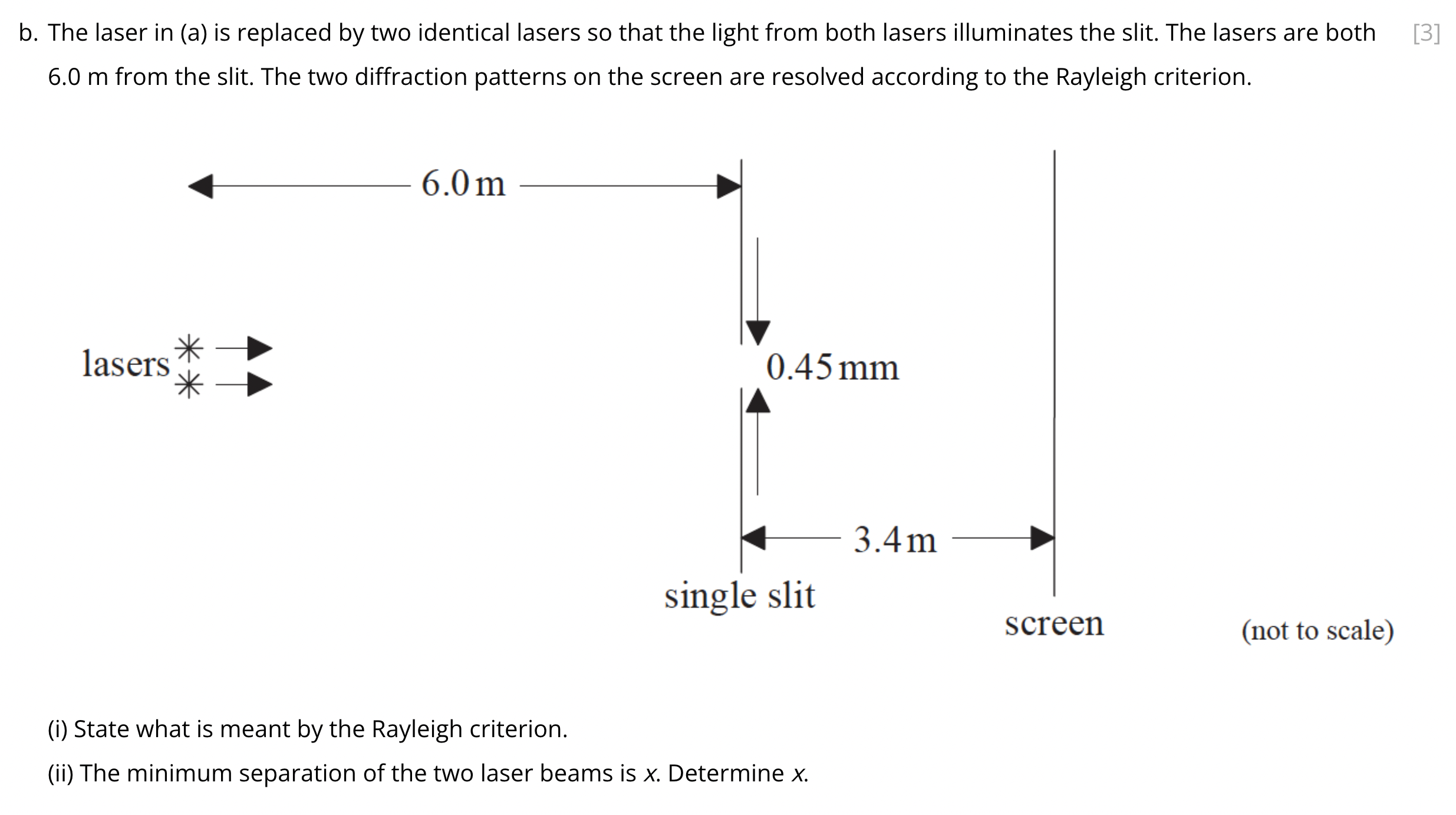
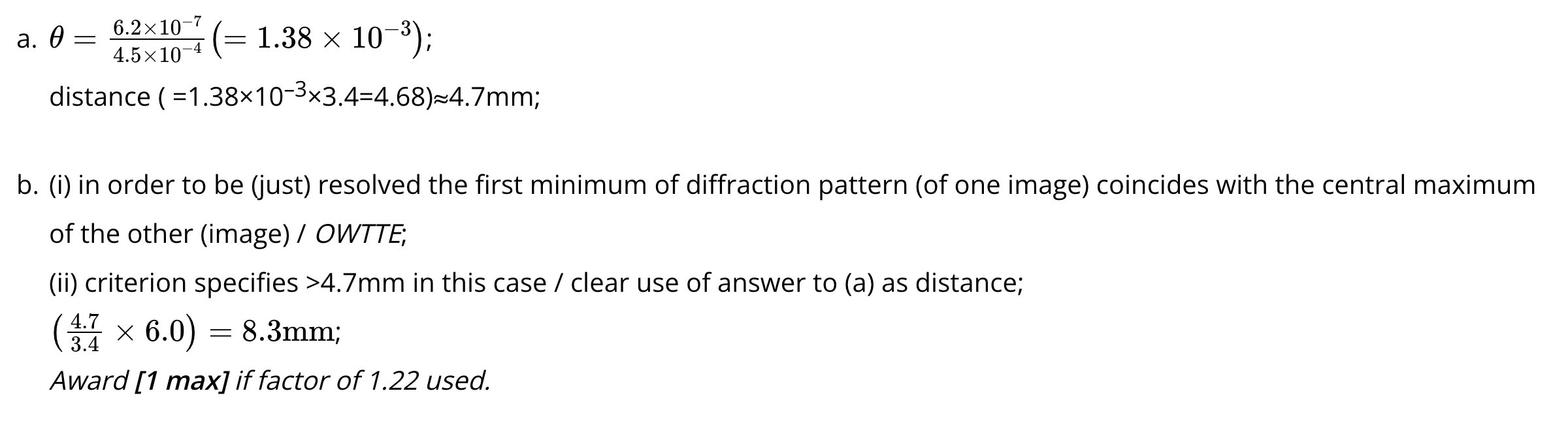
This question is about diffraction and interference. a. Light of wavelength 620 nm from a laser is incident on a single rectangular slit of width 0.45 mm. [2] 0.45 mm 3.4 In single slit screen (not to scale) After passing through the slit, the light is incident on a screen that is a distance of 3.4 m from the slit. Calculate the distance between the centre and the first minimum of the diffraction pattern. b. The laser in (a) is replaced by two identical lasers so that the light from both lasers illuminates the slit. The lasers are both [3] 6.0 m from the slit. The two diffraction patterns on the screen are resolved according to the Rayleigh criterion. { 6.0m 9K > lasers 9K _> 0.45 mm 3.4m single slit screen (not to scale) (i) State what is meant by the Rayleigh criterion. (ii) The minimum separation of the two laser beams is X. Determine X. a. 0 = 33:13:: (= 1.38 X 10³),- distance ( =1.38X10'3X3.4=4.68)=4.7mm; b. (i) in order to be (just) resolved the first minimum of diffraction pattern (of one image) coincides with the central maximum of the other (image) / 0W7 75; (ii) criterion specifies >4.7mm in this case / clear use of answer to (a) as distance; 4.7 . (37 x 6.0) = 8.3mm, Award [1 max] if factor of 7.22 used
Step by Step Solution
There are 3 Steps involved in it

Get step-by-step solutions from verified subject matter experts