







Question: For questions 1-3, assume an 8-bit integer and answer each one for the case of a two's complement number and unsigned number, indicating if
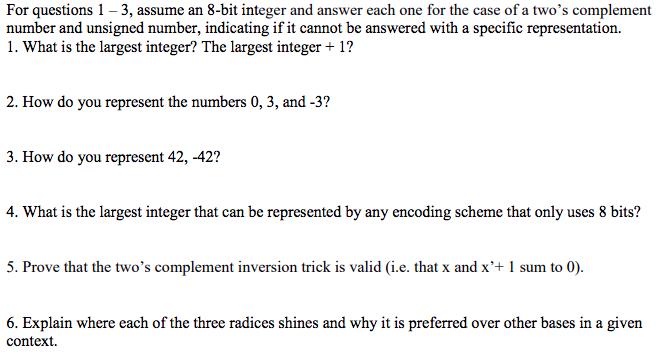
For questions 1-3, assume an 8-bit integer and answer each one for the case of a two's complement number and unsigned number, indicating if it cannot be answered with a specific representation. 1. What is the largest integer? The largest integer + 1? 2. How do you represent the numbers 0, 3, and -3? 3. How do you represent 42, -42? 4. What is the largest integer that can be represented by any encoding scheme that only uses 8 bits? 5. Prove that the two's complement inversion trick is valid (i.e. that x and x'+ 1 sum to 0). 6. Explain where each of the three radices shines and why it is preferred over other bases in a given context.
Step by Step Solution
There are 3 Steps involved in it

Get step-by-step solutions from verified subject matter experts
 Study Help