







Question: For questions asking for big-O estimates, make your answer as tight and as simple as possible. For example, (5n+1)(log5n)=O(nlogn) would be an acceptable answer, but
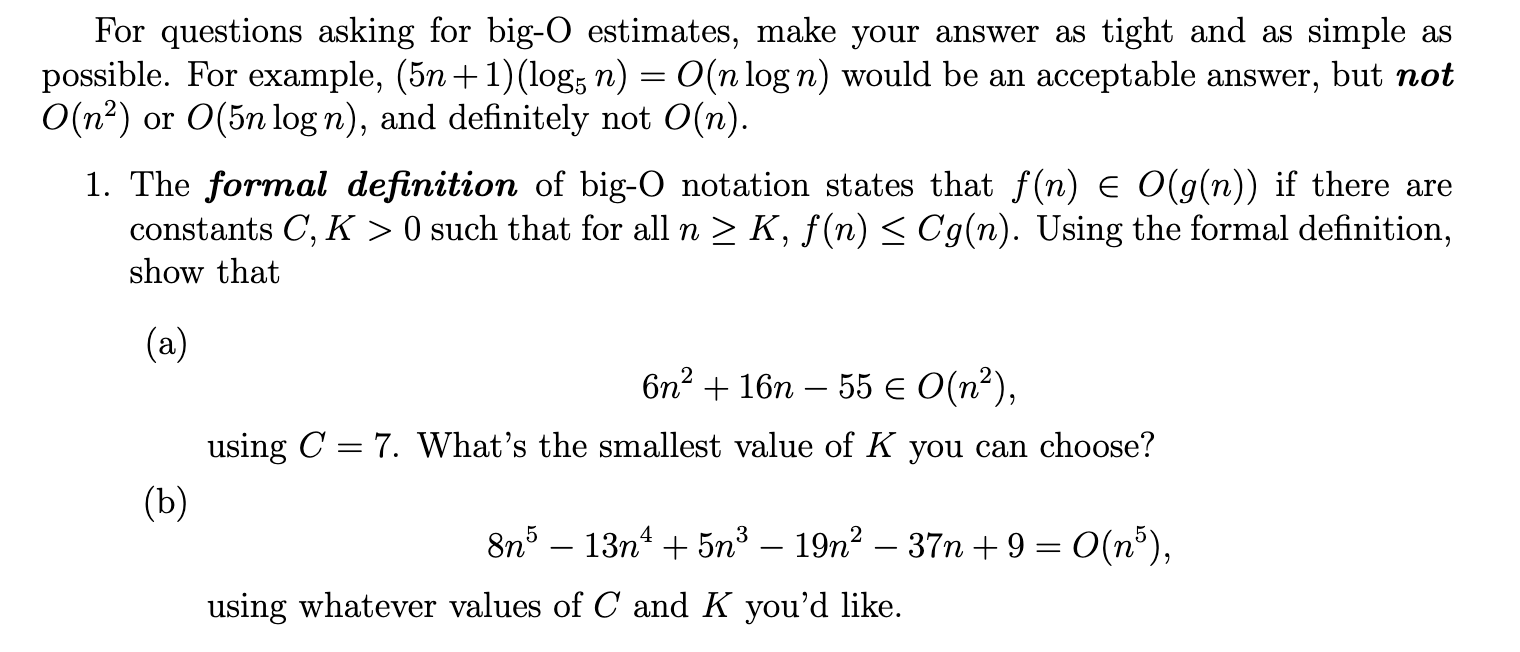
For questions asking for big-O estimates, make your answer as tight and as simple as possible. For example, (5n+1)(log5n)=O(nlogn) would be an acceptable answer, but not O(n2) or O(5nlogn), and definitely notO(n). 1. The formal definition of big-O notation states that f(n)O(g(n)) if there are constants C,K>0 such that for all nK,f(n)Cg(n). Using the formal definition, show that (a) 6n2+16n55O(n2) using C=7. What's the smallest value of K you can choose? (b) 8n513n4+5n319n237n+9=O(n5) using whatever values of C and K you'd like. For questions asking for big-O estimates, make your answer as tight and as simple as possible. For example, (5n+1)(log5n)=O(nlogn) would be an acceptable answer, but not O(n2) or O(5nlogn), and definitely notO(n). 1. The formal definition of big-O notation states that f(n)O(g(n)) if there are constants C,K>0 such that for all nK,f(n)Cg(n). Using the formal definition, show that (a) 6n2+16n55O(n2) using C=7. What's the smallest value of K you can choose? (b) 8n513n4+5n319n237n+9=O(n5) using whatever values of C and K you'd like
Step by Step Solution
There are 3 Steps involved in it

Get step-by-step solutions from verified subject matter experts
 Study Help