







Question: For Questions show the code solution for this question1.a),i) and ii) and for false method and bisection method please include comments explaining the code and
For Questions show the code solution for this question1.a),i) and ii) and for false method and bisection method please include comments explaining the code and providing detail to it that explains what is do what and what does this variable represents, etc. Please show the steps clearly for false method and bisection method. this must be in a matlab code

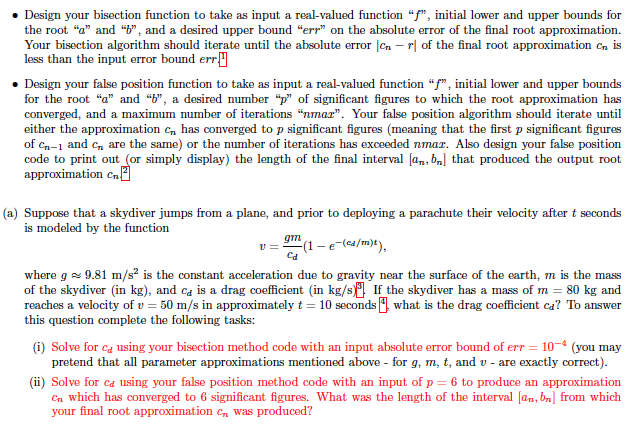
For this problem you are required to build a MATLAB functions for the bisection method and false position method to approximate a root r satisfying f(r)=0 for a given function f. - Design your bisection function to take as input a real-valued function " f", initial lower and upper bounds for the root " a " and " b ", and a desired upper bound "err" on the absolute error of the final root approximation. Your bisection algorithm should iterate until the absolute error cnr of the final root approximation cn is less than the input error bound err. - Design your false position function to take as input a real-valued function " ", initial lower and upper bounds for the root " a" and " b" ", a desired number "p" of significant figures to which the root approximation has converged, and a maximum number of iterations "nmax". Your false position algorithm should iterate until either the approximation cn has converged to p significant figures (meaning that the first p significant figures of cn1 and cn are the same) or the number of iterations has exceeded nmax. Also design your false position code to print out (or simply display) the length of the final interval [an,bn] that produced the output root approximation cnn2 a) Suppose that a skydiver jumps from a plane, and prior to deploying a parachute their velocity after t seconds is modeled by the function v=cdgm(1e(cd/m)t), where g9.81m/s2 is the constant acceleration due to gravity near the surface of the earth, m is the mass of the skydiver (in kg ), and cd is a drag coefficient (in kg/s ) 3 . If the skydiver has a mass of m=80kg and reaches a velocity of v=50m/s in approximately t=10 seconds 4 , what is the drag coefficient cd ? To answer this question complete the following tasks: (i) Solve for cd using your bisection method code with an input absolute error bound of err =104 (you may pretend that all parameter approximations mentioned above - for g,m,t, and v - are exactly correct). (ii) Solve for cd using your false position method code with an input of p=6 to produce an approximation cn which has converged to 6 significant figures. What was the length of the interval [an,bn] from which your final root approximation cn was produced
Step by Step Solution
There are 3 Steps involved in it

Get step-by-step solutions from verified subject matter experts
 Study Help