







Question: For questions which require numerical answer, utilize continuous calculation. Do not round off on the middle of the solution. Round off to two decimal places
For questions which require numerical answer, utilize continuous calculation. Do not round off on the middle of the solution. Round off to two decimal places on your final answer unless specifically mentioned on the question otherwise.
Note: Usually only the value of C and K is asked using four (4) decimal places.
For numerical answer which is integer, do not add any number after the decimal point, just encode your answer as integer
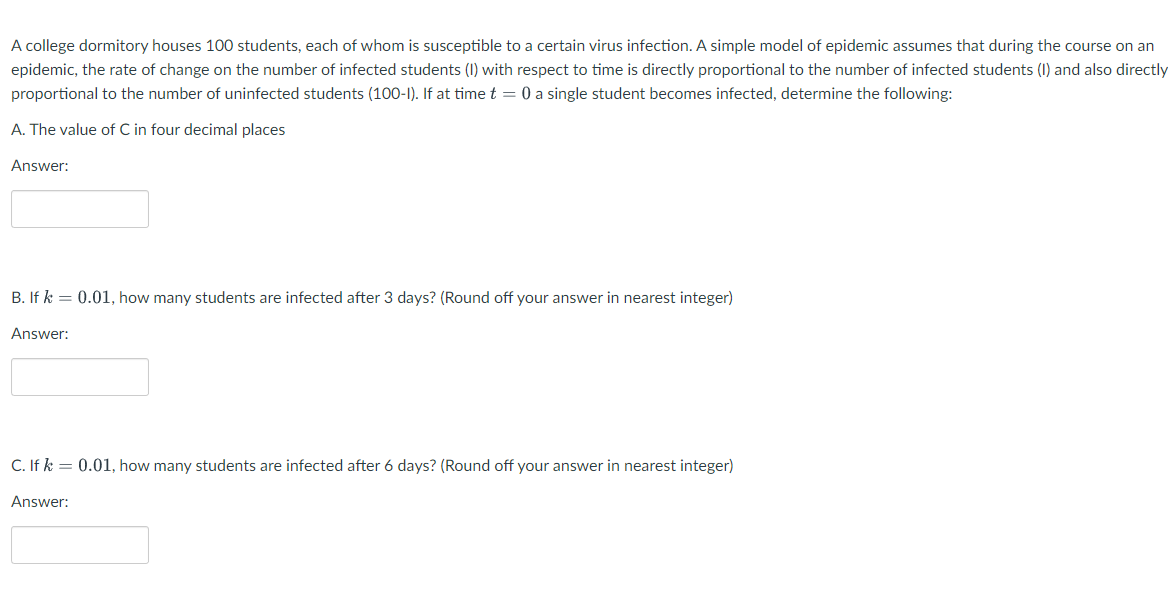
A college dormitory houses 100 students, each of whom is susceptible to a certain virus infection. A simple model of epidemic assumes that during the course on an epidemic, the rate of change on the number of infected students [I] with respect to time is directly proportional to the number of infected students {I} and also directly proportional to the number of uninfected students (lOO-I]. If at time t = O a single student becomes infected, determine the following: A. The value of C in four decimal places Answer: B. If k = 0.01, how many students are infected after 3 days? (Round off your answer in nearest integer) Answer: C. If k = 0.01, how many students are infected after 6 days? (Round off your answer in nearest integer)
Step by Step Solution
There are 3 Steps involved in it

Get step-by-step solutions from verified subject matter experts
 Study Help