







Question: For second time, disregard question. I solved it already. Please credit question back to account. Thanks. DISREGARD QUESTIONS, PLEASE CREDIT QUESTION BACK TO ME. THANKS
For second time, disregard question. I solved it already. Please credit question back to account. Thanks.
DISREGARD QUESTIONS, PLEASE CREDIT QUESTION BACK TO ME. THANKS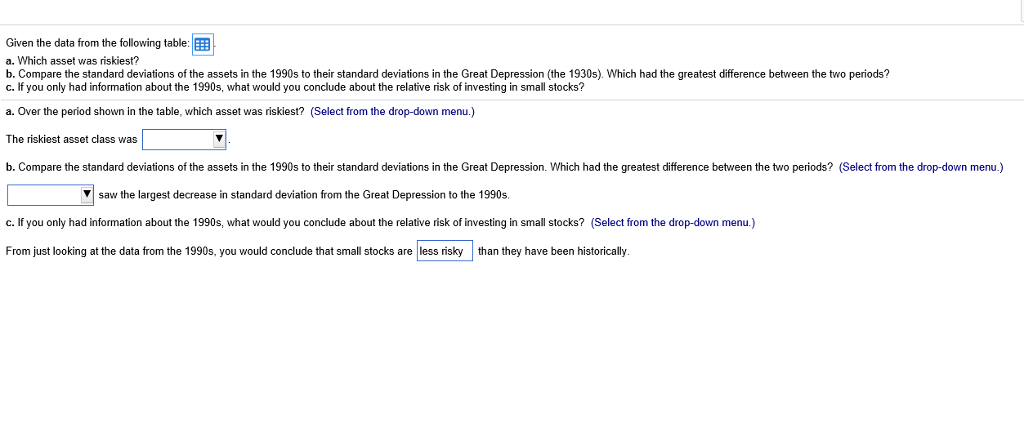
Given the data from the following table: a. Which asset was riskiest? b. Compare the standard deviations of the assets in the 1990s to their standard deviations in the Great Depression (the 1930s). Which had the greatest difference between the two periods? c. If you only had information about the 1990s, what would you conclude about the relative risk of investing in small stocks? a. Over the period shown in the table, which asset was riskiest? (Select from the drop-down menu.) The riskiest asset class was b. Compare the standard deviations of the assets in the 1990s to their standard deviations in the Great Depression. Which had the greatest difference between the two periods? (Select from the drop-down menu.) saw the largest decrease in standard deviation from the Great Depression to the 1990s c. If you only had information about the 1990s, what would you conclude about the relative risk of investing in small stocks? (Select from the drop-down menu.) From just looking at the data from the 1990s, you would conclude that small stocks are less risky than they have been historically. Given the data from the following table: a. Which asset was riskiest? b. Compare the standard deviations of the assets in the 1990s to their standard deviations in the Great Depression (the 1930s). Which had the greatest difference between the two periods? c. If you only had information about the 1990s, what would you conclude about the relative risk of investing in small stocks? a. Over the period shown in the table, which asset was riskiest? (Select from the drop-down menu.) The riskiest asset class was b. Compare the standard deviations of the assets in the 1990s to their standard deviations in the Great Depression. Which had the greatest difference between the two periods? (Select from the drop-down menu.) saw the largest decrease in standard deviation from the Great Depression to the 1990s c. If you only had information about the 1990s, what would you conclude about the relative risk of investing in small stocks? (Select from the drop-down menu.) From just looking at the data from the 1990s, you would conclude that small stocks are less risky than they have been historically
Step by Step Solution
There are 3 Steps involved in it

Get step-by-step solutions from verified subject matter experts
 Study Help