







Question: For the C clamp shown, a force is applied at the end of the 0 . 3 7 5 in diameter handle. The screw is
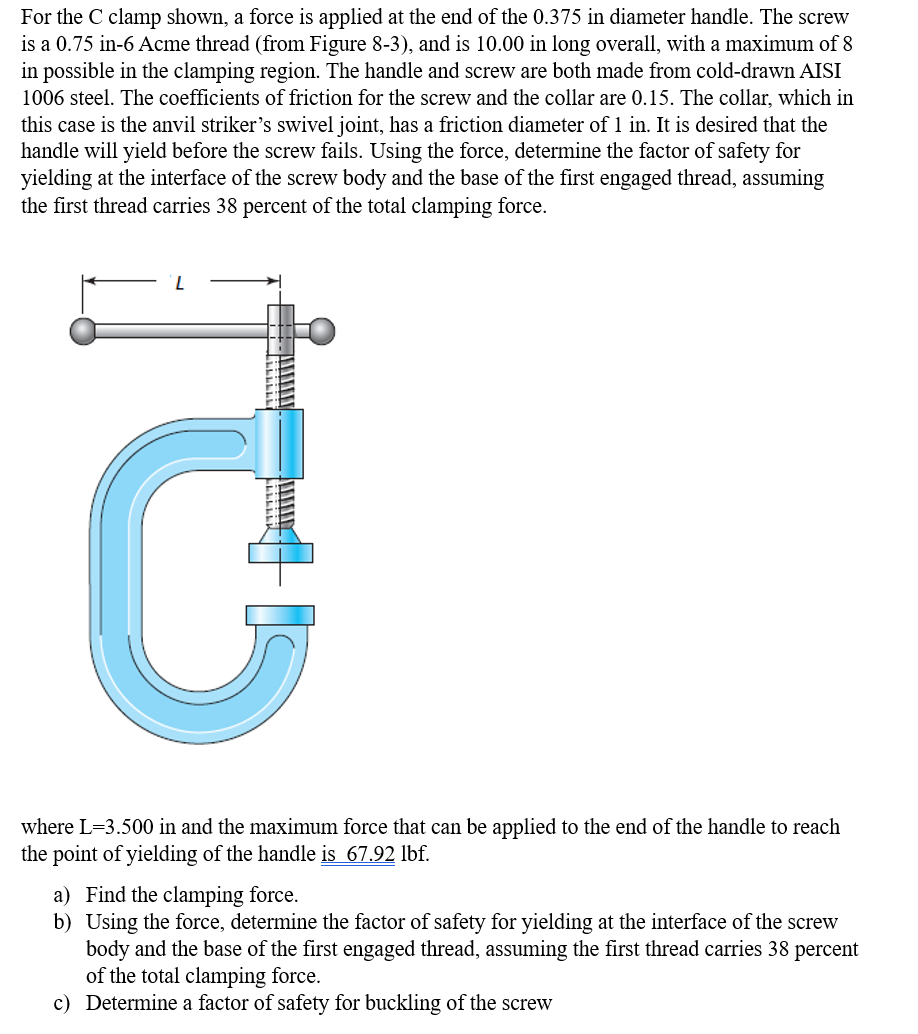
For the C clamp shown, a force is applied at the end of the indiameter handle.Thescrew is a in Acme thread from Figure and is in long overall, with amaximum of in possible in the clamping region. The handle and screw are bothmade from colddrawn AISI steel. The coefficients of friction for the screw andthe collar are The collar, which in this case is the anvil strikers swivel joint, hasa friction diameter of in It is desired that the handle will yield before the screw fails. Using the force,determine the factor of safety for yielding at theinterface of the screw body and the base of the first engaged thread, assuming thefirst thread carries percent of the total clamping force.
whereLin and the maximum force that can be applied to the end of the handle toreach the point of yielding of the handle is lbf
a Find the clamping force.
b Using the force,determine the factor of safety for yielding at theinterface of the screw body and the base of the first engaged thread, assuming thefirst thread carries percent of the total clamping force.
c Determine a factor of safety for buckling of the screw For the C clamp shown, a force is applied at the end of the in diameter handle. The screw is a in Acme thread from Figure and is in long overall, with a maximum of in possible in the clamping region. The handle and screw are both made from colddrawn AISI steel. The coefficients of friction for the screw and the collar are The collar, which in this case is the anvil striker's swivel joint, has a friction diameter of mathrmin It is desired that the handle will yield before the screw fails. Using the force, determine the factor of safety for yielding at the interface of the screw body and the base of the first engaged thread, assuming the first thread carries percent of the total clamping force.
where mathrmL in and the maximum force that can be applied to the end of the handle to reach the point of yielding of the handle is lbf
a Find the clamping force.
b Using the force, determine the factor of safety for yielding at the interface of the screw body and the base of the first engaged thread, assuming the first thread carries percent of the total clamping force.
c Determine a factor of safety for buckling of the screw
Step by Step Solution
There are 3 Steps involved in it
1 Expert Approved Answer
Step: 1 Unlock

Question Has Been Solved by an Expert!
Get step-by-step solutions from verified subject matter experts
Step: 2 Unlock
Step: 3 Unlock
 Study Help