







Question: For the Case: Read and analyze the situation as presented. The analysis should be about 4-5 pages long, certainly no nore than six. No cover
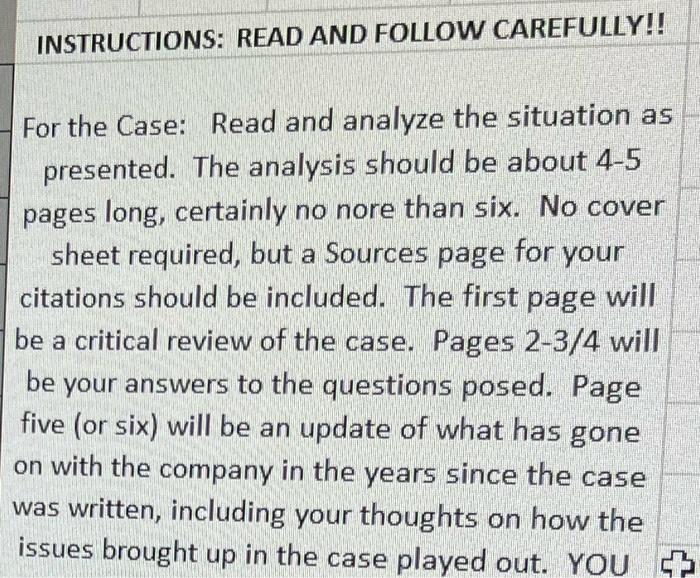
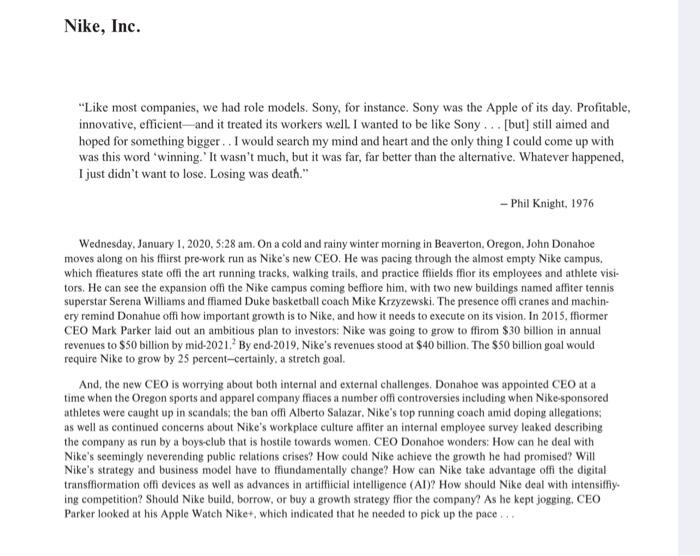
For the Case: Read and analyze the situation as presented. The analysis should be about 4-5 pages long, certainly no nore than six. No cover sheet required, but a Sources page for your citations should be included. The first page will be a critical review of the case. Pages 2-3/4 will be your answers to the questions posed. Page five (or six) will be an update of what has gone on with the company in the years since the case was written, including your thoughts on how the issues brought up in the case played out. YOU Nike, Inc. "Like most companies, we had role models. Sony, for instance. Sony was the Apple of its day. Profitable, innovative, efficient - and it treated its workers well. I wanted to be like Sony ... [but] still aimed and hoped for something bigger. I I would search my mind and heart and the only thing I could come up with was this word 'winning.' It wasn't much, but it was far, far better than the alternative. Whatever happened, I just didn't want to lose. Losing was death." - Phil Knight, 1976 Wednesday, January 1, 2020,5:28 am. On a cold and rainy winter morning in Beaverton, Oregon, John Donahoe moves along on his ffirst pre-work run as Nike's new CEO. He was pacing through the almost empty Nike campus. which ffieatures state offi the art running tracks, walking trails, and practice ffields ffior its employees and athlete visitors. He can see the expansion offi the Nike campus coming beffiore him, with two new buildings named affiter tennis superstar Serena Williams and ffiamed Duke basketball coach Mike Krzyzewski. The presence off cranes and machinery remind Donahue offi how important growth is to Nike, and how it needs to execute on its vision. In 2015, ffiormer CEO Mark Parker laid out an ambitious plan to investors: Nike was going to grow to ffirom $30 billion in annual revenues to $50 billion by mid-2021, 2 By end-2019, Nike's revenues stood at $40 billion. The $50 billion goal would require Nike to grow by 25 percent-certainly, a stretch goal. And, the new CEO is worrying about both internal and external challenges. Donahoe was appointed CEO at a time when the Oregon sports and apparel company ffiaces a number offi controversies including when Nike-sponsored athletes were caught up in scandals; the ban off Alberto Salazar. Nike's top running coach amid doping allegations: as well as continued concerns about Nike's workplace culture affiter an internal employee survey leaked deseribing the company as run by a boys-club that is hostile towards women. CEO Donahoe wonders: How can he deal with Nike's seemingly neverending public relations crises? How could Nike achieve the growth he had promised? Will Nike's strategy and business model have to ffiundamentally change? How can Nike take advantage offi the digital transfformation offi devices as well as advances in artifficial intelligence (AI)? How should Nike deal with intensiffying competition? Should Nike build, borrow, or buy a growth strategy ffior the company? As he kept jogging. CEO Parker looked at his Apple Watch Niket, which indicated that he needed to pick up the pace
Step by Step Solution
There are 3 Steps involved in it

Get step-by-step solutions from verified subject matter experts
 Study Help