







Question: For the first set of problems use the truth table method to determine the kind of statement it is. For the second, translate and then
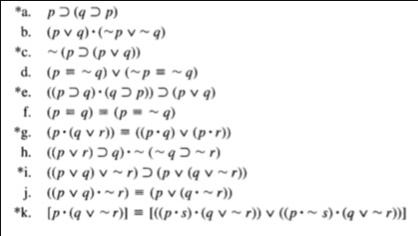
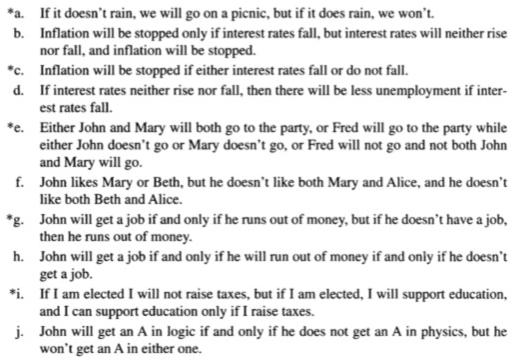 For the first set of problems use the truth table method to determine the kind of statement it is. For the second, translate and then determine the kind of statement it is. I need help with a, h from the first set of problems, and h, i, & j from the second set. For your translations, be sure to clearly indicate your simple statements.
*a. p (qp) b. (pv q) (~pv~q) *c. (p (pv q)) N *e. d. (p=~q) v (~p=~q) ((pq) (qp)) (pv q) (p= q) = (p=~q) f. *g. (p (q v r))= ((p.q) v (p-r)) h. ((pvr)q)~ (~g~r) *i. ((pvq) v~r) (pv (qv~r)) j. ((pv q) ~r) = (pv (q-~r)) *k. [p (q v~r)] = [((ps) (q v~r)) v ((p~s) (q v~r))]
Step by Step Solution
There are 3 Steps involved in it
Sure lets go through each statement and determine its type First Set of Problems 1 a p qp This state... View full answer

Get step-by-step solutions from verified subject matter experts
 Study Help