







Question: For the first version, you will implement the primary data structure as a 2-dimensional array Strings[NUM][LEN], where NUM is the number of strings, and LEN
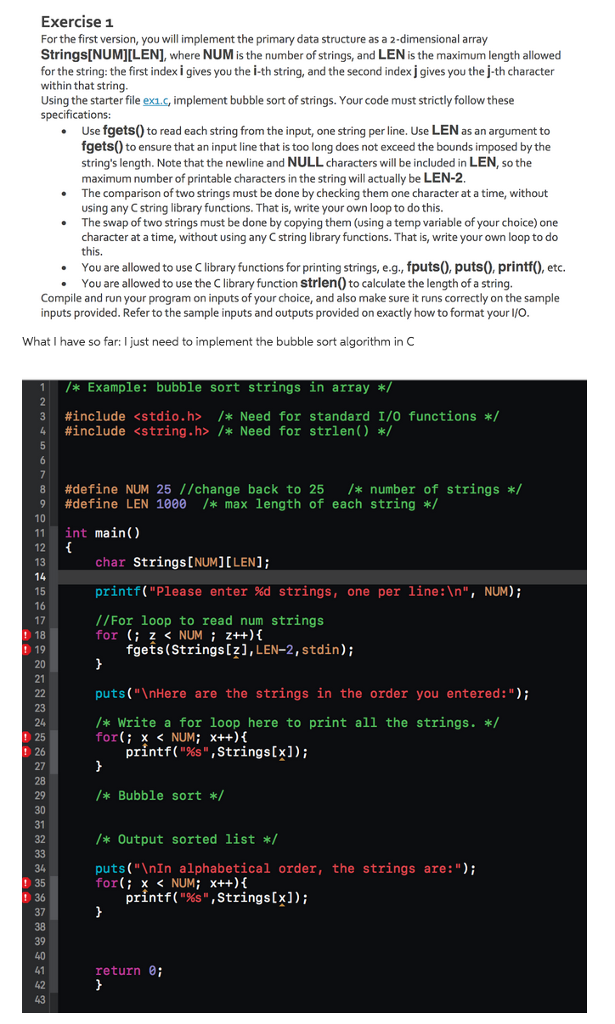
For the first version, you will implement the primary data structure as a 2-dimensional array Strings[NUM][LEN], where NUM is the number of strings, and LEN is the maximum length allowed for the string: the first index i gives you the i-th string, and the second index j gives you the j-th character within that string. Using the starter file ex1.c, implement bubble sort of strings. Your code must strictly follow these specifications: Use f gets () to read each string from the input, one string per line. Use LEN as an argument to f get ()() to ensure that an input line that is too long does not exceed the bounds imposed by the string's length. Note that the newline and NULL characters will be included in LEN, so the maximum number of printable characters in the string will actually be LEN-2. the comparison of two strings must be done by checking them one character at a time, without using any C string library functions. That is, write your own loop to do this. The swap of two strings must be done by copying them (using a temp variable of your choice) one character at a time, without using any C string library functions. That is, write your own loop to do this. You are allowed to use C library functions for printing strings, e.g., f puts (), puts(), print f(), etc. You are allowed to use the C library function stolen () to calculate the length of a string. Compile and run your program on inputs of your choice, and also make sure it runs correctly on the sample inputs provided. Refer to the sample inputs and outputs provided on exactly how to format your I/O. What I have so far: I just need to implement the bubble sort algorithm in C
Step by Step Solution
There are 3 Steps involved in it

Get step-by-step solutions from verified subject matter experts
 Study Help