







Question: For the following code loop: for (i=0; i if ((i mod 2)==0) { // Do some stuff, no branches here } } a) The code
For the following code loop:
for (i=0; i
if ((i mod 2)==0)
{ // Do some stuff, no branches here
}
}
a) The code results in at least two conditional branches. Using a one-bit predictor for branch prediction, what is the prediction accuracy for the loop and for the if statement? Assume the initial prediction is to take the branch.
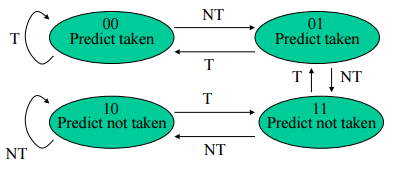
b) Using the two-bit predictor shown by the finite state automaton below, what is the prediction accuracy for the loop and the if statement? Assume you start in state 00.
home / study / engineering / computer science / computer science questions and answers / for the following code loop: for (i=0; i
Question: For the following code loop: for (i=0; i
For the following code loop:
for (i=0; i
a) The code results in at least two conditional branches. Using a one-bit predictor for branch prediction, what is the prediction accuracy for the loop and for the if statement? Assume the initial prediction is to take the branch.
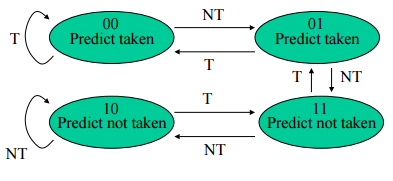
b) Using the two-bit predictor shown by the finite state automaton below, what is the prediction accuracy for the loop and the if statement? Assume you start in state 00.
c) Would a correlation predictor help in this case?
NT 01 Predict taken Predict taken 10 Predict not taken Predict not taken NT NT NT 01 Predict taken Predict taken 10 Predict not taken Predict not taken NT NT NT 01 Predict taken Predict taken 10 Predict not taken Predict not taken NT NT NT 01 Predict taken Predict taken 10 Predict not taken Predict not taken NT NT
Step by Step Solution
There are 3 Steps involved in it

Get step-by-step solutions from verified subject matter experts
 Study Help