



Question: For the following event definitions, identify whether they are mutually exclusive or not, selecting a reason for your choice in each case. (a) Event
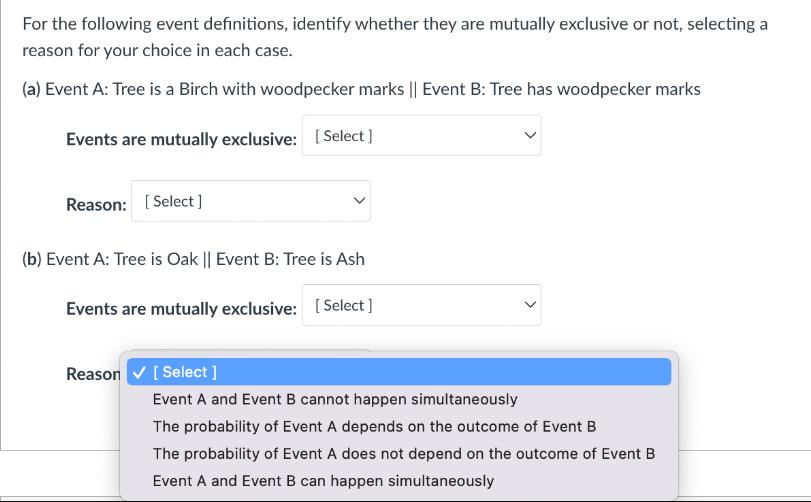
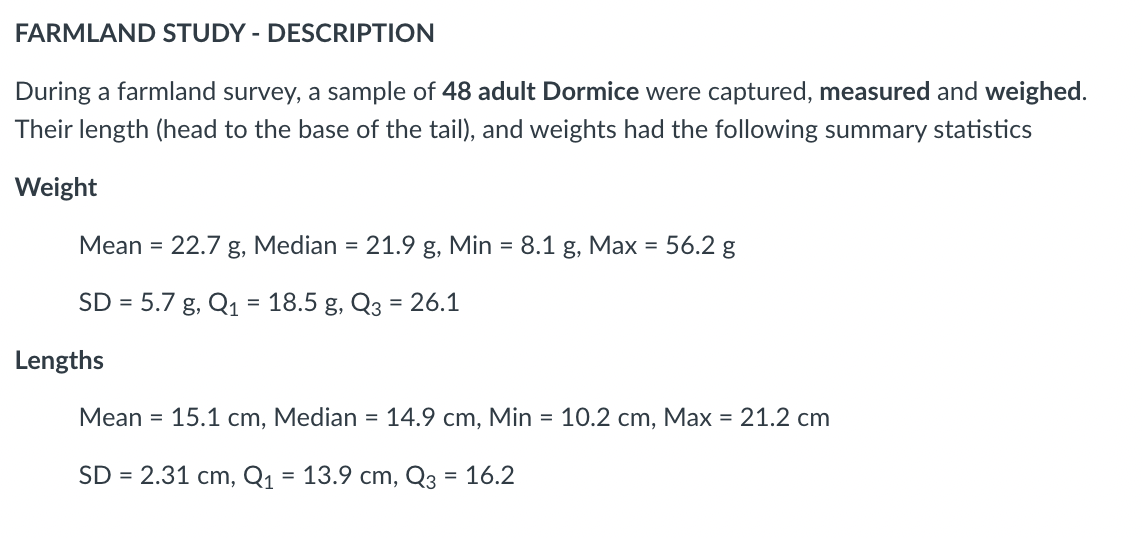
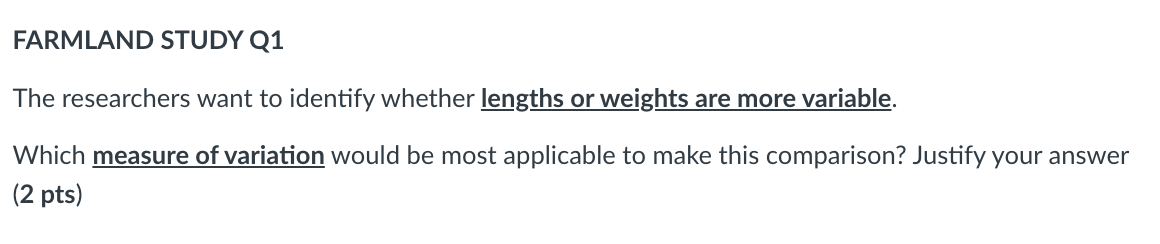
For the following event definitions, identify whether they are mutually exclusive or not, selecting a reason for your choice in each case. (a) Event A: Tree is a Birch with woodpecker marks || Event B: Tree has woodpecker marks Events are mutually exclusive: [Select] Reason: [Select] (b) Event A: Tree is Oak || Event B: Tree is Ash Events are mutually exclusive: [Select] Reason [Select] Event A and Event B cannot happen simultaneously The probability of Event A depends on the outcome of Event B The probability of Event A does not depend on the outcome of Event B Event A and Event B can happen simultaneously FARMLAND STUDY - DESCRIPTION During a farmland survey, a sample of 48 adult Dormice were captured, measured and weighed. Their length (head to the base of the tail), and weights had the following summary statistics Weight Mean = 22.7 g, Median = 21.9 g, Min = 8.1 g, Max = 56.2 g SD = 5.7 g, Q1 = 18.5 g, Q3 = 26.1 Lengths Mean 15.1 cm, Median = 14.9 cm, Min = 10.2 cm, Max = 21.2 cm SD = 2.31 cm, Q = 13.9 cm, Q3 = 16.2 FARMLAND STUDY Q1 The researchers want to identify whether lengths or weights are more variable. Which measure of variation would be most applicable to make this comparison? Justify your answer (2 pts)
Step by Step Solution
There are 3 Steps involved in it

Get step-by-step solutions from verified subject matter experts