







Question: For the following problem, use the appropriate appendix table or technology. The ability to jump helps salamanders move quickly to avoid predators. A paper investigated
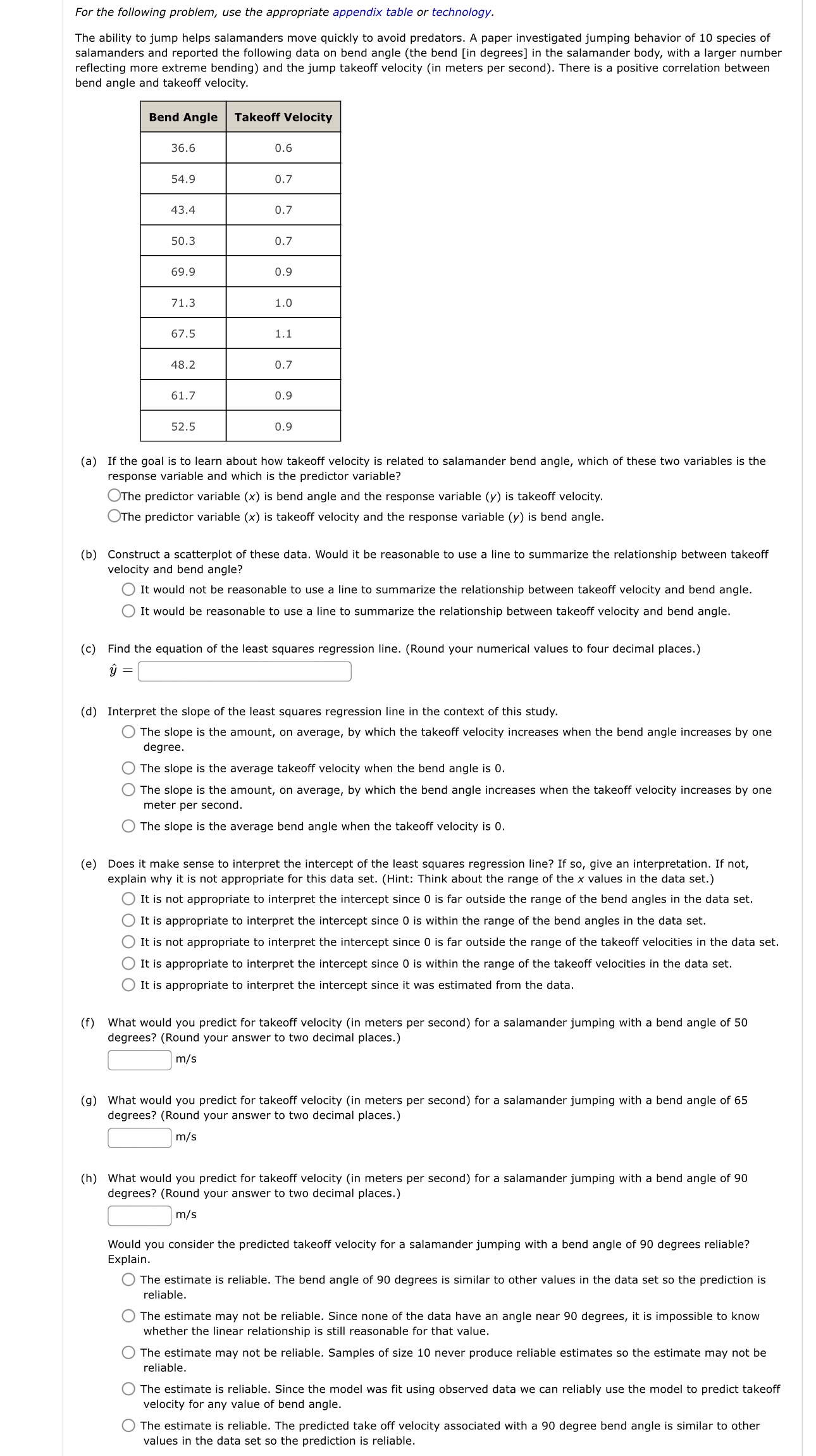
For the following problem, use the appropriate appendix table or technology. The ability to jump helps salamanders move quickly to avoid predators. A paper investigated jumping behavior of 10 species of salamanders and reported the following data on bend angle (the bend [in degrees] in the salamander body, with a larger number reflecting more extreme bending) and the jump takeoff velocity (in meters per second). There is a positive correlation between bend angle and takeoff velocity. Bend Angle | Takeoff Velocity 36.6 0.6 54.9 0.7 43.4 0.7 50.3 0.7 69.9 0.9 71,3 1.0 67.5 151 48.2 0.7 61.7 0.9 - 52.5 0.9 (a) If the goal is to learn about how takeoff velocity is related to salamander bend angle, which of these two variables is the response variable and which is the predictor variable? OThe predictor variable (x) is bend angle and the response variable (y) is takeoff velocity. (OThe predictor variable (x) is takeoff velocity and the response variable (y) is bend angle. (b) Construct a scatterplot of these data. Would it be reasonable to use a line to summarize the relationship between takeoff velocity and bend angle? (O 1t would not be reasonable to use a line to summarize the relationship between takeoff velocity and bend angle. () 1t would be reasonable to use a line to summarize the relationship between takeoff velocity and bend angle. (c) Find the equation of the least squares regression line. (Round your numerical values to four decimal places.) =\\ (d) Interpret the slope of the least squares regression line in the context of this study. () The slope is the amount, on average, by which the takeoff velocity increases when the bend angle increases by one degree. O The slope is the average takeoff velocity when the bend angle is 0. () The slope is the amount, on average, by which the bend angle increases when the takeoff velocity increases by one meter per second. () The slope is the average bend angle when the takeoff velocity is 0. (e) Does it make sense to interpret the intercept of the least squares regression line? If so, give an interpretation. If not, explain why it is not appropriate for this data set. (Hint: Think about the range of the x values in the data set.) () It is not appropriate to interpret the intercept since 0 is far outside the range of the bend angles in the data set. () 1t is appropriate to interpret the intercept since 0 is within the range of the bend angles in the data set. () Itis not appropriate to interpret the intercept since 0 is far outside the range of the takeoff velocities in the data set. () 1t is appropriate to interpret the intercept since 0 is within the range of the takeoff velocities in the data set. () 1t is appropriate to interpret the intercept since it was estimated from the data. (f) What would you predict for takeoff velocity (in meters per second) for a salamander jumping with a bend angle of 50 degrees? (Round your answer to two decimal places.) m/s (g) What would you predict for takeoff velocity (in meters per second) for a salamander jumping with a bend angle of 65 degrees? (Round your answer to two decimal places.) m/s (h) What would you predict for takeoff velocity (in meters per second) for a salamander jumping with a bend angle of 90 degrees? (Round your answer to two decimal places.) m/s Would you consider the predicted takeoff velocity for a salamander jumping with a bend angle of 90 degrees reliable? Explain. () The estimate is reliable. The bend angle of 90 degrees is similar to other values in the data set so the prediction is reliable. () The estimate may not be reliable. Since none of the data have an angle near 90 degrees, it is impossible to know whether the linear relationship is still reasonable for that value. () The estimate may not be reliable. Samples of size 10 never produce reliable estimates so the estimate may not be reliable. (O) The estimate is reliable. Since the model was fit using observed data we can reliably use the model to predict takeoff velocity for any value of bend angle. (O The estimate is reliable. The predicted take off velocity associated with a 90 degree bend angle is similar to other values in the data set so the prediction is reliable
Step by Step Solution
There are 3 Steps involved in it

Get step-by-step solutions from verified subject matter experts
 Study Help