







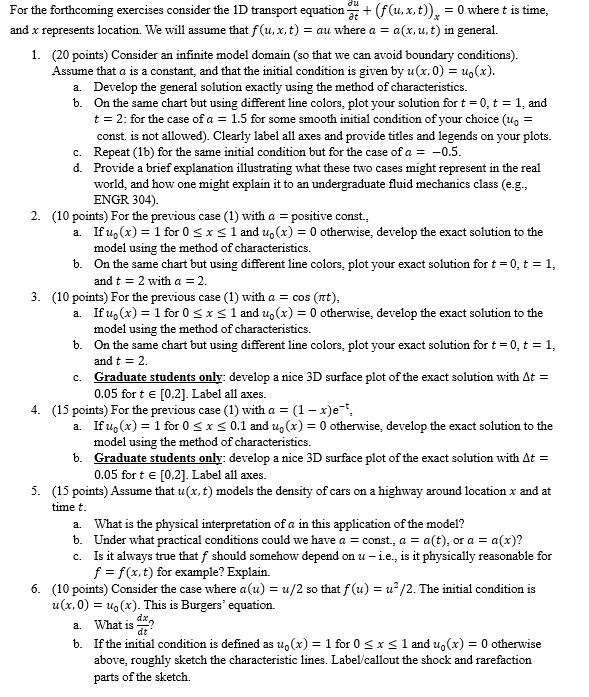
Question: For the forthcoming exercises consider the 1 D transport equation d e l u d e l t + ( f ( u , x
For the forthcoming exercises consider the D transport equation where is time,
and represents location. We will assume that where in general.
points Consider an infinite model domain so that we can avoid boundary conditions
Assume that is a constant, and that the initial condition is given by
a Develop the general solution exactly using the method of characteristics.
b On the same chart but using different line colors, plot your solution for and
: for the case of for some smooth initial condition of your choice
const. is not allowed Clearly label all axes and provide titles and legends on your plots.
c Repeat b for the same initial condition but for the case of
d Provide a brief explanation illustrating what these two cases might represent in the real
world, and how one might explain it to an undergraduate fluid mechanics class eg
ENGR
points For the previous case with positive const.,
a If for and otherwise, develop the exact solution to the
model using the method of characteristics.
b On the same chart but using different line colors, plot your exact solution for
and with
points For the previous case with
a If for and otherwise, develop the exact solution to the
model using the method of characteristics.
b On the same chart but using different line colors, plot your exact solution for
and
c Graduate students only: develop a nice surface plot of the exact solution with
for tin Label all axes.
points For the previous case with
a If for and otherwise, develop the exact solution to the
model using the method of characteristics.
b Graduate students only: develop a nice surface plot of the exact solution with
for tin Label all axes.
points Assume that models the density of cars on a highway around location and at
time
a What is the physical interpretation of in this application of the model?
b Under what practical conditions could we have const., or
c Is it always true that should somehow depend on ie is it physically reasonable for
for example? Explain.
points Consider the case where so that The initial condition is
This is Burgers' equation.
a What is
b If the initial condition is defined as for and otherwise
above, roughly sketch the characteristic lines. Labelcallout the shock and rarefaction
parts of the sketch.
Step by Step Solution
There are 3 Steps involved in it
1 Expert Approved Answer
Step: 1 Unlock

Question Has Been Solved by an Expert!
Get step-by-step solutions from verified subject matter experts
Step: 2 Unlock
Step: 3 Unlock
 Study Help