







Question: For the frame shown in the figures below you will develop seismic loads acting on the braced frame shown in isolation ( B 1 -
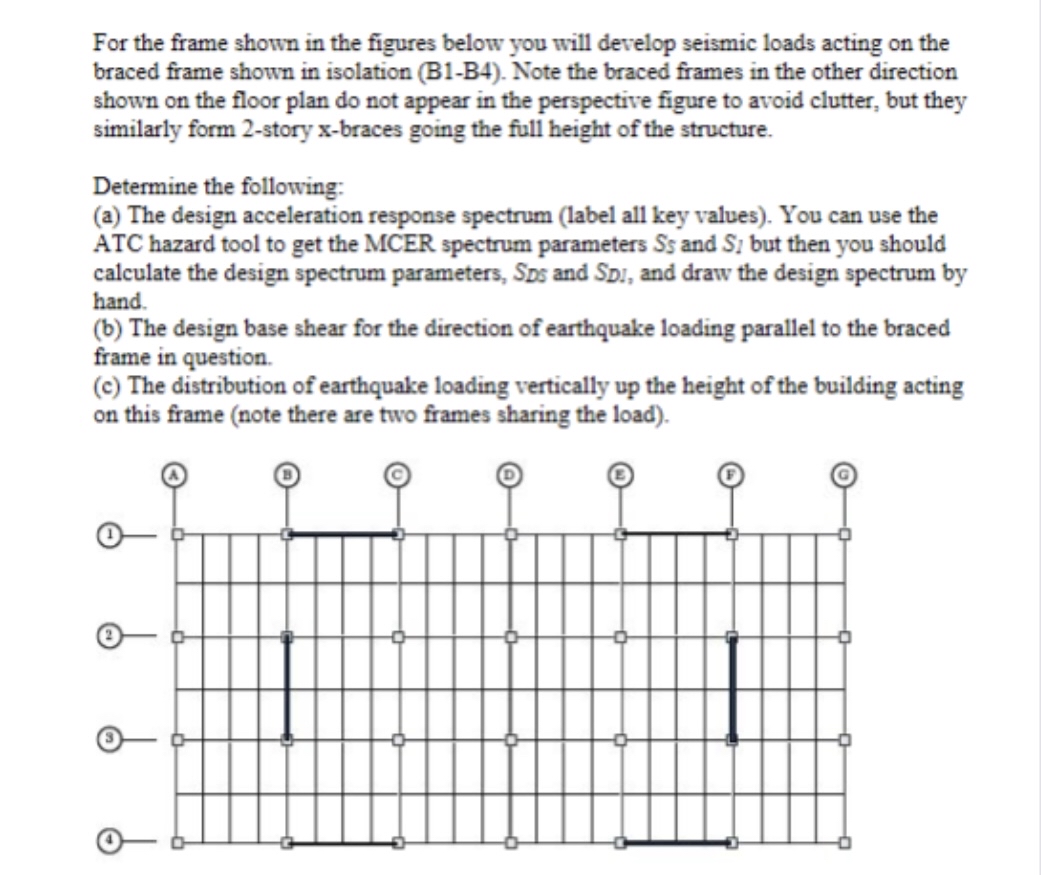
For the frame shown in the figures below you will develop seismic loads acting on the braced frame shown in isolation BB Note the braced frames in the other direction shown on the floor plan do not appear in the perspective figure to avoid clutter, but they similarly form story braces going the full height of the structure.
Determine the following:
a The design acceleration response spectrum label all key values You can use the ATC hazard tool to get the MCER spectrum parameters and but then you should calculate the design spectrum parameters, SDS and SDI, and draw the design spectrum by hand.
b The design base shear for the direction of earthquake loading parallel to the braced frame in question.
c The distribution of earthquake loading vertically up the height of the building acting on this frame note there are two frames sharing the load
Building parameters:
Lateral Load Resisting System: Special Concentrically Braced Frame
Dead Loads: Roof: psf Levels : psf
Location: Use More Hall's location
The story heights are and the bay widths are
Occupancy: Office building, less than people congregated in one area.
Soil Type: Very Dense Soil Soft Rock.
For the frame shown in the figures below you will develop seismic loads acting on the braced frame shown in isolation BB Note the braced frames in the other direction shown on the floor plan do not appear in the perspective figure to avoid clutter, but they similarly form story braces going the full height of the structure.
Determine the following:
a The design acceleration response spectrum label all key values You can use the ATC hazard tool to get the MCER spectrum parameters and but then you should calculate the design spectrum parameters, SDS and SDI, and draw the design spectrum by hand.
b The design base shear for the direction of earthquake loading parallel to the braced frame in question.
c The distribution of earthquake loading vertically up the height of the building acting on this frame note there are two frames sharing the load
Step by Step Solution
There are 3 Steps involved in it
1 Expert Approved Answer
Step: 1 Unlock

Question Has Been Solved by an Expert!
Get step-by-step solutions from verified subject matter experts
Step: 2 Unlock
Step: 3 Unlock
 Study Help