







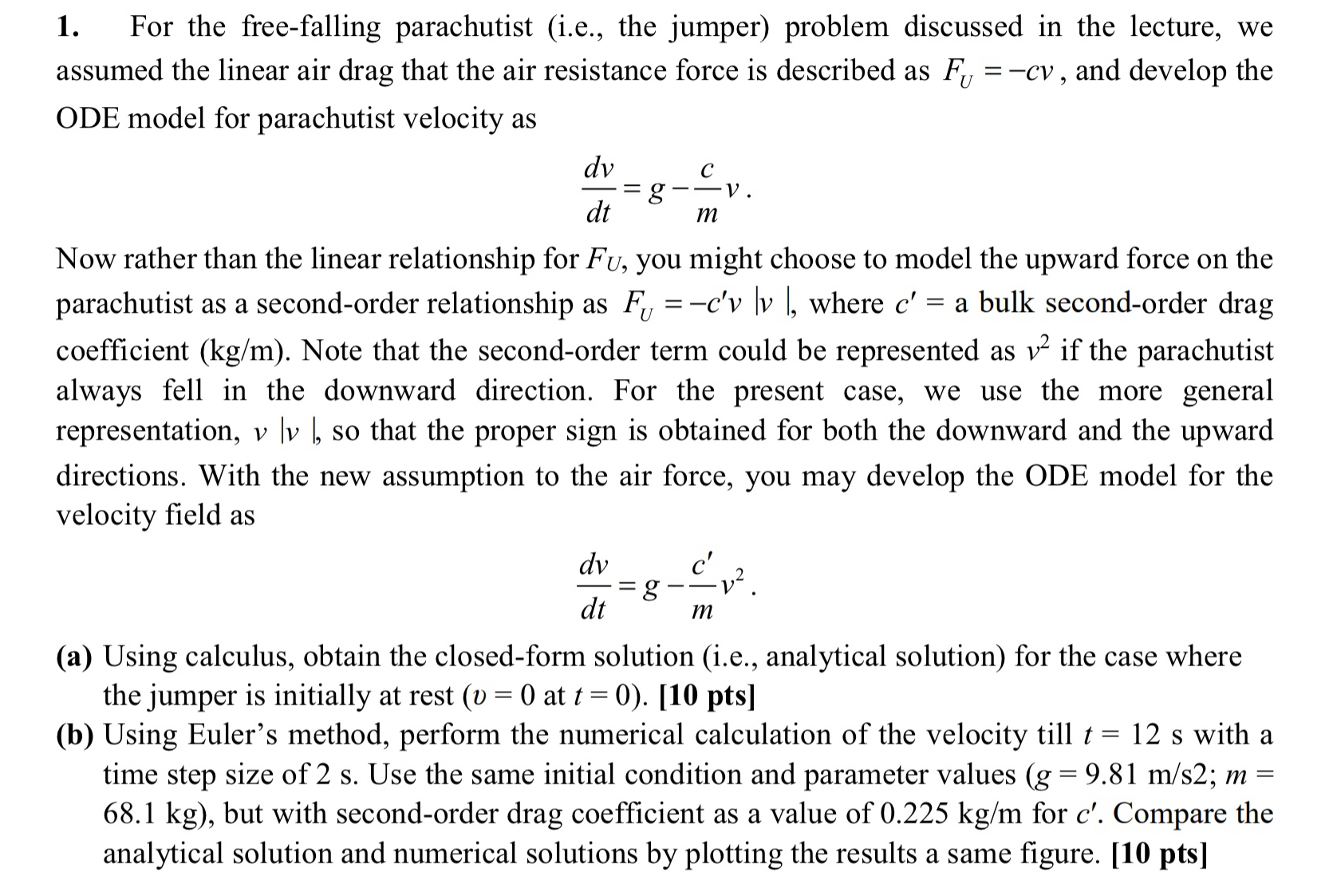
Question: For the free - falling parachutist ( i . e . , the jumper ) problem discussed in the lecture, we assumed the linear air
For the freefalling parachutist ie the jumper problem discussed in the lecture, we
assumed the linear air drag that the air resistance force is described as and develop the
ODE model for parachutist velocity as
Now rather than the linear relationship for you might choose to model the upward force on the
parachutist as a secondorder relationship as where a bulk secondorder drag
coefficient Note that the secondorder term could be represented as if the parachutist
always fell in the downward direction. For the present case, we use the more general
representation, so that the proper sign is obtained for both the downward and the upward
directions. With the new assumption to the air force, you may develop the ODE model for the
velocity field as
a Using calculus, obtain the closedform solution ie analytical solution for the case where
the jumper is initially at rest at pts
b Using Euler's method, perform the numerical calculation of the velocity till with a
time step size of s Use the same initial condition and parameter values
kg but with secondorder drag coefficient as a value of for Compare the
analytical solution and numerical solutions by plotting the results a same figure. pts
Step by Step Solution
There are 3 Steps involved in it
1 Expert Approved Answer
Step: 1 Unlock

Question Has Been Solved by an Expert!
Get step-by-step solutions from verified subject matter experts
Step: 2 Unlock
Step: 3 Unlock
 Study Help