



Question: For the given circuit: VDD = 1.8V. Assume, n = 0.1V-1, p = 0.05V-1, VTHn = 0.4V, VTHp = -0.5V, nCox = 100A/V 2 ,
For the given circuit: VDD = 1.8V. Assume, n = 0.1V-1, p = 0.05V-1, VTHn = 0.4V, VTHp = -0.5V, nCox = 100A/V2, pCox = 50A/V2 (W/L)MB0 = 20/0.5, (W/L)MB1 = 2*(20/0.5), (W/L)M1 = (W/L)M2 = 50/0.3, (W/L)M3 = (W/L)M4 = 50/1. a) If R1 = 120k, determine IB. Assume n = 0, for MB0. (Hint: use approximation method, starting point, VB = 0.6V). Accuracy up to 1 decimal place is sufficient. b) The common mode voltage of Vin+, Vin- = 1V. Determine ISS using approximation method (starting point, n = p = 0). (Hint: Use half-circuit for the common mode view, Vx, Vout has no effect of current, ISS. Does the p-devices effect ISS?) Accuracy up to 1 decimal place is sufficient. Also, calculate Vy from this view. c) Determine Vx. (Hint: use the differential mode view. Assume, n = 0 as the starting point.) Accuracy up to 1 decimal place is sufficient. d) Calculate the differential gain using the currents calculated above and the finite n, p values. e) Calculate the common mode gain using the currents calculated above and the finite n, p values.
For M2, the gate voltage is Vin :
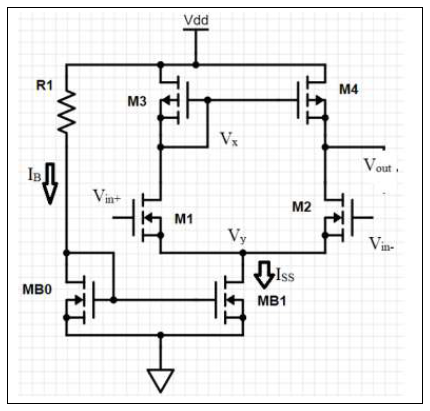
Vdd R1 M4 M3 JET VA Vout Vint M2 M1 Vy I Vine MBO CE Iss MB1 Vdd R1 M4 M3 JET VA Vout Vint M2 M1 Vy I Vine MBO CE Iss MB1
Step by Step Solution
There are 3 Steps involved in it

Get step-by-step solutions from verified subject matter experts