







Question: For the question below, use these symbols correspondingly: Preference relation: ? Strictly preferred to: ? Indifference: ~ Is a subset of: ? i.e. A ?
For the question below, use these symbols correspondingly:
Preference relation: ?
Strictly preferred to: ?
Indifference: ~
Is a subset of: ? i.e. A ? B means A is a subset of B
Please bold things like R (real numbers), R+ means positive real numbers, vice versa.
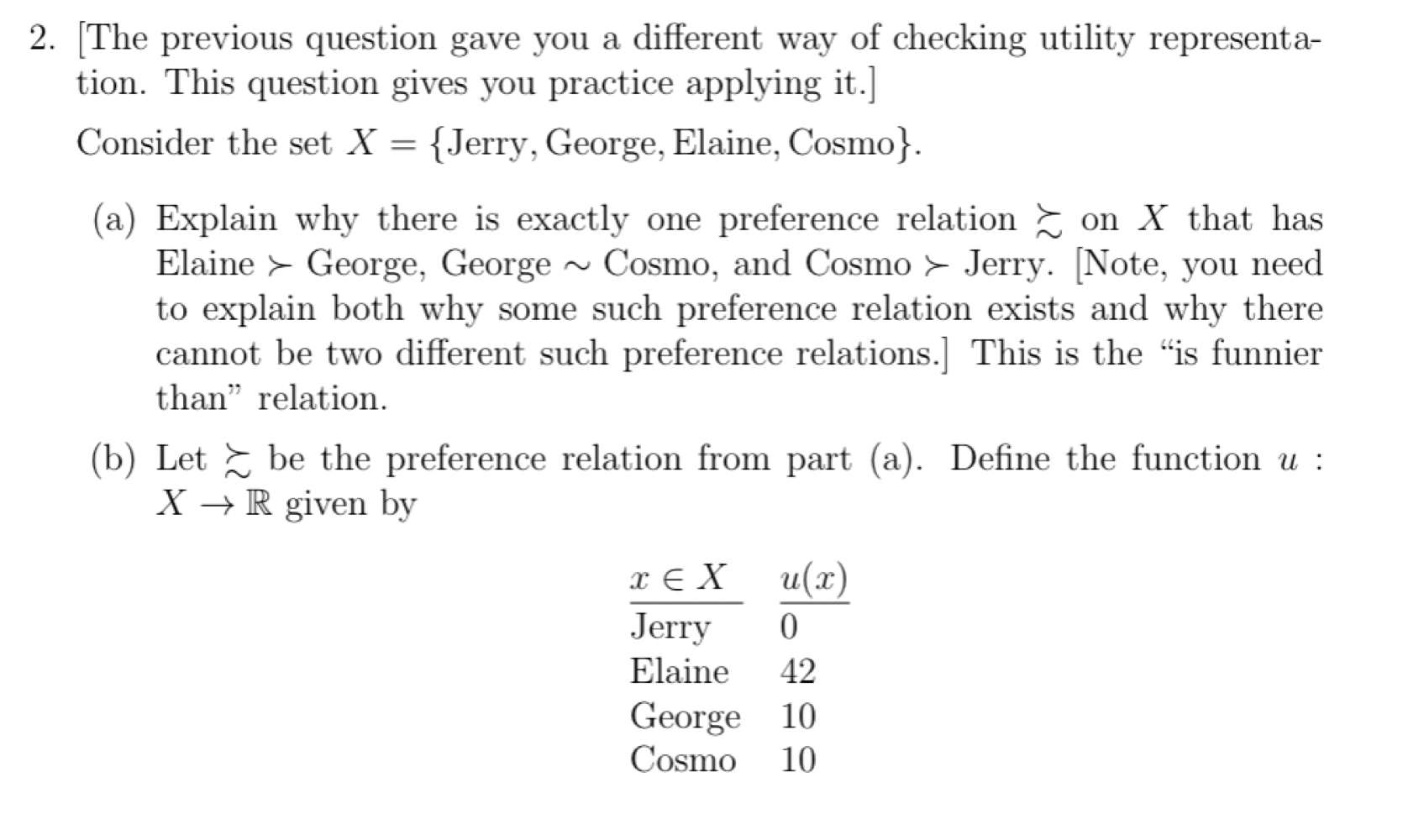
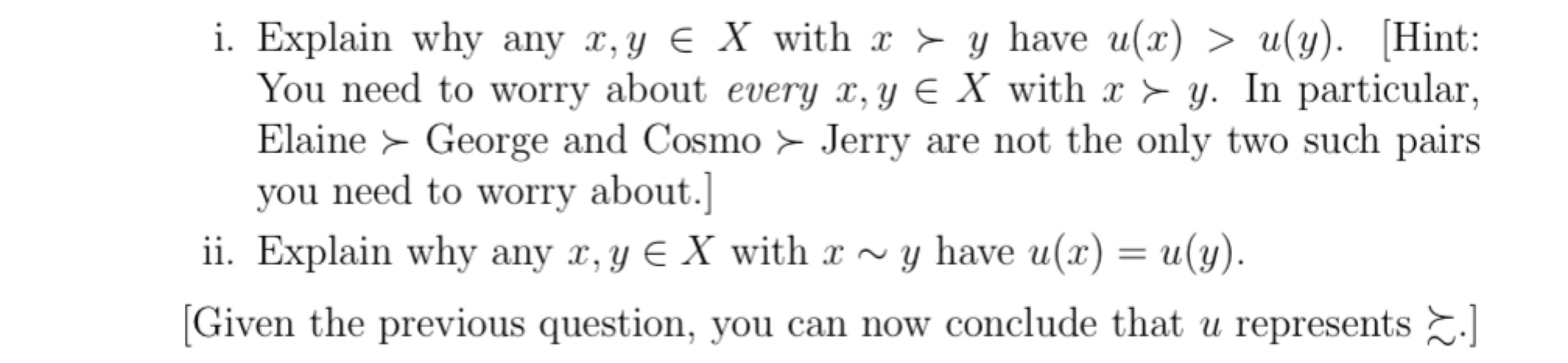
2. The previous question gave you a different way of checking utility representa- tion. This question gives you practice applying it.] Consider the set X = {Jerry, George, Elaine, Cosmo}. (a) Explain why there is exactly one preference relation _ on X that has Elaine > George, George ~ Cosmo, and Cosmo > Jerry. Note, you need to explain both why some such preference relation exists and why there cannot be two different such preference relations.] This is the "is funnier than" relation. (b) Let _ be the preference relation from part (a). Define the function u : X - R given by u (x Jerry 0 Elaine 42 George 10 Cosmo 10i. Explain why any may 6 X with :1: >- 3; have u(;1:) > u(y). [Hint: You need to worry about every 1, y E X with :1: >- y. In particular, Elaine > George and Cosmo > Jerry are not the only two such pairs you need to worry about.] ii. Explain why any :13, y E X with 1' ~ y have u(;l:) = u(y). [Given the previous question, you can now conclude that it represents 5]
Step by Step Solution
There are 3 Steps involved in it

Get step-by-step solutions from verified subject matter experts
 Study Help