







Question: For the questions below, enter your answers using interval notation. You can use U to represent a union, e.g. enter (1,2) U (3,5) for (1,
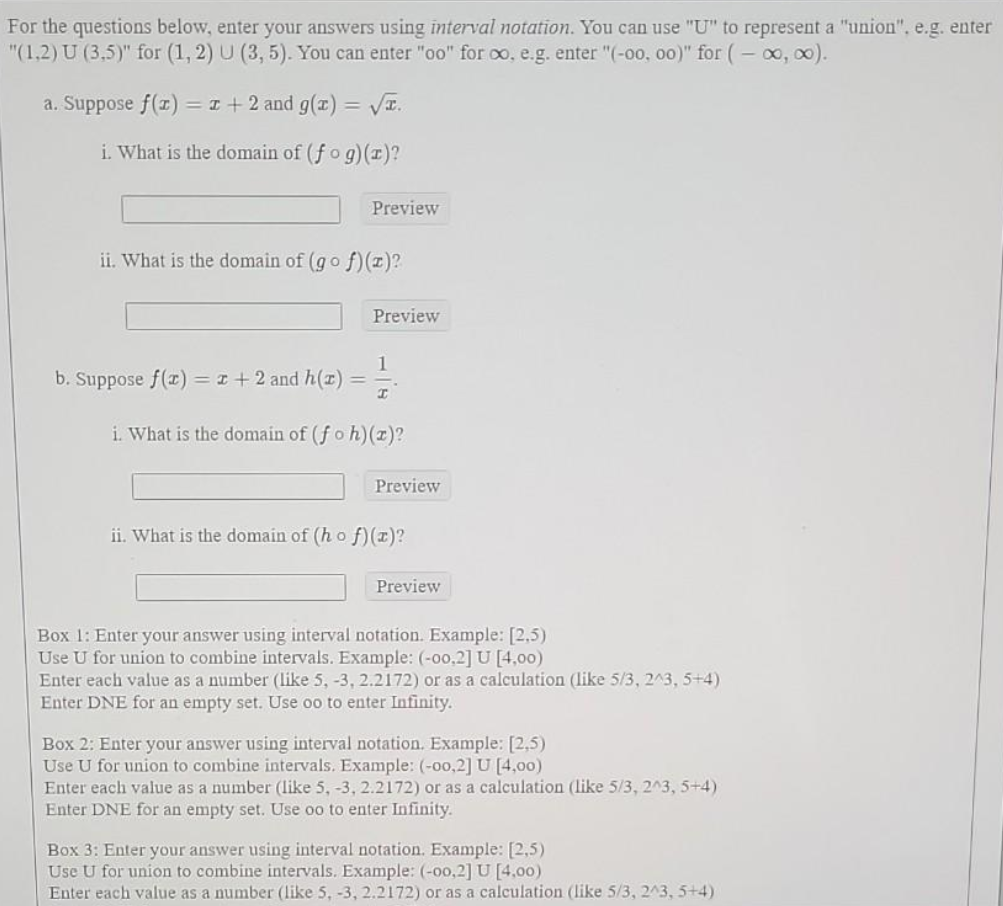
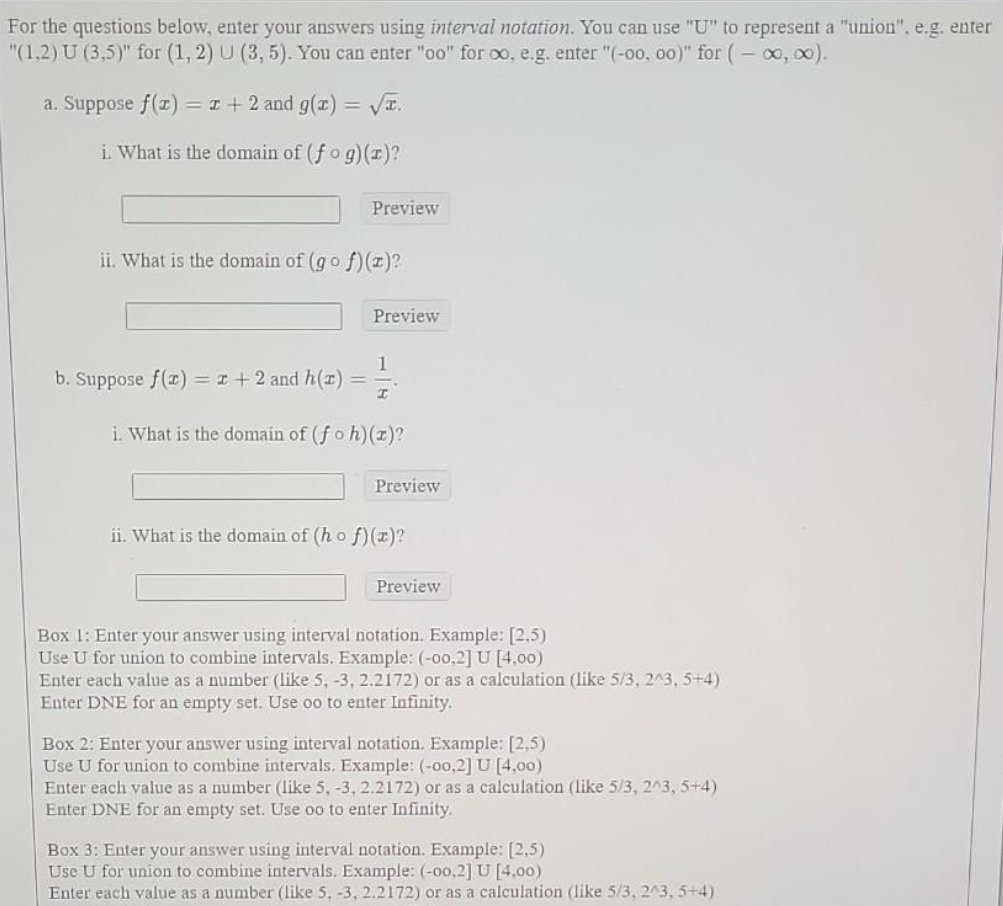
For the questions below, enter your answers using interval notation. You can use "U" to represent a "union", e.g. enter "(1,2) U (3,5)" for (1, 2) U (3, 5). You can enter "oo" for co, e.g. enter "(-00, 00)" for ( - 00, 00). a. Suppose f(x) = 1 + 2 and g(x) = VI. i. What is the domain of (f o g)(I)? Preview ii. What is the domain of (go f) (I)? Preview b. Suppose f(x) = x + 2 and h(I) = i. What is the domain of (f oh)(x)? Preview ii. What is the domain of (ho f) (x)? Preview Box 1: Enter your answer using interval notation. Example: [2,5) Use U for union to combine intervals. Example: (-00,2] U [4,00) Enter each value as a number (like 5, -3, 2.2172) or as a calculation (like 5/3, 243, 5+4) Enter DNE for an empty set. Use oo to enter Infinity. Box 2: Enter your answer using interval notation. Example: [2,5) Use U for union to combine intervals. Example: (-00,2] U [4,00) Enter each value as a number (like 5, -3, 2.2172) or as a calculation (like 5/3, 243, 5+4) Enter DNE for an empty set. Use oo to enter Infinity. Box 3: Enter your answer using interval notation. Example: [2,5) Use U for union to combine intervals. Example: (-oo,2] U [4,00) Enter each value as a number (like 5, -3, 2.2172) or as a calculation (like 5/3, 243, 5+4)
Step by Step Solution
There are 3 Steps involved in it

Get step-by-step solutions from verified subject matter experts
 Study Help