







Question: For the remaining questions, consider a 4-bit block cipher, described in hexadecimal by the following table: e C a 0 Plaintext Ciphertext Plaintext Ciphertext 8
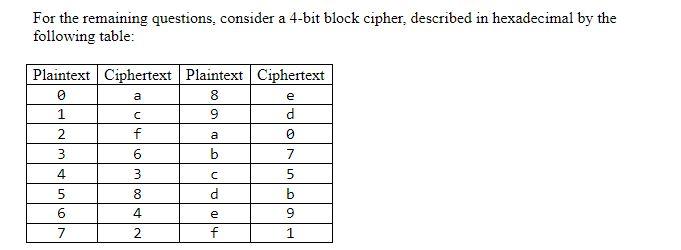
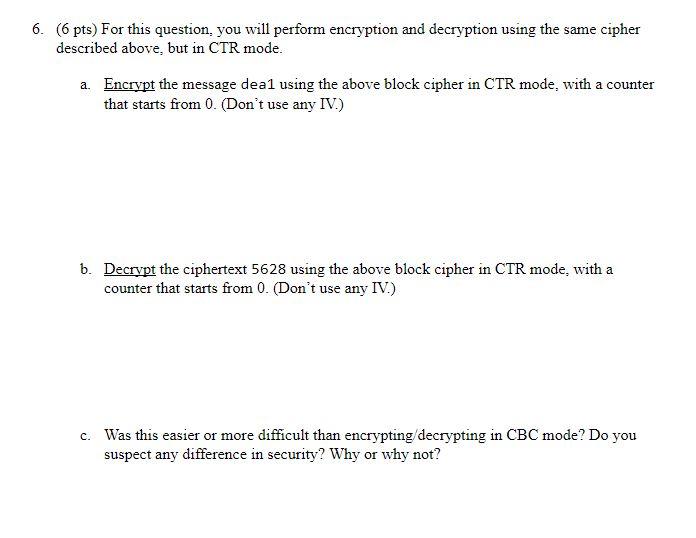
For the remaining questions, consider a 4-bit block cipher, described in hexadecimal by the following table: e C a 0 Plaintext Ciphertext Plaintext Ciphertext 8 1 9 d 2 f 6 b 3 5 d b 6 4 9 7 2 f 1 7 3 4 5 8 9 hD 6. 6 pts) For this question, you will perform encryption and decryption using the same cipher described above, but in CTR mode. a. Encrypt the message deal using the above block cipher in CTR mode, with a counter that starts from 0. (Don't use any IV.) b. Decrypt the ciphertext 5628 using the above block cipher in CTR mode, with a counter that starts from 0. (Don't use any IV.) c. Was this easier or more difficult than encrypting decrypting in CBC mode? Do you suspect any difference in security? Why or why not? For the remaining questions, consider a 4-bit block cipher, described in hexadecimal by the following table: e C a 0 Plaintext Ciphertext Plaintext Ciphertext 8 1 9 d 2 f 6 b 3 5 d b 6 4 9 7 2 f 1 7 3 4 5 8 9 hD 6. 6 pts) For this question, you will perform encryption and decryption using the same cipher described above, but in CTR mode. a. Encrypt the message deal using the above block cipher in CTR mode, with a counter that starts from 0. (Don't use any IV.) b. Decrypt the ciphertext 5628 using the above block cipher in CTR mode, with a counter that starts from 0. (Don't use any IV.) c. Was this easier or more difficult than encrypting decrypting in CBC mode? Do you suspect any difference in security? Why or why not
Step by Step Solution
There are 3 Steps involved in it

Get step-by-step solutions from verified subject matter experts
 Study Help