







Question: For the Responsive Supplier, (1)What are the corresponding (a) expected overstock; (b) expected understock; and (c) expected profit for product Trendy? CASE STUDY The Need
For the Responsive Supplier,
(1)What are the corresponding (a) expected overstock; (b) expected understock; and (c) expected profit for product Trendy?
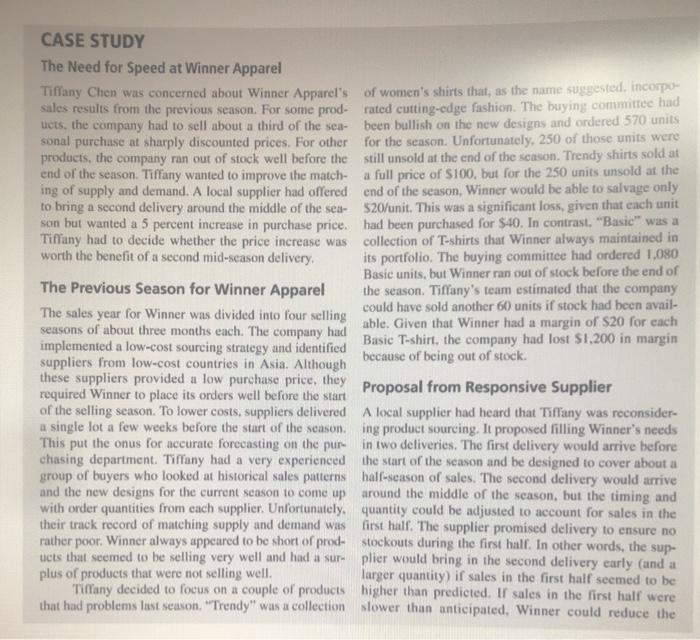
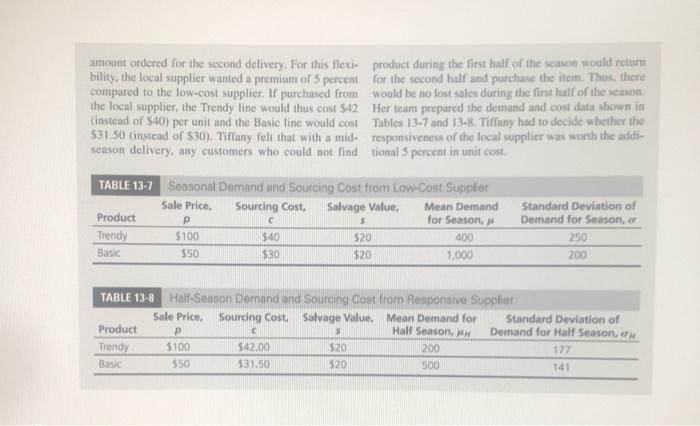
CASE STUDY The Need for Speed at Winner Apparel Tiffany Chen was concerned about Winner Apparel's of women's shirts that, as the name suggested, incorpo sales results from the previous season. For some prod- rated cutting-edge fashion. The buying committee had ucts, the company had to sell about a third of the sea- been bullish on the new designs and ordered 570 units sonal purchase at sharply discounted prices. For other for the season. Unfortunately, 250 of those units were products, the company ran out of stock well before the still unsold at the end of the season. Trendy shirts sold at end of the season. Tiffany wanted to improve the match a full price of $100, but for the 250 units unsold at the ing of supply and demand. A local supplier had offered end of the season. Winner would be able to salvage only to bring a second delivery around the middle of the sea- $20/unit. This was a significant loss, given that each unit son but wanted a 5 percent increase in purchase price, had been purchased for $40. In contrast. "Basic" was a Tiffany had to decide whether the price increase was collection of T-shirts that Winner always maintained in worth the benefit of a second mid-season delivery. its portfolio. The buying committee had ordered 1.080 Basic units, but Winner ran out of stock before the end of The Previous Season for Winner Apparel the season. Tiffany's team estimated that the company The sales year for Winner was divided into four selling able. Given that Winner had a margin of $20 for each could have sold another 60 units if stock had been avail- seasons of about three months each. The company had Basic T-shirt, the company had lost $1,200 in margin implemented a low-cost sourcing strategy and identified these suppliers provided a low purchase price, they Proposal from Responsive Supplier suppliers from low-cost countries in Asia. Although because of being out of stock. required Winner to place its orders well before the start of the selling season. To lower costs, suppliers delivered A local supplier had heard that Tiffany was reconsider- a single lot a few weeks before the start of the season. ing product sourcing. It proposed filling Winner's needs This put the onus for accurate forecasting on the pur in two deliveries. The first delivery would arrive before chasing department. Tiffany had a very experienced the start of the season and be designed to cover about a group of buyers who looked at historical sales patterns half-season of sales. The second delivery would arrive and the new designs for the current season to come up around the middle of the season, but the timing and with order quantities from each supplier. Unfortunately, quantity could be adjusted to account for sales in the their track record of matching supply and demand was first half. The supplier promised delivery to ensure no rather poor. Winner always appeared to be short of prod- Stockouts during the first hall. In other words, the sup- ucts that seemed to be selling very well and had a sur plier would bring in the second delivery early (and a plus of products that were not selling well. Targer quantity) if sales in the first half seemed to be Tiffany decided to focus on a couple of products higher than predicted. If sales in the first half were that had problems last season. "Trendy" was a collection slower than anticipated. Winner could reduce the amount ordered for the second delivery. For this flexi- product during the first half of the season would return bility, the local supplier wanted a premium of 5 percent for the second half and purchase the item. Thus, there compared to the low-cost supplier . If purchased from would be no lost sales during the first half of the season. the local supplier, the Trendy line would thus cost $42 Her eam prepared the demand and cost data shown in (instead of $40) per unit and the Basic line would cost Tables 13-7 and 13-8. Tiffany had to decide whether the $31.50 instead of $30), Tiffany felt that with a mide responsiveness of the local supplier was worth the addi- season delivery, any customers who could not find tional 5 percent in unit cost. TABLE 13-7 Seasonal Demand and Sourcing Cost from Low Cost Supplier Sale Price, Sourcing Cost Salvage Value Mean Demand Product for Season, Trendy $100 $40 520 400 Basic $50 $30 520 1,000 Standard Deviation of Demand for Season, 250 200 TABLE 13-8 Half-Season Demand and Sourcing Cost from Responsive Supplier Sale Price. Sourcing Cost Salvage Value Man Demand for Standard Deviation of Product Half Season, Demand for Half Season Trendy $100 $42.00 $20 200 Basic 550 $31.50 $20 500 141 P c 5
Step by Step Solution
There are 3 Steps involved in it
1 Expert Approved Answer
Step: 1 Unlock

Question Has Been Solved by an Expert!
Get step-by-step solutions from verified subject matter experts
Step: 2 Unlock
Step: 3 Unlock
 Study Help