



Question: For this assignment, we will analyze performance characteristics of the Merlin 1D, determine key factors in maintaining consistent performance, and identify methods of improving performance
For this assignment, we will analyze performance characteristics of the Merlin 1D, determine key factors in maintaining consistent performance, and identify methods of improving performance over the baseline design. Your computations must be performed in MATLAB. When presenting data, round your result (at the end!) to three decimal places.
It is up to you to determine how best to present your results (tables, plots, equations, etc.) and
demonstrate your mastery of these topics. Make it easy to follow your thinking and verify your
work (which includes commenting your code)
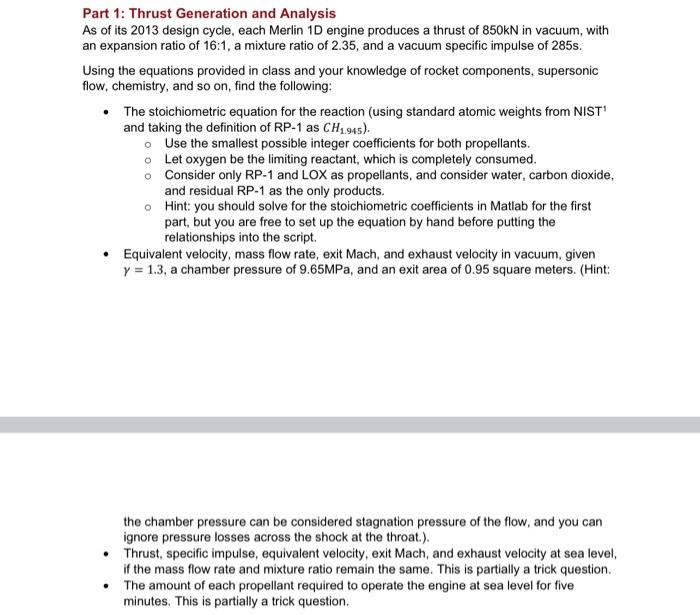
Part 1: Thrust Generation and Analysis As of its 2013 design cycle, each Merlin 1D engine produces a thrust of 850kN in vacuum, with an expansion ratio of 16:1, a mixture ratio of 2.35, and a vacuum specific impulse of 285s. Using the equations provided in class and your knowledge of rocket components, supersonic flow, chemistry, and so on, find the following: - The stoichiometric equation for the reaction (using standard atomic weights from NIST" and taking the definition of RP-1 as CH1.945 ). Use the smallest possible integer coefficients for both propellants. Let oxygen be the limiting reactant, which is completely consumed. - Consider only RP-1 and LOX as propellants, and consider water, carbon dioxide, and residual RP-1 as the only products. Hint: you should solve for the stoichiometric coefficients in Matlab for the first part, but you are free to set up the equation by hand before putting the relationships into the script. - Equivalent velocity, mass flow rate, exit Mach, and exhaust velocity in vacuum, given =1.3, a chamber pressure of 9.65MPa, and an exit area of 0.95 square meters. (Hint: the chamber pressure can be considered stagnation pressure of the flow, and you can ignore pressure losses across the shock at the throat.). - Thrust, specific impulse, equivalent velocity, exit Mach, and exhaust velocity at sea level, if the mass flow rate and mixture ratio remain the same. This is partially a trick question. - The amount of each propellant required to operate the engine at sea level for five minutes. This is partially a trick
Step by Step Solution
There are 3 Steps involved in it

Get step-by-step solutions from verified subject matter experts