Question: For this assignment, we will not calculate partial depreciation for year 1, in other words, no matter when during the year the asset was purchased,
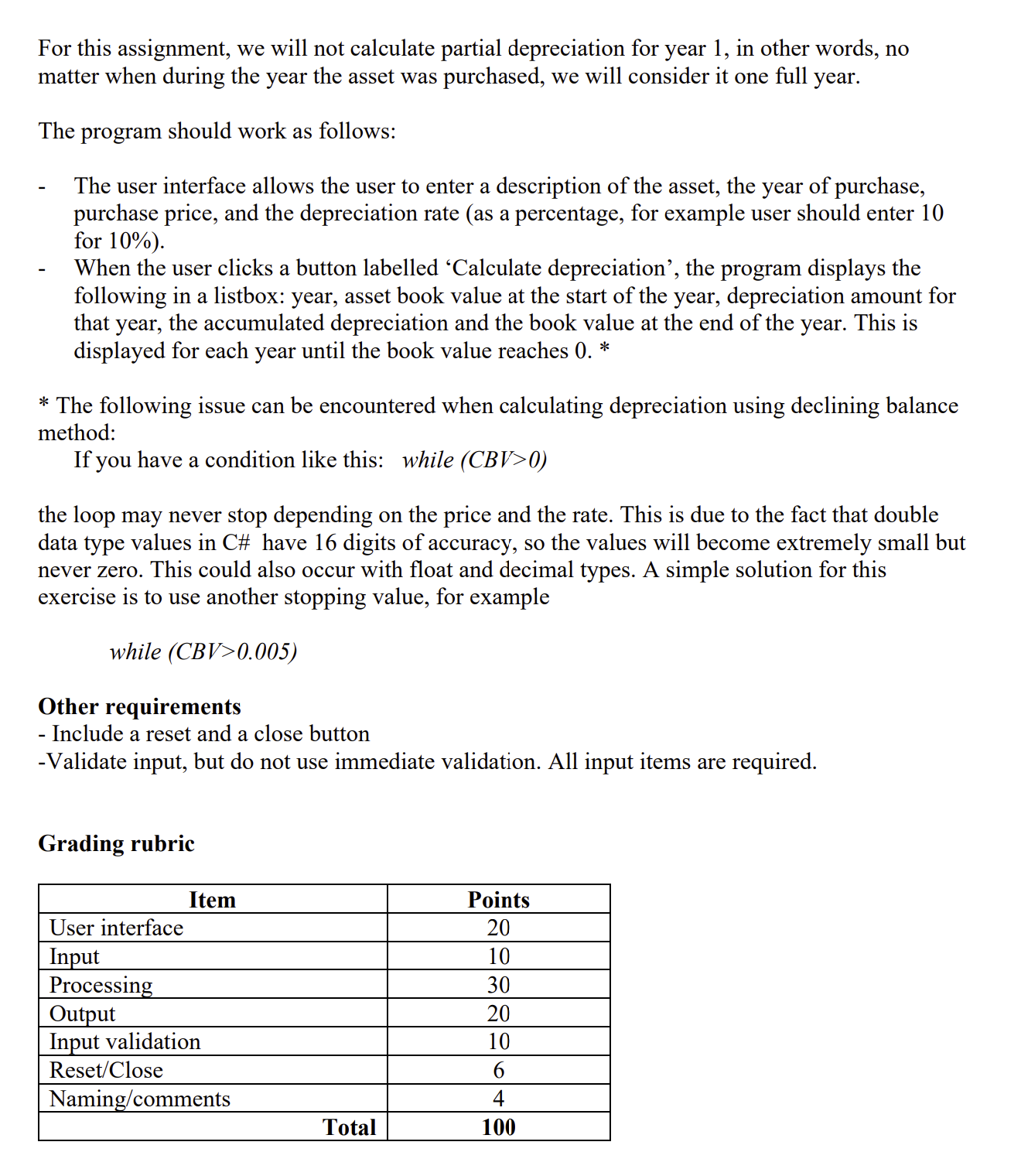
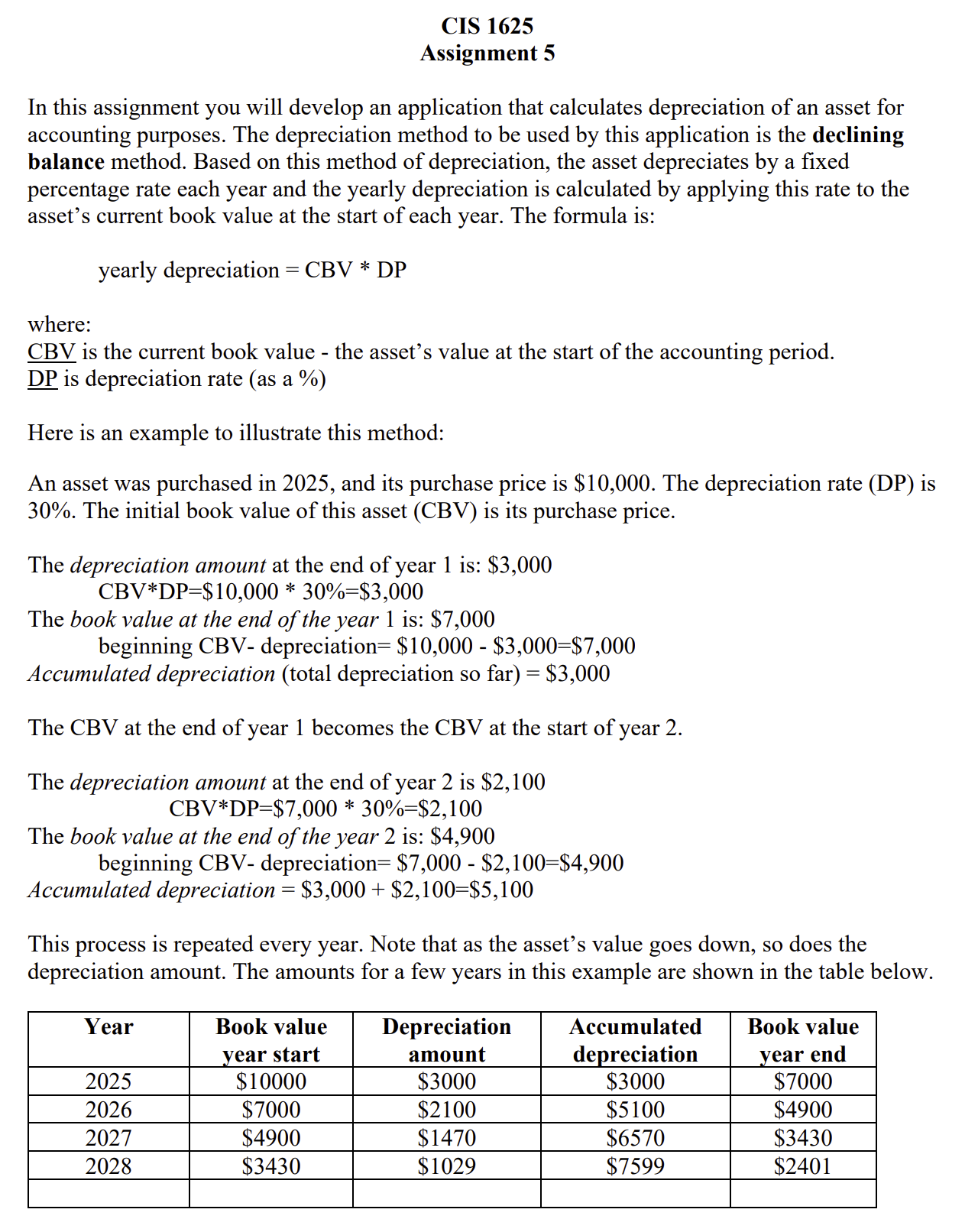
For this assignment, we will not calculate partial depreciation for year 1, in other words, no matter when during the year the asset was purchased, we will consider it one full year. The program should work as follows: - The user interface allows the user to enter a description of the asset, the year of purchase, purchase price, and the depreciation rate (as a percentage, for example user should enter 10 for 10%). - When the user clicks a button labelled 'Calculate depreciation', the program displays the following in a listbox: year, asset book value at the start of the year, depreciation amount for that year, the accumulated depreciation and the book value at the end of the year. This is displayed for each year until the book value reaches 0. * * The following issue can be encountered when calculating depreciation using declining balance method: If you have a condition like this: while (CBV>0) the loop may never stop depending on the price and the rate. This is due to the fact that double data type values in C# have 16 digits of accuracy, so the values will become extremely small but never zero. This could also occur with float and decimal types. A simple solution for this exercise is to use another stopping value, for example while (CBV>0.005) Other requirements - Include a reset and a close button -Validate input, but do not use immediate validation. All input items are required. Grading rubric Item Points User interface 20 Input 10 Processing 30 20 Input validation 10 Reset/Close 6 Naming/comments 4 CIS 1625 Assignment 5 In this assignment you will develop an application that calculates depreciation of an asset for accounting purposes. The depreciation method to be used by this application is the declining balance method. Based on this method of depreciation, the asset depreciates by a fixed percentage rate each year and the yearly depreciation is calculated by applying this rate to the asset's current book value at the start of each year. The formula is: yearly depreciation = CBV * DP where: CBV is the current book value - the asset's value at the start of the accounting period. DP is depreciation rate (as a %) Here is an example to illustrate this method: An asset was purchased in 2025, and its purchase price is $10,000. The depreciation rate (DP) is 30%. The initial book value of this asset (CBV) is its purchase price. The depreciation amount at the end of year | is: $3,000 CBV*DP=$10,000 * 30%=$3,000 The book value at the end of the year | is: $7,000 beginning CBV- depreciation= $10,000 - $3,000=$7,000 Accumulated depreciation (total depreciation so far) = $3,000 The CBV at the end of year 1 becomes the CBV at the start of year 2. The depreciation amount at the end of year 2 is $2,100 CBV*DP=$7,000 * 30%=$2,100 The book value at the end of the year 2 is: $4,900 beginning CBV- depreciation= $7,000 - $2,100=$4,900 Accumulated depreciation = $3,000 + $2,100=$5,100 This process is repeated every year. Note that as the asset's value goes down, so does the depreciation amount. The amounts for a few years in this example are shown in the table below. Year Book value Depreciation Accumulated Book value year start amount depreciation year end 2025 $10000 $3000 $3000 $7000 2026 $7000 $2100 $5100 $4900 2027 $4900 $1470 $6570 $3430 $1029
Step by Step Solution
There are 3 Steps involved in it
1 Expert Approved Answer
Step: 1 Unlock
Question Has Been Solved by an Expert!
Get step-by-step solutions from verified subject matter experts
Step: 2 Unlock
Step: 3 Unlock
Students Have Also Explored These Related Accounting Questions!









 Study Help