







Question: For this discussion, you must first read the Case for Analysis: Rhinebeck Industrial found in Chapter 6 of your textbook. Then, respond to the following
For this discussion, you must first read the Case for Analysis: Rhinebeck Industrial found in Chapter 6 of your textbook. Then, respond to the following questions:
 Do you support the proposal to reorganize into a worldwide product structure? Why, Why not?
Respond to at least two of your peers, assessing their analysis recommendations for Rhinebeck Industrial. Would you have made the same recommendation? Why or why not?
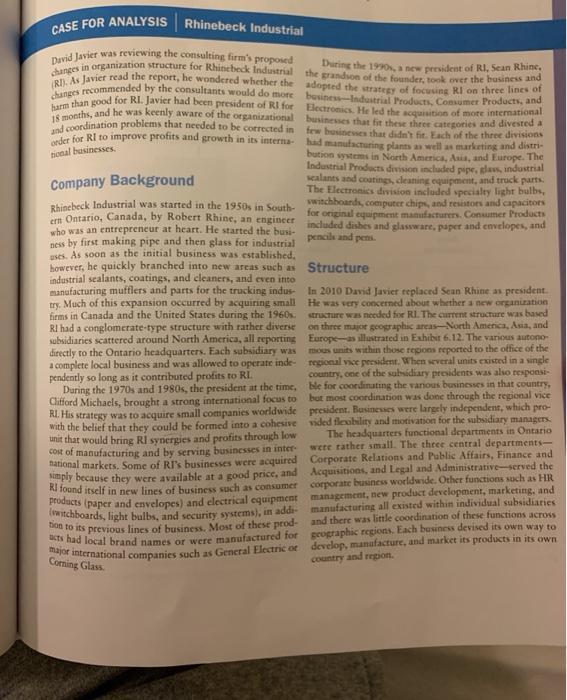
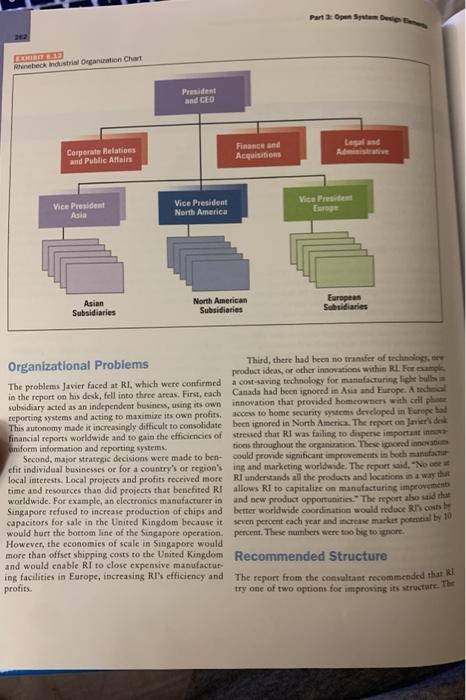
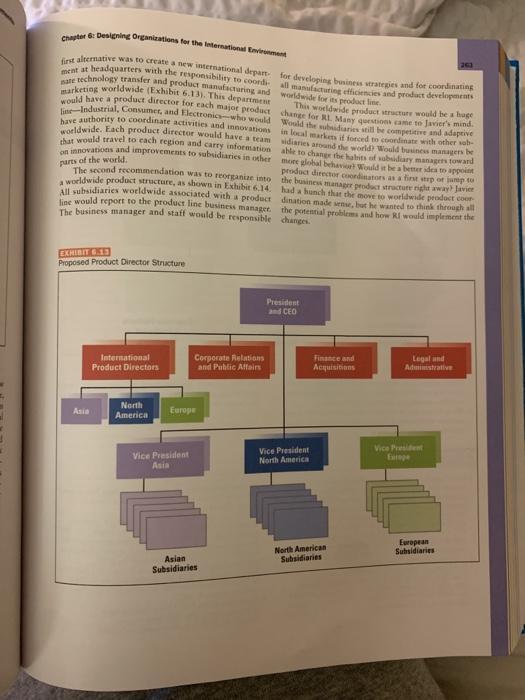
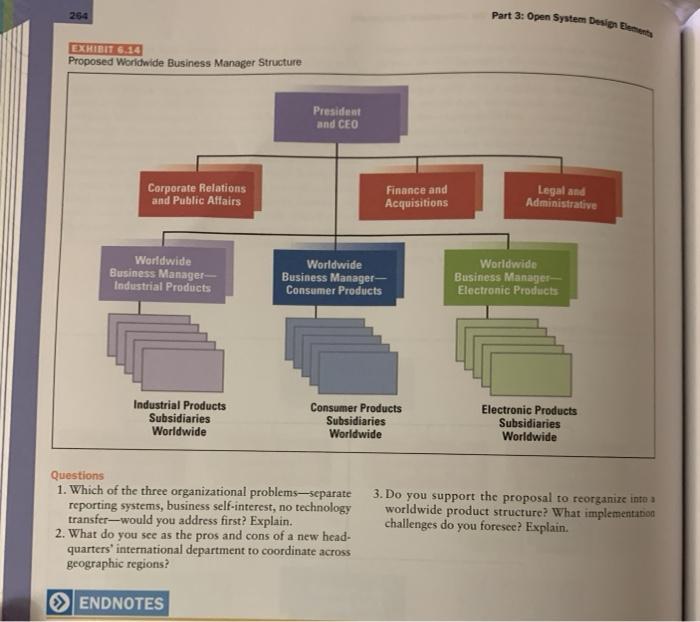
CASE FOR ANALYSIS Rhinebeck Industrial During the 1990s, a new president of RI, Sean Rhine. business-Industrial Products, Consumer Products, and David Javier was reviewing the consulting firm's proposed changes in organization structure for Rhinebeck Industrial the grandson of the founder, took over the business and (RI). As Javier read the report, he wondered whether the adopted the strategy of focusing RI on three lines of changes recommended by the consultants would do more harm than good for RI. Javier had been president of RI for Electronics. He led the acquisition of more international 18 months, and he was keenly aware of the organizational businesses that fit these three categories and divested a and coordination problems that needed to be corrected in order for RI to improve profits and growth in its interna- tional businesses. few businesses that didn't fit. Each of the three divisions had manufacturing plants as well as marketing and distri- bution systems in North America, Asia, and Europe. The Industrial Products division included pipe, glass, industrial sealants and coatings, cleaning equipment, and truck parts. The Electronics division included specialty light bulbs, switchboards, computer chips, and resistors and capacitors included dishes and glassware, paper and envelopes, and for original equipment manufacturers. Consumer Products pencils and pens Company Background Rhinebeck Industrial was started in the 1950s in South- Ontario, Canada, by Robert Rhine, an engineer who was an entrepreneur at heart. He started the busi- ness by first making pipe and then glass for industrial uses. As soon as the initial business was established. however, he quickly branched into new areas such as industrial sealants, coatings, and cleaners, and even into manufacturing mufflers and parts for the trucking indus- try. Much of this expansion occurred by acquiring small firms in Canada and the United States during the 1960s. RI had a conglomerate-type structure with rather diverse subsidiaries scattered around North America, all reporting directly to the Ontario headquarters. Each subsidiary was a complete local business and was allowed to operate inde- pendently so long as it contributed profits to RI. During the 1970s and 1980s, the president at the time, Clifford Michaels, brought a strong international focus to RI. His strategy was to acquire small companies worldwide with the belief that they could be formed into a cohesive unit that would bring RI synergies and profits through low cost of manufacturing and by serving businesses in inter- national markets. Some of RI's businesses were acquired simply because they were available at a good price, and RI found itself in new lines of business such as consumer products (paper and envelopes) and electrical equipment (witchboards, light bulbs, and security systems), in adds tion to its previous lines of business. Most of these prod- acts had local brand names or were manufactured for ajor international companies such as General Electric or Corning Glass. Structure In 2010 David Javier replaced Sean Rhine as president. He was very concerned about whether a new organization structure was needed for RI. The current structure was based on three major geographic areas-North America, Asia, and Europe-as illustrated in Exhibit 6.12. The various autono- mous units within those regions reported to the office of the regional vice president. When several units existed in a single country, one of the subsidiary presidents was also responsi- ble for coordinating the various businesses in that country, but most coordination was done through the regional vice president. Businesses were largely independent, which pro- vided flexibility and motivation for the subsidiary managers. The headquarters functional departments in Ontario were rather small. The three central departments- Corporate Relations and Public Affairs, Finance and Acquisitions, and Legal and Administrative-served the corporate business worldwide. Other functions such as HR management, new product development, marketing, and manufacturing all existed within individual subsidiaries and there was little coordination of these functions across geographic regions. Each business devised its own way to develop, manufacture, and market its products in its own country and region. EXHIBIT 6.17 Rhinebeck industrial Organization Chart Corporate Relations and Public Affairs Vice President Asia Asian Subsidiaries President and CEO Vice President North America Finance and Acquisitions North American Subsidiaries Organizational Problems The problems Javier faced at Rl, which were confirmed in the report on his desk, fell into three areas. First, each subsidiary acted as an independent business, using its own reporting systems and acting to maximize its own profits, This autonomy made it increasingly difficult to consolidate financial reports worldwide and to gain the efficiencies of uniform information and reporting systems. Second, major strategic decisions were made to ben efit individual businesses or for a country's or region's local interests. Local projects and profits received more time and resources than did projects that benefited RI worldwide. For example, an electronics manufacturer in Singapore refused to increase production of chips and capacitors for sale in the United Kingdom because it would hurt the bottom line of the Singapore operation. However, the economies of scale in Singapore would more than offset shipping costs to the United Kingdom and would enable RI to close expensive manufactur- ing facilities in Europe, increasing RI's efficiency and profits. Part 3: Open System Legaland Administrative Vice President Europe European Subsidiaries Third, there had been no transfer of technologs, re product ideas, or other innovations within RL. For example, a cost-saving technology for manufacturing light bulbs in Canads had been ignored in Asia and Europe. A technical innovation that provided homeowners with cell phone access to home security systems developed in Europe had been ignored in North America. The report on Javier's desk stressed that RI was failing to disperse important innova tions throughout the organization. These ignored innovation could provide significant improvements in both manufactu ing and marketing worldwide. The report said, "No one at RI understands all the products and locations in a way that allows RI to capitalize on manufacturing improvements and new product opportunities. The report also said that better worldwide coordination would reduce R's costs b seven percent each year and increase market potential by 10 percent. These numbers were too big to ignore. Recommended Structure The report from the consultant recommended that R try one of two options for improving its structure. The Chapter 6: Designing Organizations for the International Env first alternative was to create a new international depart for developing business strategies and for coordinating ment at headquarters with the responsibility to coordi- all manufacturing efficiencies and product developments nate technology transfer and product manufacturing and worldwide for its product line. marketing worldwide (Exhibit 6.13). This department This worldwide product structure would be a huge would have a product director for each major product change for RL. Many questions came to Javier's mind. I have authority to coordinate activities and innovations worldwide. Each product director would have a team that would travel to each region and carry information on innovations and improvements to subsidiaries in other parts of the world. The second recommendation was to reorganize into a worldwide product structure, as shown in Exhibit 6.14. All subsidiaries worldwide associated with a product line would report to the product line business manager. The business manager and staff would be responsible EXHIBIT 6.13 Proposed Product Director Structure Asia International Product Directors North America Corporate Relations and Public Affairs Europe Vice President Asia Asian Subsidiaries and adaptive sidiaries around the world? Would business managed able to change the habits of subsidiary managers toward in local markets if forced to coordinate with other sub- appoint more global behavioe? Would it be a better idea to product director coordinators as a first step of jump to had a hunch that the move to worldwide product coor the business manager product structure right away Javier dination made sense, but he wanted to think through all the potential problems and how RI would implement the changes. President and CEO Vice President North America Finance and Acquisitions North American Subsidiaries Legal and Administrative 10 Vice President 263 European Subsidiaries 264 EXHIBIT 6.14 Proposed Worldwide Business Manager Structure Corporate Relations and Public Affairs Worldwide Business Manager- Industrial Products Industrial Products Subsidiaries Worldwide President and CEO ENDNOTES Finance and Acquisitions Worldwide Business Manager- Consumer Products Questions 1. Which of the three organizational problems-separate reporting systems, business self-interest, no technology transfer-would you address first? Explain. 2. What do you see as the pros and cons of a new head- quarters' international department to coordinate across geographic regions? Consumer Products Subsidiaries Worldwide Part 3: Open System Design Elements Legal and Administrative Worldwide Business Manager- Electronic Products Electronic Products Subsidiaries Worldwide 3. Do you support the proposal to reorganize into a worldwide product structure? What implementation challenges do you foresee? ExplainStep by Step Solution
There are 3 Steps involved in it
1 Expert Approved Answer
Step: 1 Unlock

Question Has Been Solved by an Expert!
Get step-by-step solutions from verified subject matter experts
Step: 2 Unlock
Step: 3 Unlock
 Study Help