







Question: For this exercise, we'll explore gender differences. Run three t-tests to assess the following, referring to the separate handout on t-tests in SPSS. First, do
For this exercise, we'll explore gender differences. Run three t-tests to assess the following, referring to the separate handout on t-tests in SPSS. First, do women start having children at a significantly different age than men (AGEKDBRN)? Second, do women and men differ in the number of hours they reported watching television per day, typically (TVHOURS)? Finally, do women and men differ in the number of hours they report working in the previous week (HRS1)?
a. For each of these, state your research and null hypotheses.
b. Show your results by including relevant SPSS output for these t-tests.
c. Interpret the t-test results for each hypothesis test, noting either your critical value of t relative to your t obtained found in your output (don't hand calculate it but do identify it in your output) OR by comparing your p-value to your alpha-level of .05 (be sure you identify the specific p-values that you compare here). Your interpretation should be written as a well-formulated paragraph explaining the results to someone without a foundation in statistics (imagine explain your results to a friend or family member).
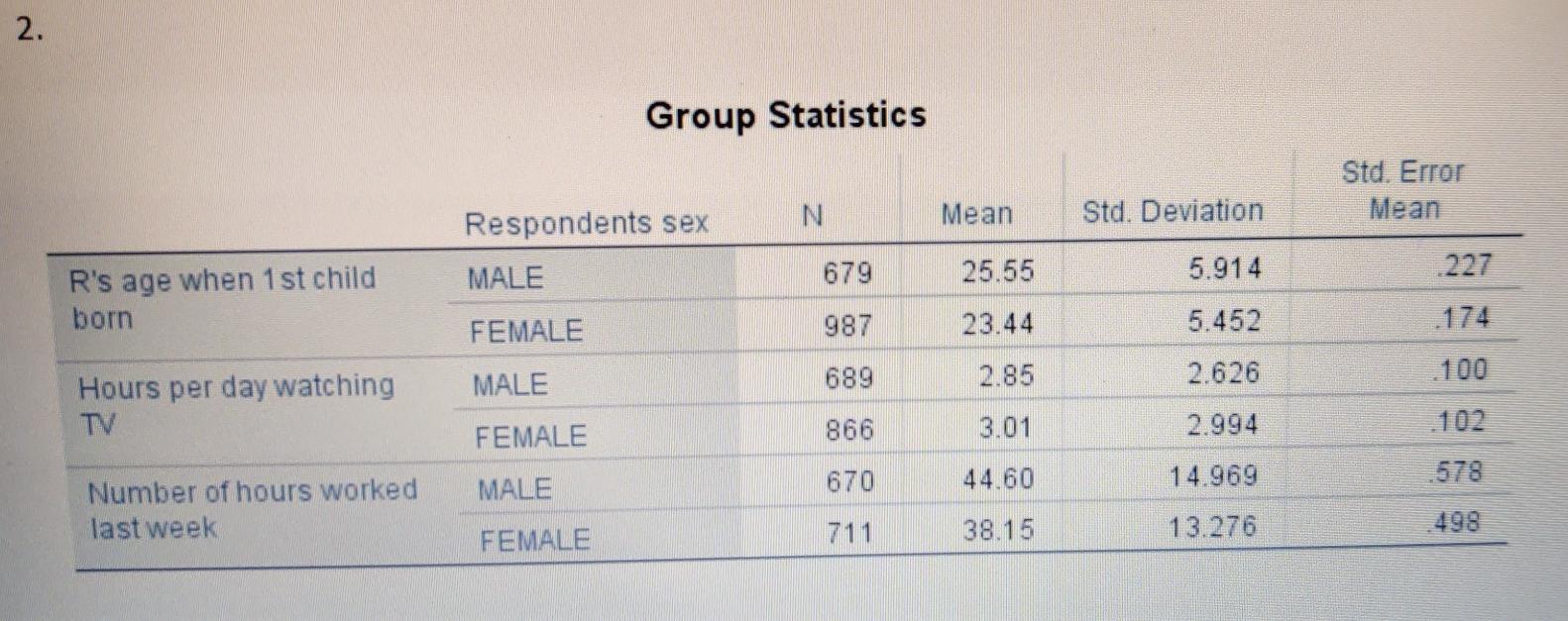
2. Group Statistics Std. Error Respondents sex N Mean Std. Deviation Mean R's age when 1st child MALE 679 25.55 5.914 227 born FEMALE 987 23.44 5.452 174 Hours per day watching MALE 689 2.85 2.626 100 TV FEMALE 866 3.01 2.994 102 Number of hours worked MALE 670 44.60 14.969 .578 last week FEMALE 711 38.15 13.276 498
Step by Step Solution
There are 3 Steps involved in it

Get step-by-step solutions from verified subject matter experts
 Study Help