







Question: For this milestone, you will draft your decision tree. This task presupposes a data set, a viable decision analysis research question, and the necessary data
For this milestone, you will draft your decision tree. This task presupposes a data set, a viable decision analysis research question, and the necessary data prep. Make sure to reflect on your instructor's feedback from the Milestone One assignment.
Experiment with different modeling styles. The main objective is to draft your model and explain what you did and why it is the best model for your research question.
Your submission should include the following critical elements:
- A clear description of the structure and purpose of the decision tree model that you choose.
- Documentation that refers to potential complications in the analysis process, in an outline or bulleted format. This should be clear, concise, and thorough.
- An evaluation of the results of the model, which includes a discussion of whether or not the results are reasonable and the model is accurate, whether or not there are elements that are not present or are needlessly present, and any errors that may be present.
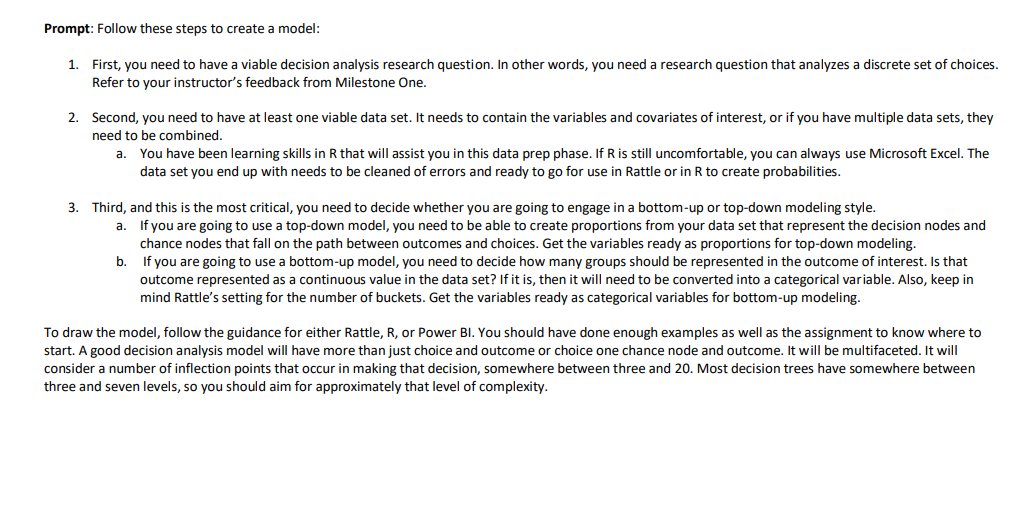
Prompt: Follow these steps to create a model: 1. First, you need to have a viable decision analysis research question. In other wordsr you need a research question that analyzes a discrete set of choicl. Refer to your instructor's feedback from Milestone One. 2. Second. you need to have at least one viable data set. It needs to contain the va riabla and cova riates of interest, or if you have multiple data sets. they need to be combined. a. You have been learning skills in R that will assist you in this data prep phase. If R is still uncomfortable, you can always use Microso; Exoel. The data set you end up with needs to be cleaned of errors and ready to go for use in Rattle or in R to create probabilities. 3. Third, and this is the most critical, you need to decide whether you are going to engage in a bottomAup or top-down modeling style. a. lfyou are going to use a top-down model, you need to be able to create proportions from your data set that represent the decision nodes and chance nodes that fall on the path between outcomes and choices. Get the variables ready as proportions for top-down modeling. b. If you are going to use a bottom-up model, you need to decide how many groups should be represented in the outcome of interest. Is that outcome represented as a continuous value in the data set? If it is, then it will need to be converted into a categorical variable. Also, keep in mind Rattle's setting for the number of buckets. Get the variables ready ascategorical variables for bottom-up modeling. To draw the model, follow the guidance for either Rattle, R, or Power Bl. You should have done enough examples as well as the assignment to know where to start. A good decision analysis model will have more than just choice and outcome or choice one chance node and outcome. It will be multifaceted. It will consider a number of inection points that occur in making that decision, somewhere between three and 20. Most decision trees have somewhere between three and seven levels. so you should aim for approximately that level of complexity
Step by Step Solution
There are 3 Steps involved in it

Get step-by-step solutions from verified subject matter experts
 Study Help