







Question: For this phase, we're going to evaluate the risks and descriptions submitted by peers. For each risk in the spreadsheet, you will need to assign
For this phase, we're going to evaluate the risks and descriptions submitted by peers. For each risk in the spreadsheet, you will need to assign scores. This will vary some according to the risks that have been submitted by classmates, but there will be multiple parts to each score:
Impact- For this, you will score each risk in the spreadsheet on a scale of 1 to 5. Use the descriptions below to provide a basis for how to score each risk:
- Negligible - Something that is likely to have little or no impact on operations or long term organizational plans.
- Low - May cause minor incidents, but no delay or disruption of operations, and no long term impact.
- Moderate - May cause some disruption to operations, potentially delaying projects or making services temporarily unavailable.
- Significant - Causes major disruptions to operations or organizational effectiveness, may cause project, product, or line failures.
- Catastrophic - Could result in extreme impacts to the organization, loss of life, and potentially failure of the organization as a whole.
Likelihood- For likelihood, you're looking at how likely the risk is to affect the organization. It's often important to attach a timeline to the likelihood score as well. For the purposes of this example, let's say the planning window is 5 years. For the scoring, it can translate to either a qualitative value, or percentages for a more quantitative approach:
- Improbable (0-20%)
- Remote (20-40%)
- Occasional (40-60%)
- Probable (60-80%)
- Frequent (80-100%)
Knowledge- This is a fairly new category in understanding risk. For knowledge, this score should be based on how well you believe you understand the risk as described, and how confident you are with your scores. Understanding how well we know a risk, or how confident we are about it can help in identifying areas in which we may need to gain more knowledge, to consult experts, etc. I understand that in this class, many of these topics may be new, but it can be a helpful way to combine possible knowledge about risk with how it is presented. This is the first time we are gathering 'knowledge' scores as well, so it will also help determine how this gets used in future classes. For this score, values may be as follows:
- Unsure / Unknown of the risk
- Sort of understand the risk
- Understand the basics
- Semi-confident in understanding the risk
- Completely understand this risk and surrounding information
Important Links:
- Risk Descriptions will be available in the Announcements (Risk Scoring Part II)
- Risk Scoring Sheets will be available in the Announcements (Risk Scoring Part II)- Make a copy or download this spreadsheet, enter your scoring. This is what you will submit for your assignment.
See the below chart for more information. Remember, scores will be 1-5 for Impact, and 1-5 for Likelihood.
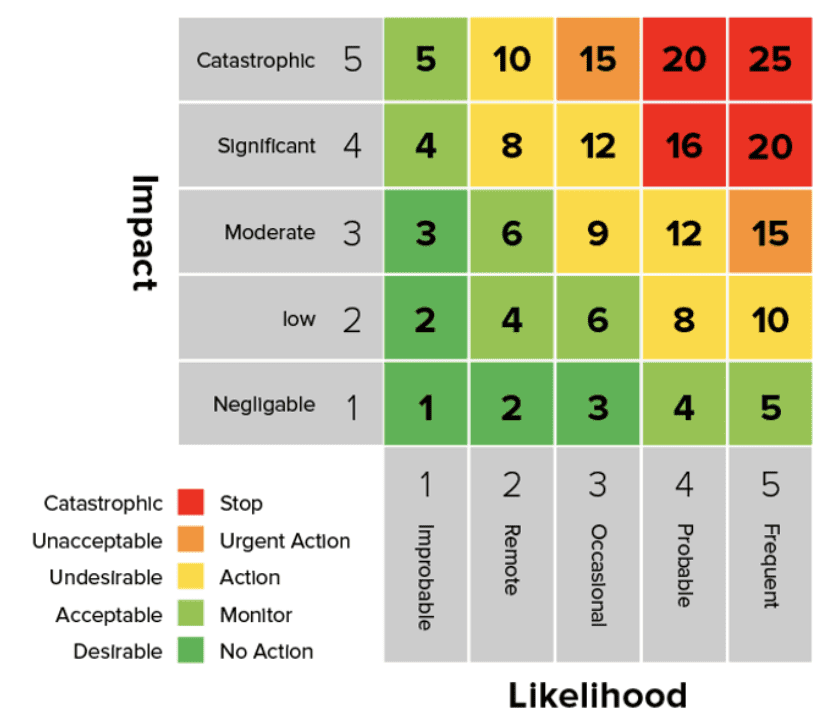
Catastrophic 5 5 10 15 20 25 Significant 4 4 8 12 16 20 Impact Moderate 3 3 6 9 12 15 low 2 2 4 6 8 10 Negligable 1 2 3 4 5 - N 4 Catastrophic Stop Unacceptable Urgent Action LO Frequent m Occasional Remote Probable Undesirable Action Improbable Acceptable Monitor Desirable No Action Likelihood
Step by Step Solution
There are 3 Steps involved in it

Get step-by-step solutions from verified subject matter experts
 Study Help