







Question: For this problem, consider binary trees where nodes can have either a left child and/or a right child, or no children (in other words, children
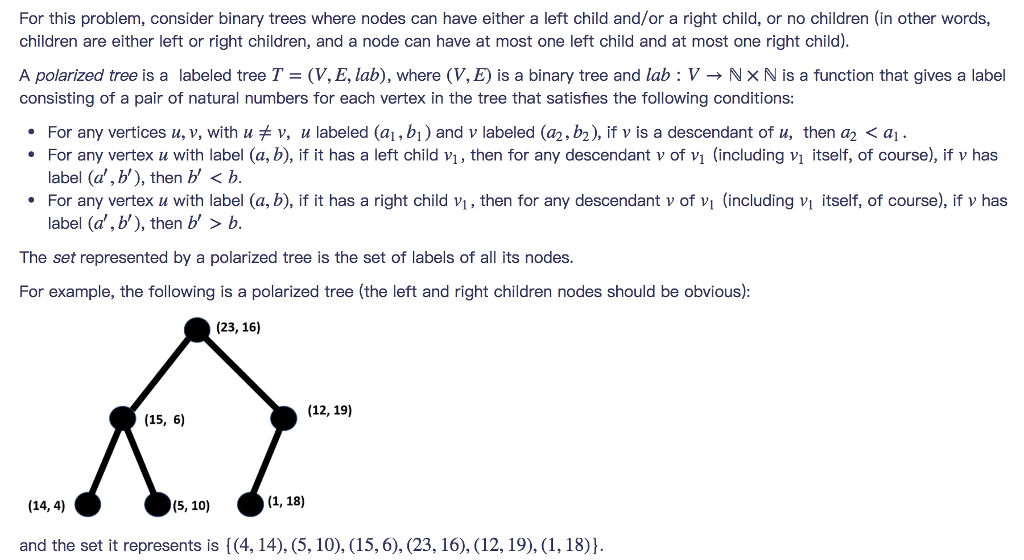

For this problem, consider binary trees where nodes can have either a left child and/or a right child, or no children (in other words, children are either left or right children, and a node can have at most one left child and at most one right child) A polarized tree is a labeled tree T (V, E, lab), where (V,E) is a binary tree and lab : V N X N is a function that gives a label consisting of a pair of natural numbers for each vertex in the tree that satisfies the following conditions: . For any vertices i, v, with uv, u labeled (al, bi ) and v labeled (a2, b2), if v is a descendant of 1, then a. b. The set represented by a polarized tree is the set of labels of all its nodes. For example, the following is a polarized tree (the left and right children nodes should be obvious): (23, 16) ( (12,19) (15, 6) (14,4 (5,10) and the set it represents is ((4, 14), (5, 10), (15, 6), (23, 16), (12,19),(1, 18)
Step by Step Solution
There are 3 Steps involved in it

Get step-by-step solutions from verified subject matter experts
 Study Help