







Question: For this problem, I found that L is equal to thousand, and using that MD = MS, price level is equal to 1. Did I
For this problem, I found that L is equal to thousand, and using that MD = MS, price level is equal to 1.
Did I use the wrong method in this part?
Also, for part d, how do I include all A,B,andC in a single graph?
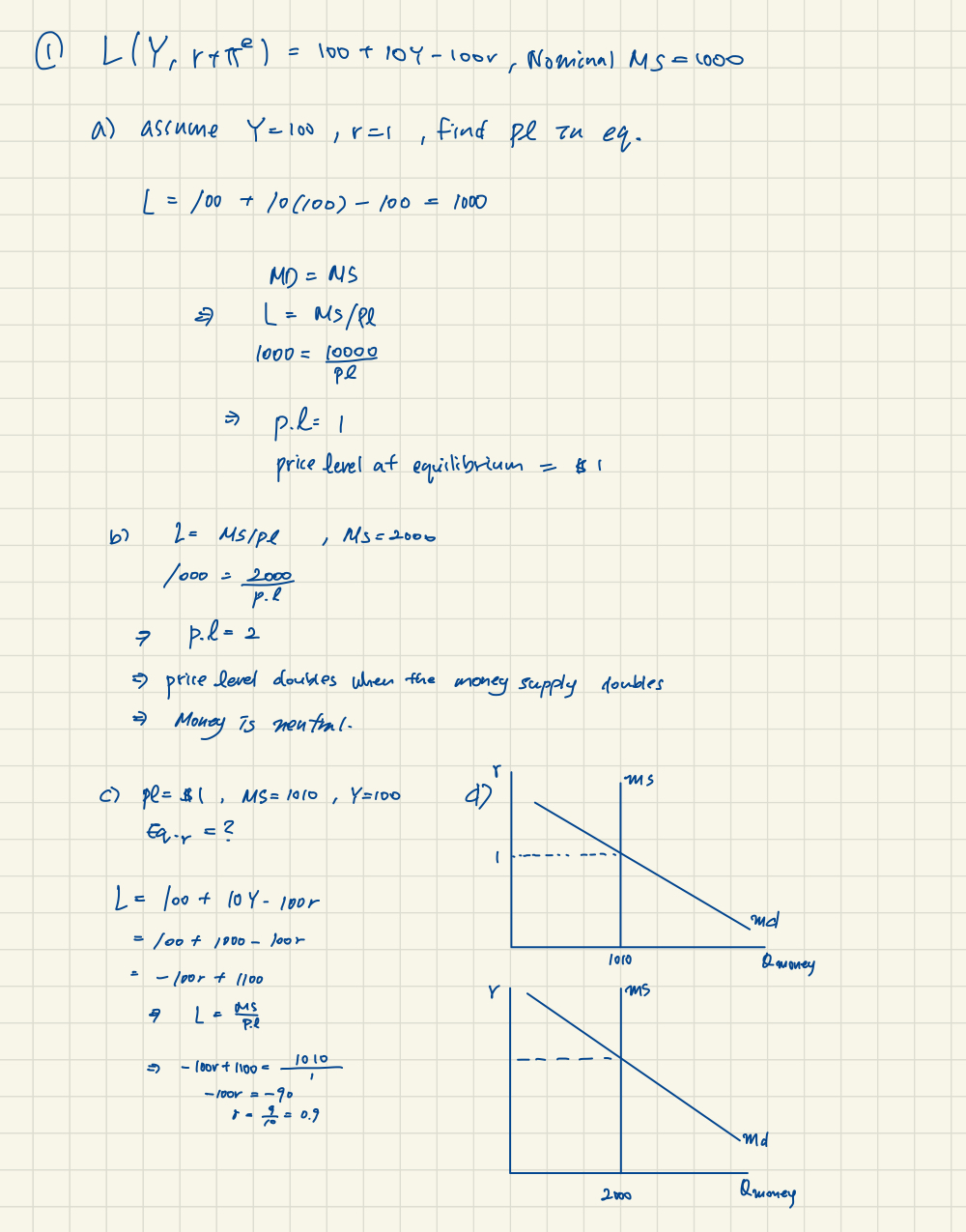
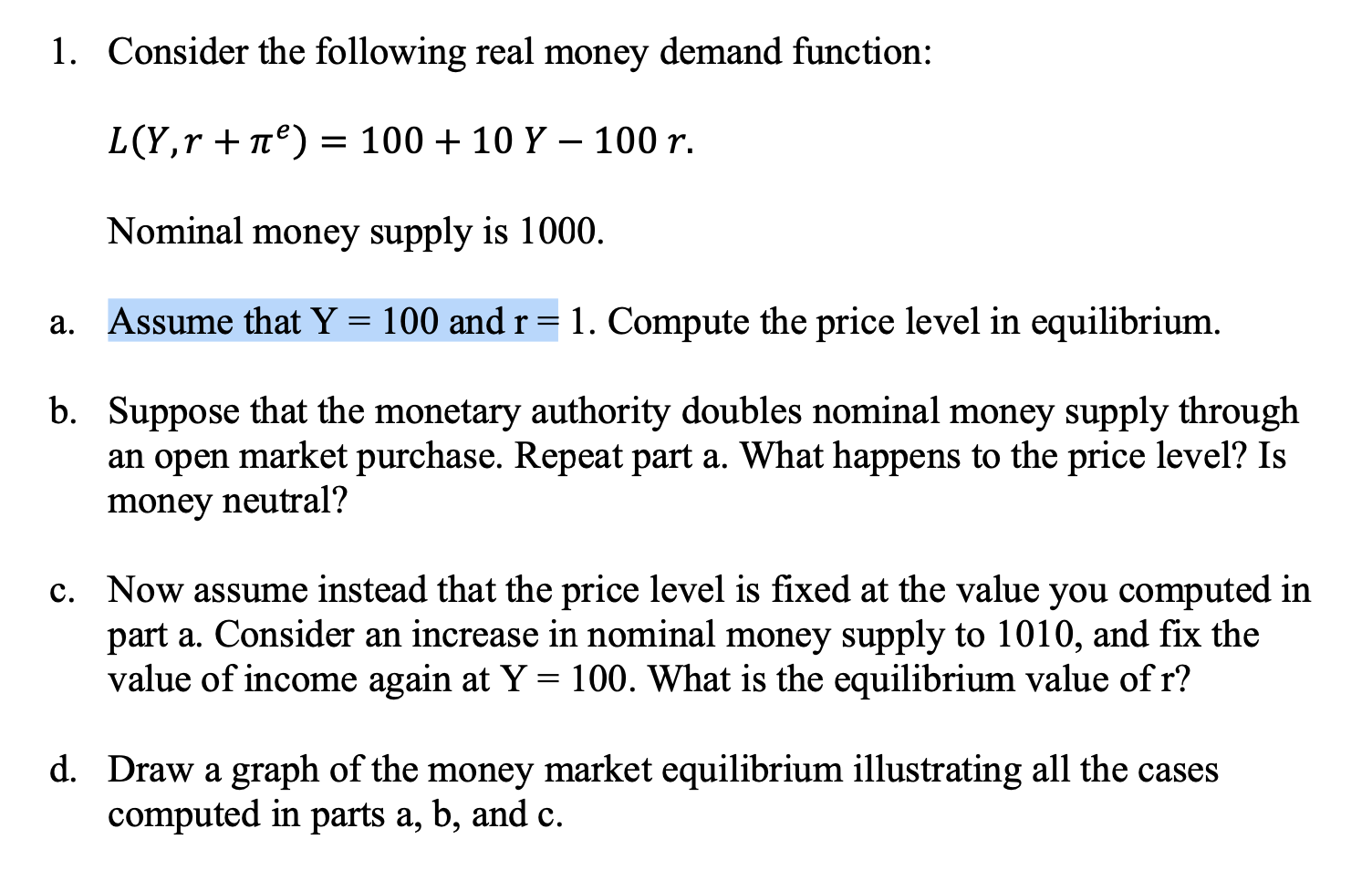
@ L( Y , ryTTe ) = 100 + 104 - 10or , Nominal MS = 1000 a) assume Y=100 , ral , find pl in eq . [ = /00 + 10 (100) - 100 = 1000 MD = NS L = MS/ PQ 1000 = 1000 0 pe P. R = 1 price level at equilibrium = $1 2 = MS/pl 1 MS = 2006 1000 = 2000 p. R 7 p.l = 2 $) price level doubles when the money supply doubles 2) Money is neutral . () pe = $1 , MS= 1010 , 1=100 ms 1 L = 100 + 104- 10or mad = 100 + 1800 - 1001 = - 100+ + 1100 loro Q money Y MS 9 1 = MS P.e - loor + /100 = 10 10 - - -10Or = - 90 + - 2 = 0.9 md 2100 Qmoney1. Consider the following real money demand function: L(Y,r + He) = 100 + 10 Y 100 1'. Nominal money supply is 1000. a. Assume that Y = 100 and r = 1. Compute the price level in equilibrium. b. Suppose that the monetary authority doubles nominal money supply through an open market purchase. Repeat part a. What happens to the price level? Is money neutral? c. Now assume instead that the price level is xed at the value you computed in part a. Consider an increase in nominal money supply to 1010, and x the value of income again at Y = 100. What is the equilibrium value of r? (1. Draw a graph of the money market equilibrium illustrating all the cases computed in parts a, b, and c
Step by Step Solution
There are 3 Steps involved in it

Get step-by-step solutions from verified subject matter experts
 Study Help