







Question: For this problem, my task is simple. I have to be able to summarize what key concepts are being explained in the example. I
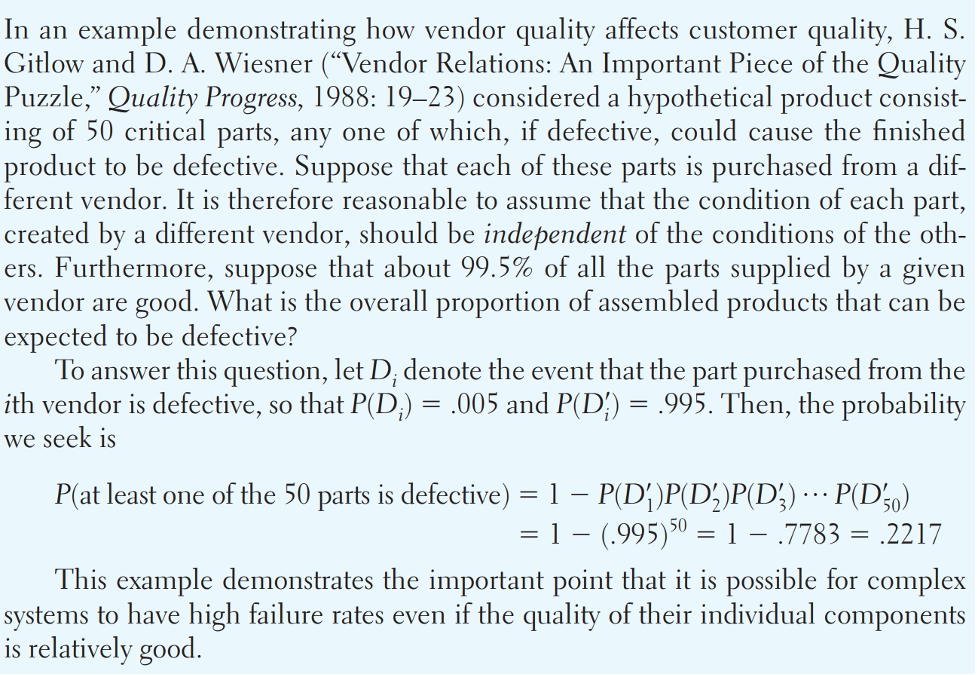
For this problem, my task is simple. I have to be able to "summarize what key concepts are being explained in the example. I have to summarize what the problem is explaining and the bottom-line concepts described in the problem."
Can you help me summarize what this problem is stating and be able to explain it in basic English? Thank you.
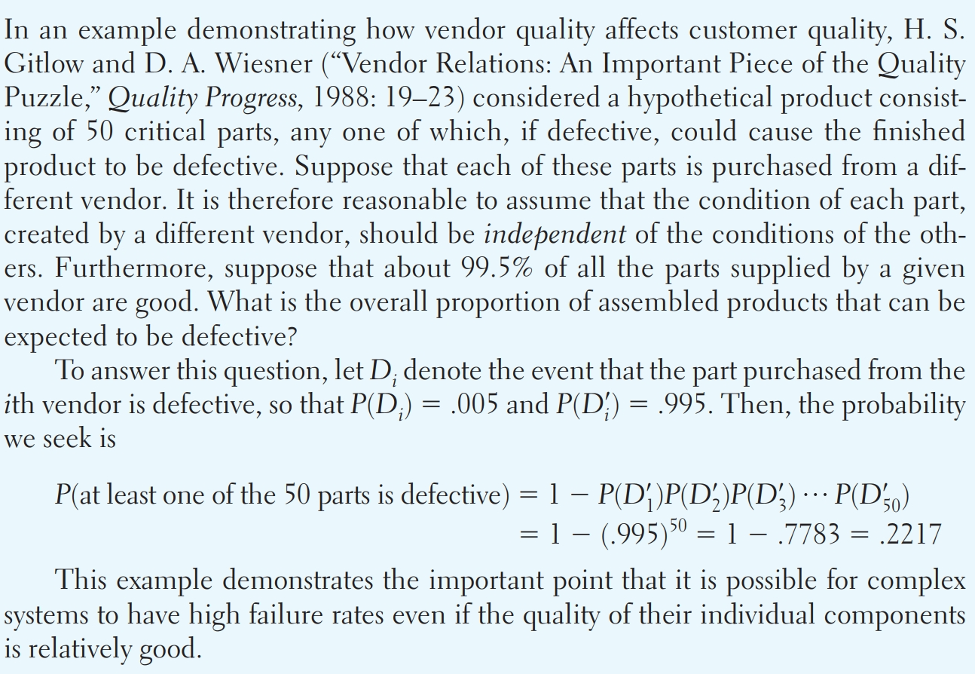
In an example demonstrating how vendor quality affects customer quality, H. S. Gitlow and D. A. Wiesner (\"Vendor Relations: An Important Piece of the Quality Puzzle,\" Quality Progress, 1988: 1923) considered a hypothetical product consist- ing of 50 critical parts, any one of which, if defective, could cause the nished product to be defective. Suppose that each of these parts is purchased from a dif- ferent vendor. It is therefore reasonable to assume that the condition of each part, created by a different vendor, should be independent of the conditions of the oth- ers. Furthermore, suppose that about 99.5% of all the parts supplied by a given vendor are good. What is the overall proportion of assembled products that can be expected to be defective? To answer this question, let D, denote the event that the part purchased from the ith vendor is defective, so that P(D,.) = .005 and P(D;) z .995. Then, the probability we seek is P(at least one of the 50 parts is defective) = l P(D'1)P(DE)P(D'3) - - - P(D'50) = l (.995)50 = l .7783 = .2217 This example demonstrates the important point that it is possible for complex systems to have high failure rates even if the quality of their individual components is relatively good
Step by Step Solution
There are 3 Steps involved in it

Get step-by-step solutions from verified subject matter experts
 Study Help