





Question: For this program, you will write a chunk based decryption program. Study the base code and make the following changes: Implement display_chunks(). Loop over each
 For this program, you will write a chunk based decryption program.
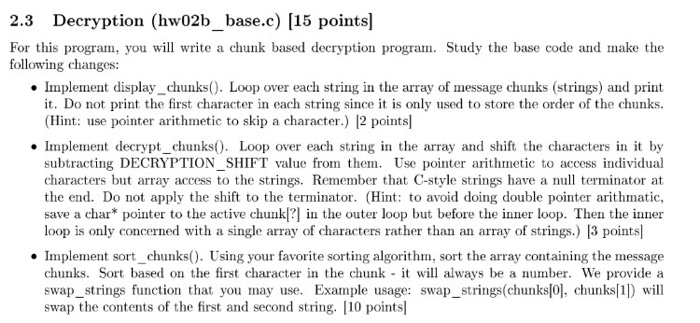
For this program, you will write a chunk based decryption program. Study the base code and make the following changes:
Implement display_chunks(). Loop over each string in the array of message chunks (strings) and print it. Do not print the rst character in each string since it is only used to store the order of the chunks. (Hint: use pointer arithmetic to skip a character.) [2 points]
Implement decrypt_chunks(). Loop over each string in the array and shift the characters in it by subtracting DECRYPTION_SHIFT value from them. Use pointer arithmetic to access individual characters but array access to the strings. Remember that C-style strings have a null terminator at the end. Do not apply the shift to the terminator. (Hint: to avoid doing double pointer arithmatic, save a char* pointer to the active chunk[?] in the outer loop but before the inner loop. Then the inner loop is only concerned with a single array of characters rather than an array of strings.) [3 points]
Implement sort_chunks(). Using your favorite sorting algorithm, sort the array containing the message chunks. Sort based on the rst character in the chunk - it will always be a number. We provide a swap_strings function that you may use. Example usage: swap_strings(chunks[0], chunks[1]) will swap the contents of the rst and second string. [10 points]
___________________________________________
////////////////////////////////////////////////////////////////////////////////
//INCLUDES
#include
#include
//macros: constants
#define CHUNK_LENGTH (20+1) //each chunk has twenty characters, we add 1 so
//there is space for the null terminator.
#define NUMBER_OF_CHUNKS 4 //the message is spread across 4 chunks.
#define DECRYPTION_SHIFT 5 //this is the ASCII table shift used for decryption.
//forward declarations
void sort_chunks();
void decrypt_chunks();
void display_chunks();
char chunks[NUMBER_OF_CHUNKS][CHUNK_LENGTH];
int main() {
//copy message into memory.
strcpy(chunks[0], "2i1%fsi%fs%jstwrtzx%");
strcpy(chunks[1], "1'H%nx%vznwp~1%kqf|j");
strcpy(chunks[2], "4R3%Wnyhmnj%%%%%%%%%");
strcpy(chunks[3], "3xzhhjxx3'%2%Ijssnx%");
//the format of a chunk is a single number indicating its order in overall
//message followed by twenty encrypted characters.
//reorder chunks in message by sorting them based on the first digital
//they contain. looking above, one can see they are currently in the order
//2, 1, 4, 3 but should be ordered 1, 2, 3, 4.
sort_chunks();
//shift the characters in the message to produce the original characters.
decrypt_chunks();
//display the decrypted message.
display_chunks();
return 0;
}
//given two strings, swaps their contents in memory.
void swap_strings(char* x, char* y) {
//create a temporary holding place for the data so we don't lose it.
char temp[CHUNK_LENGTH];
strcpy(temp, x);
strcpy(x, y);
strcpy(y, temp);
}
//sorts the strings the global chunks variable by the first character they contain.
void sort_chunks() {
//TODO: Implement sort_chunks(). Using your favorite sorting algorithm (we
// suggest selection sort), sort the array containing the message chunks.
// Sort based on the first character in the chunk - it will always be a
// number. We provide a swap_strings function that you may use. Example
// usage: swap_strings(chunks[0], chunks[1]) will swap the contents of
// the first and second string.
}
//for each string in the global chunks variable, shifts the characters in it by
//DECRYPTION_SHIFT.
void decrypt_chunks() {
//TODO: Implement decrypt_chunks(). Loop over each string in the array
// and shift the characters in it by subtracting DECRYPTION_SHIFT value
// from them. Use pointer arithmetic to access individual characters but
// array access to the strings. Remember that C-style strings have a null
// terminator at the end. Do not apply the shift to the terminator.
// (Hint: to avoid doing double pointer arithmatic, save a char* pointer
// to the active chunk[?] in the outer loop but before the inner loop.
// Then the inner loop is only concerned with a single array of
// characters rather than an array of strings.)
}
//displays the strings in the global chunks variable
void display_chunks() {
//TODO: Implement display_chunks(). Loop over each string in the array of
// message chunks (strings) and print it. Do not print the first
// character in each string since it is only used to store the order of
// the chunks. (Hint: use pointer arithmetic to skip a character.)
}

2.3 Decryption (hw02b base.c) [15 points For this program, you will write a chunk based decryption program. Study the base code and make the following changes: Implement display_chunks). Loop over each string in the array of message chunks (strings) and print it. Do not print the first character in each string since is only used to store the order of the chunks (Hint: use pointer arithmetic to skip a character.) |2 points Implemnt decrypt chunks Loop over each string in the array and shift the characters t by subtracting DECRYPTION_SHIFT value from them. Use pointer arithmetic to access individual characters but array access to the strings. Remember that C-style strings have a null terminator at the end. Do not apply the shift to the terminator. (Hint: to avoid doing double pointer arithmatic, save a char pointer to the active chunk in the outer loop but before the inner loop. Then the inner loop is only concerned with a single array of characters rather than an array of strings.) 3 points Implement sort chunks). Using your favorite sorting algorithm, sort the array containing the message chunks. Sort based on the first character in the chunk t ill always be a number. We provide a swap_strings function that you may use. Example usage: swap_strings(chunks|0], chunks 1]) wil swap the contents of the first and second string. 10 pointsl

Step by Step Solution

There are 3 Steps involved in it

1 Expert Approved Answer
Step: 1 Unlock blur-text-image
Question Has Been Solved by an Expert!

Get step-by-step solutions from verified subject matter experts

Step: 2 Unlock
Step: 3 Unlock

Students Have Also Explored These Related Databases Questions!