Question: For this second Application Assignment, you are first asked to use concepts from the text to describe yourself in terms of your emotional intelligence, time
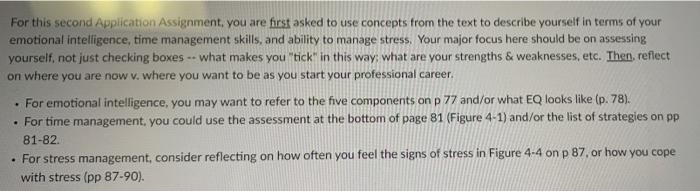
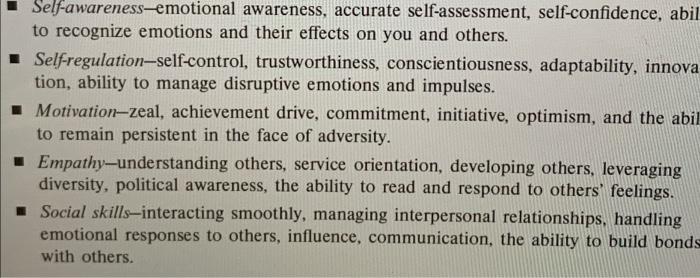
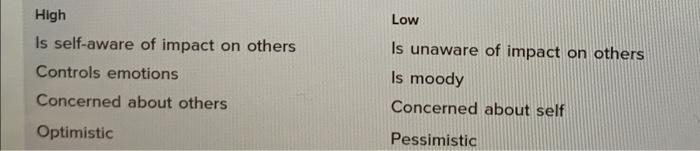
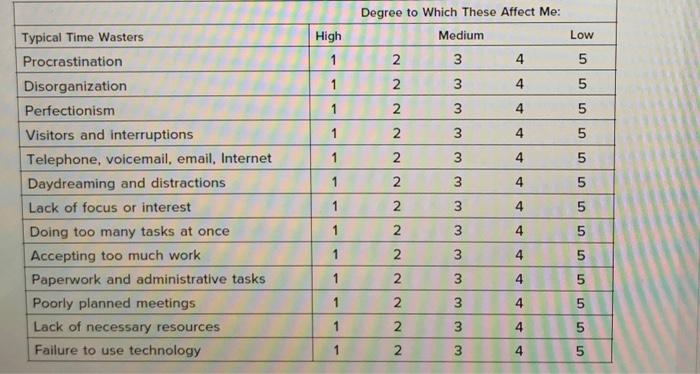
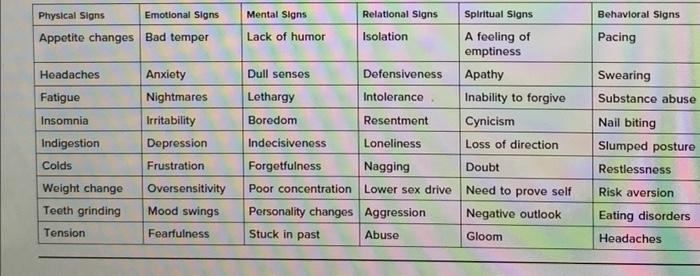
For this second Application Assignment, you are first asked to use concepts from the text to describe yourself in terms of your emotional intelligence, time management skills, and ability to manage stress. Your major focus here should be on assessing yourself, not just checking boxes -- what makes you "tick" in this way, what are your strengths & weaknesses, etc. Then, reflect on where you are now v. where you want to be as you start your professional career. . For emotional intelligence, you may want to refer to the five components on p 77 and/or what EQ looks like (p. 78). For time management, you could use the assessment at the bottom of page 81 (Figure 4-1) and/or the list of strategies on pp 81-82 . For stress management, consider reflecting on how often you feel the signs of stress in Figure 4-4 on p 87, or how you cope with stress (pp 87-90). Self-awareness-emotional awareness, accurate self-assessment, self-confidence, abil to recognize emotions and their effects on you and others. Self-regulation-self-control, trustworthiness, conscientiousness, adaptability, innova tion, ability to manage disruptive emotions and impulses. Motivation-zeal, achievement drive, commitment, initiative, optimism, and the abil to remain persistent in the face of adversity. Empathy-understanding others, service orientation, developing others, leveraging diversity, political awareness, the ability to read and respond to others' feelings. Social skills-interacting smoothly, managing interpersonal relationships, handling emotional responses to others, influence, communication, the ability to build bonds with others. Low High Is self-aware of impact on others Controls emotions Concerned about others Is unaware of impact on others Is moody Concerned about self Optimistic Pessimistic Degree to Which These Affect Me: Medium Low High 1 Us 2 3 4 5 1 1 N 3 5 2 2 4 4 2 5 1 1 3 3 N 4 5 1 2 2 3 4 5 1 N 3 4 Typical Time Wasters Procrastination Disorganization Perfectionism Visitors and interruptions Telephone, voicemail, email, Internet Daydreaming and distractions Lack of focus or interest Doing too many tasks at once Accepting too much work Paperwork and administrative tasks Poorly planned meetings Lack of necessary resources Failure to use technology 1 2 3 4 1 N 3 4 5 1 2. 3 5 4 4 UU 1 2 3 5 1 2 3 3 4 5 1 2 3 4 5 1 2. 3 4 5 Physical Signs Emotional Signs Relational Signs Spiritual Signs Behavioral Signs Mental Signs Lack of humor Appetite changes Bad temper Isolation Pacing Headaches Fatigue Swearing Substance abuse Insomnia Anxiety Nightmares Irritability Depression Frustration Oversensitivity Mood swings Fearfulness Indigestion Colds A feeling of emptiness Apathy Inability to forgive Cynicism Loss of direction Doubt Need to prove self Negative outlook Dull senses Defensiveness Lethargy Intolerance Boredom Resentment Indecisiveness Loneliness Forgetfulness Nagging Poor concentration Lower sex drive Personality changes Aggression Stuck in past Abuse Nail biting Slumped posture Restlessness Risk aversion Eating disorders Headaches Weight change Teeth grinding Tension Gloom









 Study Help