







Question: For this section, if you cannot answer a question with a specific number or value, describe the answer in words. (a) How do you
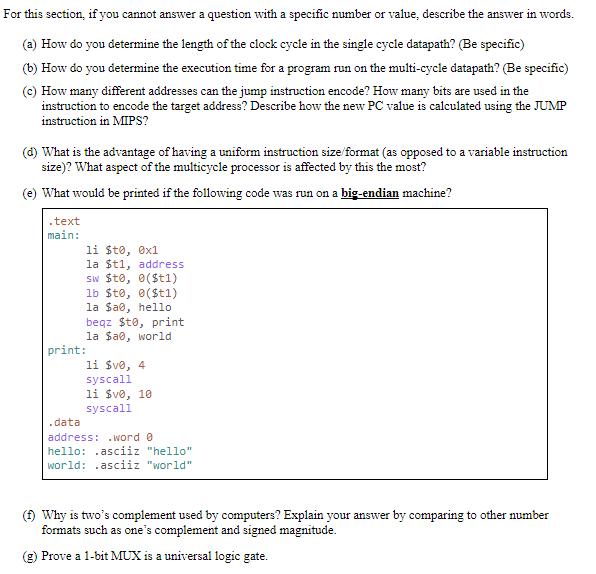
For this section, if you cannot answer a question with a specific number or value, describe the answer in words. (a) How do you determine the length of the clock cycle in the single cycle datapath? (Be specific) (b) How do you determine the execution time for a program run on the multi-cycle datapath? (Be specific) (c) How many different addresses can the jump instruction encode? How many bits are used in the instruction to encode the target address? Describe how the new PC value is calculated using the JUMP instruction in MIPS? (d) What is the advantage of having a uniform instruction size/format (as opposed to a variable instruction size)? What aspect of the multicycle processor is affected by this the most? (e) What would be printed if the following code was run on a big-endian machine? .text main: print: li $t0, 0x1 la $t1, address sw $t0, 0($t1) 10 Sto, e($t1) la $ao, hello beqz $t0, print la $a0, world li $v0, 4 syscall li $v0, 10 syscall .data address: .word 0 hello: .asciiz "hello" world: .asciiz "world" (f) Why is two's complement used by computers? Explain your answer by comparing to other number formats such as one's complement and signed magnitude. (g) Prove a 1-bit MUX is a universal logic gate.
Step by Step Solution
There are 3 Steps involved in it
a In a singlecycle datapath the clock cycle length is determined by the longest combinational logic ... View full answer

Get step-by-step solutions from verified subject matter experts
 Study Help