







Question: For this semester, each selected article must have been published after May 1st, 2022 . Each Deep Dive response should, at a minimum, include the
For this semester, each selected article must have been published after May 1st, 2022. Each Deep Dive response should, at a minimum, include the follow information and / or sections, which will result in a written response that is approximately two pages long.
A reader should always be able to find your exact data sources with minimal effort.
- A one- to two-paragraph summary of the article as it is written. Assume that someone reading your Deep Dive submission has not and will not read the source article in its entirety. Provide enough details that someone understands what is going on, but not so much that a reader is better off just going straight to the source instead.
- A one- to two-paragraph extension of the article, performing SWOT analysis. Apply SWOT terminology that are reflected in your chosen article? Which strategic management concepts have the authors omitted to appeal to an audience of laypeople that a professional manager with a business degree would use to more accurately describe or analyze the situation at hand? Does the author seem biased in their discussion of the topic at hand? Are there any key points that are missing that would give a more holistic understanding of the situation? Are there other topics from this class that this article is related to? Is this article similar to or different from any other articles you have read on this topic?
- A one- to two-paragraph analysis based on your own professional judgment and experience regarding the situation and how your focal organization should proceed from here given your understanding of the situation as presented.
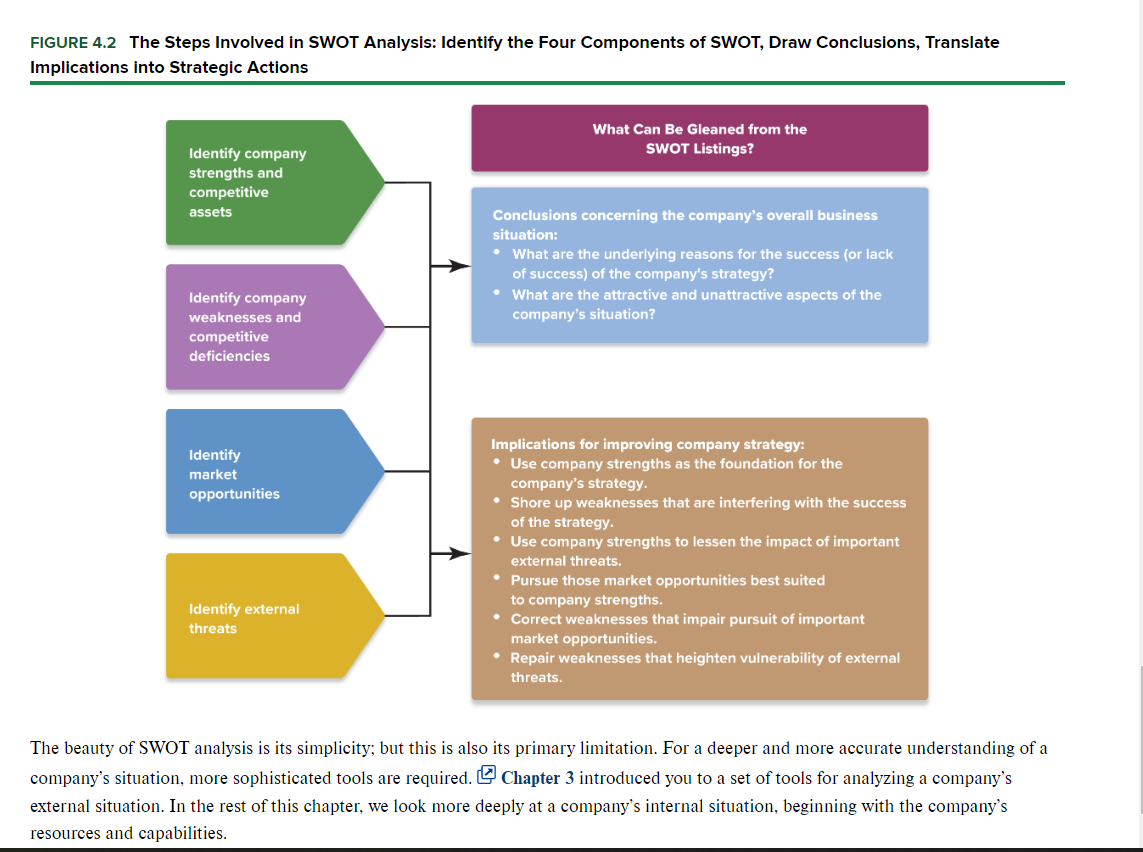
FIGURE 4.2 The Steps Involved In SWOT Analysis: Identify the Four Components of SWOT. Draw Conclusions, Translate Implications lnto Strategic Actions What Can Be Gleaned from the Identify company SWOT Listings? strengths and competitive 35535 Conclusions concerning the company's overall business situation: ' What are the underlying reasons for the success [or lack of success) of the company's strategy? mentify company What are the attractive and unattractive aspects of the weaknesses and comPa"Y'5 situation? competitive deficiencies Implications for improving company strategy: Use company strengths as the foundation for the company's strategy. Shore up weaknesses that are interfering with the success of the strategy. Use company strengths to lessen the impact of important external threats. Pursue those market opportunities best suited to company strengths. Correct weaknesses that impair pursuit of important market opportunities. Repair weaknesses that heighten vulnerability of external threats. Identify market opportunities Identify external threats The beauty of SWOT analysis is its simplicity; but this is also its primary limitation. For a deeper and more accurate understanding of a company's situation, more sophisticated tools are required. Chapter 3 introduced you to a set of tools for analyzing a company's external situation. In the rest of this chapter, we look more deeply at a company's internal situation, beginning with the company's resources and capabilities
Step by Step Solution
There are 3 Steps involved in it

Get step-by-step solutions from verified subject matter experts
 Study Help