







Question: For this simulation, review the Concept Summaries and your notes from Chapters 6 and 7. Study the Stipulated Facts and Longville case law in
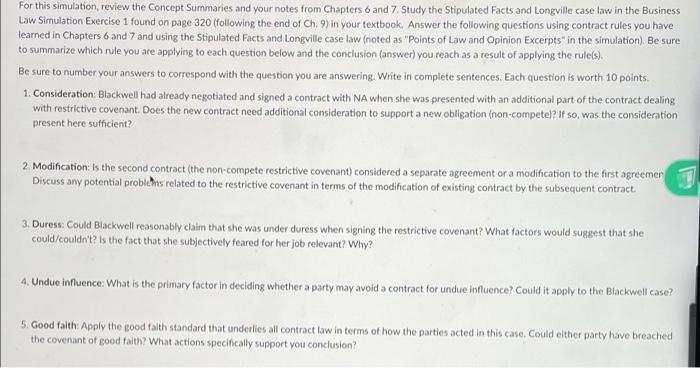
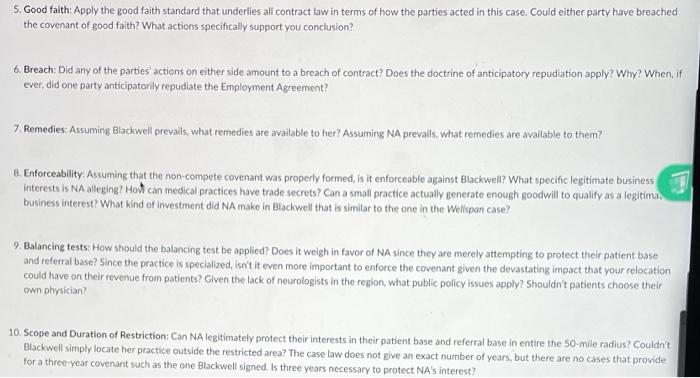
For this simulation, review the Concept Summaries and your notes from Chapters 6 and 7. Study the Stipulated Facts and Longville case law in the Business Law Simulation Exercise 1 found on page 320 (following the end of Ch. 9) in your textbook. Answer the following questions using contract rules you have learned in Chapters 6 and 7 and using the Stipulated Facts and Longville case law (noted as "Points of Law and Opinion Excerpts" in the simulation). Be sure to summarize which rule you are applying to each question below and the conclusion (answer) you reach as a result of applying the rule(s). Be sure to number your answers to correspond with the question you are answering. Write in complete sentences. Each question is worth 10 points. 1. Consideration: Blackwell had already negotiated and signed a contract with NA when she was presented with an additional part of the contract dealing with restrictive covenant. Does the new contract need additional consideration to support a new obligation (non-compete)? If so, was the consideration present here sufficient? 2. Modification: Is the second contract (the non-compete restrictive covenant) considered a separate agreement or a modification to the first agreemen Discuss any potential problems related to the restrictive covenant in terms of the modification of existing contract by the subsequent contract. 3. Duress: Could Blackwell reasonably claim that she was under duress when signing the restrictive covenant? What factors would suggest that she could/couldn't? Is the fact that she subjectively feared for her job relevant? Why? 4. Undue influence: What is the primary factor in deciding whether a party may avoid a contract for undue influence? Could it apply to the Blackwell case? 5. Good faith: Apply the good faith standard that underlies all contract law in terms of how the parties acted in this case. Could either party have breached the covenant of good faith? What actions specifically support you conclusion?
Step by Step Solution
There are 3 Steps involved in it

Get step-by-step solutions from verified subject matter experts
 Study Help