



Question: For this week's discussion, you are asked to generate a continuous and differentiable function f(:c) with the following properties: - f(m} is decreasing at m
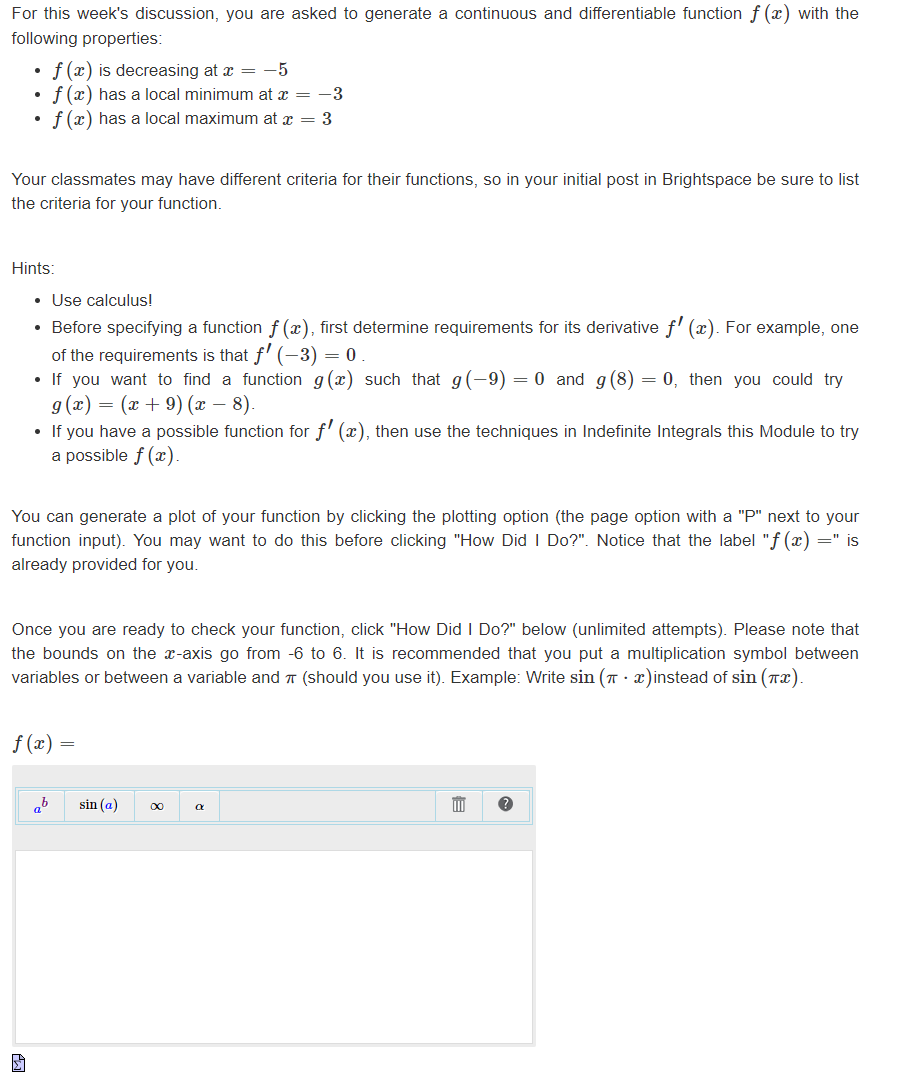
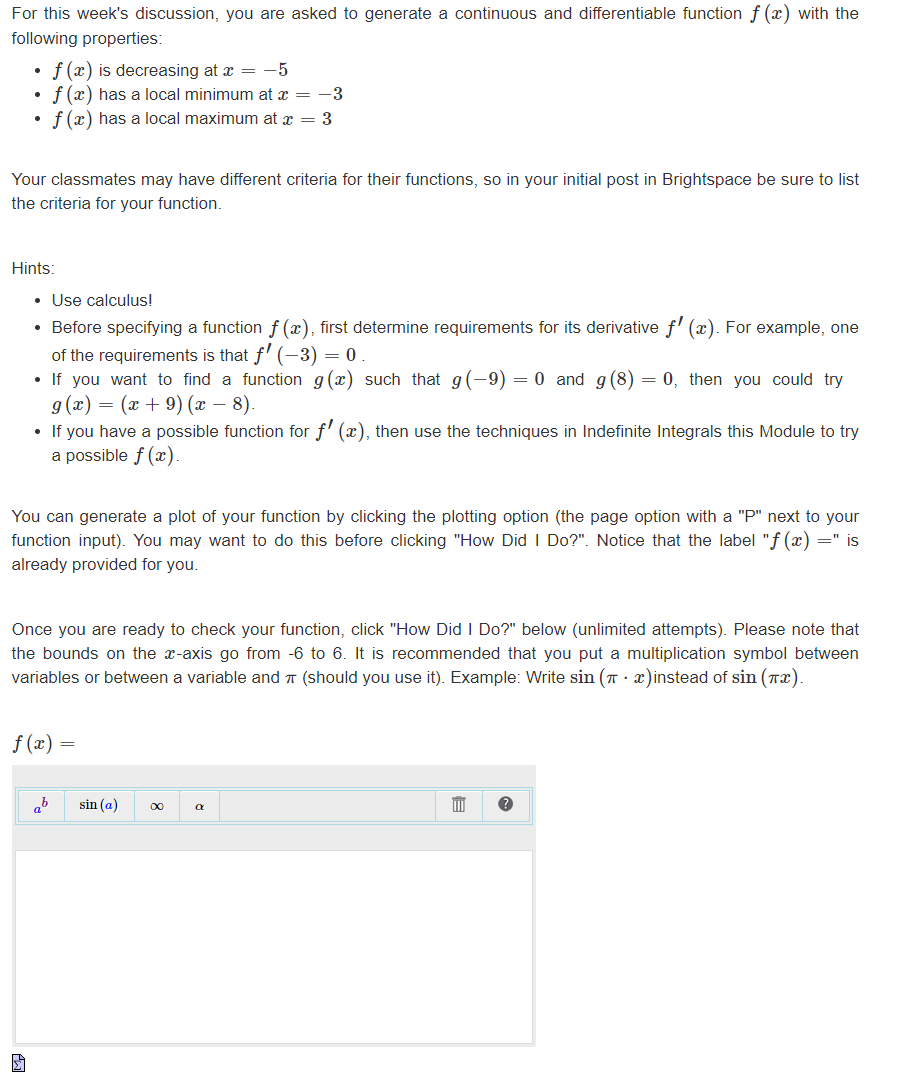
For this week's discussion, you are asked to generate a continuous and differentiable function f(:c) with the following properties: - f(m} is decreasing at m = 5 - f(:.tt} has a local minimum at a: = 3 . f(m} has a local maximum at a: = 3 Your classmates may have different criteria for their functions, so in your initial post in Brightspace be sure to list the criteria for your function. Hints: - Use calculus! - Before specifying a function f[:r:), rst determine requirements for its derivative f' (at). For example, one of the requirements is that f" [3) = U . - If you want to find a function g (at) such that g (9) = [l and g [8) = 0, then you could try 9(a) = (a? + 9H3: 8)- - If you have a possible function for f' (:13), then use the techniques in Indefinite Integrals this Module to try a possible f (at). You can generate a plot of your function by clicking the plotting option (the page option with a "P" next to your function input}. You may want to do this before clicking "How Did I Do?". Notice that the label "f {m} =" is already provided for you. Once you are ready to check your function, click "How Did I Do?\" below (unlimited attempts). Please note that the bounds on the maxis go from 6 to 6. It is recommended that you put a multiplication symbol between variables or between a variable and it (should you use it). Example: Write sin [71' - ainstead of sin (rat). HR?) =
Step by Step Solution
There are 3 Steps involved in it

Get step-by-step solutions from verified subject matter experts