





Question: For your response posts, address the following: Do you agree with your classmate's rationale about why the AICPA includes job offers in their conflict-of-interest guidelines?

For your response posts, address the following: Do you agree with your classmate's rationale about why the AICPA includes job offers in their conflict-of-interest guidelines? What is another possible reason? Do you agree with your classmate's post in terms of why this situation is considered a violation? How would you respond if you were put in this situation?
For your response posts, address the following:
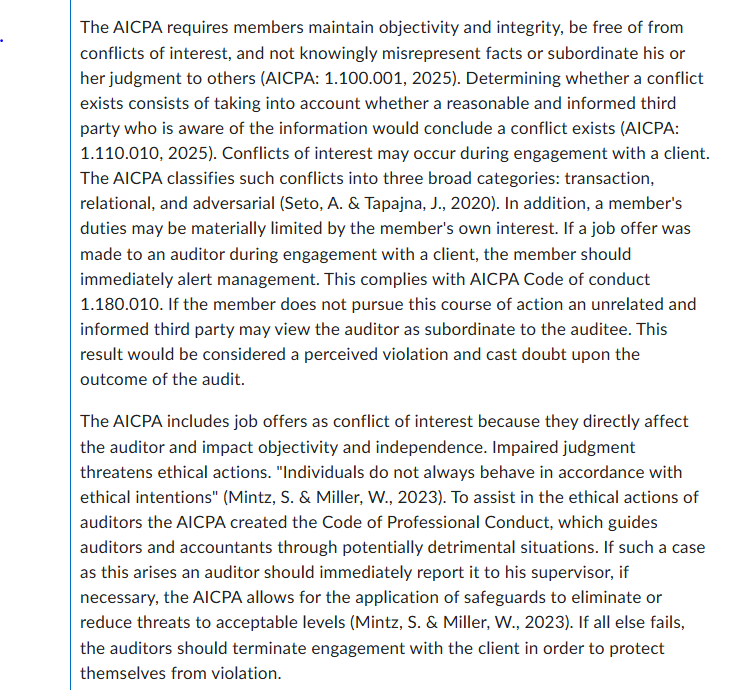
The AICPA requires members maintain objectivity and integrity, be free of from conflicts of interest, and not knowingly misrepresent facts or subordinate his or her judgment to others (AICPA: 1.100.001, 2025). Determining whether a conflict exists consists of taking into account whether a reasonable and informed third party who is aware of the information would conclude a conflict exists (AICPA: 1.110.010, 2025). Conflicts of interest may occur during engagement with a client. The AICPA classifies such conflicts into three broad categories: transaction, relational, and adversarial (Seto, A. & Tapajna, J., 2020). In addition, a member's duties may be materially limited by the member's own interest. If a job offer was made to an auditor during engagement with a client, the member should immediately alert management. This complies with AICPA Code of conduct 1.180.010. If the member does not pursue this course of action an unrelated and informed third party may view the auditor as subordinate to the auditee. This result would be considered a perceived violation and cast doubt upon the outcome of the audit. The AICPA includes job offers as conflict of interest because they directly affect the auditor and impact objectivity and independence. Impaired judgment threatens ethical actions. "Individuals do not always behave in accordance with ethical intentions" (Mintz, S. & Miller, W., 2023). To assist in the ethical actions of auditors the AICPA created the Code of Professional Conduct, which guides auditors and accountants through potentially detrimental situations. If such a case as this arises an auditor should immediately report it to his supervisor, if necessary, the AICPA allows for the application of safeguards to eliminate or reduce threats to acceptable levels (Mintz, S. & Miller, W., 2023). If all else fails, the auditors should terminate engagement with the client in order to protect themselves from violation

Step by Step Solution

There are 3 Steps involved in it

1 Expert Approved Answer
Step: 1 Unlock blur-text-image

Question Has Been Solved by an Expert!

Get step-by-step solutions from verified subject matter experts

Step: 2 Unlock
Step: 3 Unlock

Students Have Also Explored These Related Accounting Questions!