Question: For your response posts, address the following:Comment on your classmates' posts and welcome them to the class.What additional ways do you think AI will affect
For your response posts, address the following:Comment on your classmates' posts and welcome them to the class.What additional ways do you think AI will affect the future of accounting within broader society? Do you agree with your classmates about the benefits or drawbacks of these developments?Provide an example of how creative responses to technological change might be needed for the future of accounting.
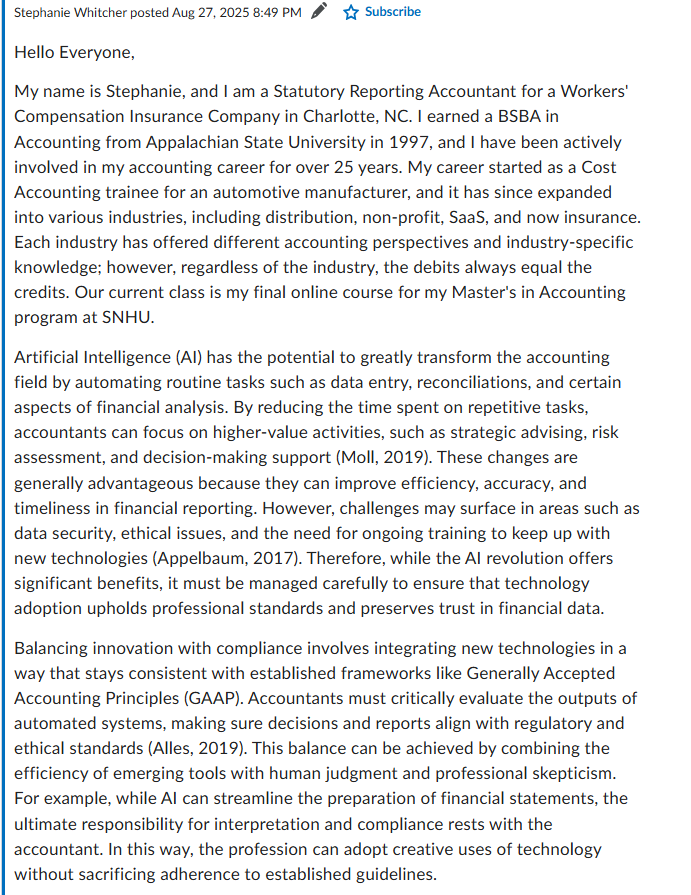
Stephanie Whitcher posted Aug ?7, 2025 8:49 PM f vy Subscribe Hello Everyone, My name is Stephanie, and | am a Statutory Reporting Accountant for a Workers' Compensation Insurance Company in Charlotte, NC. | earned a BSBA in Accounting from Appalachian State University in 1997, and | have been actively involved in my accounting career for over 25 years. My career started as a Cost Accounting trainee for an automotive manufacturer, and it has since expanded into various industries, including distribution, non-profit, SaaS, and now insurance. Each industry has offered different accounting perspectives and industry-specific knowledge; however, regardless of the industry, the debits always equal the credits. Our current class is my final online course for my Master's in Accounting program at SNHU. Artificial Intelligence (Al) has the potential to greatly transform the accounting field by automating routine tasks such as data entry, reconciliations, and certain aspects of financial analysis. By reducing the time spent on repetitive tasks, accountants can focus on higher-value activities, such as strategic advising, risk assessment, and decision-making support (Moll, 2019). These changes are generally advantageous because they can improve efficiency, accuracy, and timeliness in financial reporting. However, challenges may surface in areas such as data security, ethical issues, and the need for ongoing training to keep up with new technologies (Appelbaum, 2017). Therefore, while the Al revolution offers significant benefits, it must be managed carefully to ensure that technology adoption upholds professional standards and preserves trust in financial data. Balancing innovation with compliance involves integrating new technologies in a way that stays consistent with established frameworks like Generally Accepted Accounting Principles (GAAP). Accountants must critically evaluate the outputs of automated systems, making sure decisions and reports align with regulatory and ethical standards (Alles, 2019). This balance can be achieved by combining the efficiency of emerging tools with human judgment and professional skepticism. For example, while Al can streamline the preparation of financial statements, the ultimate responsibility for interpretation and compliance rests with the accountant. In this way, the profession can adopt creative uses of technology without sacrificing adherence to established guidelines









 Study Help