







Question: Force vectors acting on the same object at the same time are called concurrent forces. The single force that is equivalent to the combined effect
Force vectors acting on the same object at the same time are calledconcurrentforces. The single force that is equivalent to the combined effect of these concurrent forces is called theresultant.
For example:
1.) Kevin pushes on a desk with 4 Newtons to the right. Victoria pushes on thesame object at the same time with 6 Newtons to the right. Determine theresultant force.
Clearly, the one resultant force does the same job as the two vector forces. The process of combining the magnitude and direction of concurrent forces to determine their resultant is called thecomposition of forces. If two concurrent forces F1 and F2 act in thesame direction, theangle between the forces is0o and the resultant force is the sum of their magnitudes and in the same direction as the individual forces. This is thelargest resultant the two forces can have.
2.) Now, Victoria wants to push the desk to the left. Assuming the same forces as in Example 1, determine theresultantforce.
If two concurrent forces F1 and F2 act inopposite directions, theangle between the forces is 180o and the resultant force is the difference between their magnitudes (acting in the direction of the larger force). This is thesmallest resultant the two forces can have.
3.) Two forces of 100 N and 40 N are acting on a car.
a.) What is themaximum resultant force on the car? At what angle would this occur?
b.) What is theminimumresultant force on the car? At what angle would this occur?
c.) What is the range of forces that can be applied to the car?
(The range comes in handy on many Regents problems!)
d.) Can a force of 30 N possibly be attained with these two forces?
4.) A resultant force with a magnitude of 20 Newtons can be produced by two concurrent forces having magnitudes of: (Multiple choice)Hint: Find the ranges!
a. 5 N and 10 N
b. 20 N and 20 N
c. 20 N and 50 N
d. 30 N and 5 N
Now let's add vectors at 0oand 180o. When added graphically, add vectors by placing the second vector's "tail" on the first vector's "head". All vectors will be added fromtail to head. Theorder in which you add vectors does not matter; all ways will yield the same resultant. If the tails of concurrent vectors begin at the same point, you must move one of the vectors so that it becomestail to head. Theresultant is then drawnfrom the tail of the first vector to the head of the second.
5.) In a tug-of-war match, the blue team pulls to the right with 30 N of force while the red team pulls to the left with 20 N of force. Show theresultant graphically by adding the vectors.
Now show the resultant if both teams were to pull in the same direction to the right.
Let's apply this method to vectors at all angles.
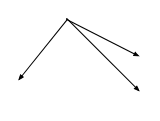
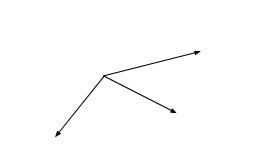
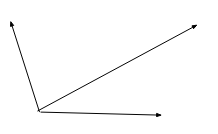
6.) Find the resultant of the following vectors:
7.)
\f\f\f\f
Step by Step Solution
There are 3 Steps involved in it

Get step-by-step solutions from verified subject matter experts
 Study Help