Question: FORMATIVE ASSESSMENT 1 [100 MARKS} Read the case study below and answer ALL of the questions that follow THE EVOLUTION OF QUALITY: HIGHER QUALITY OUTPUT,
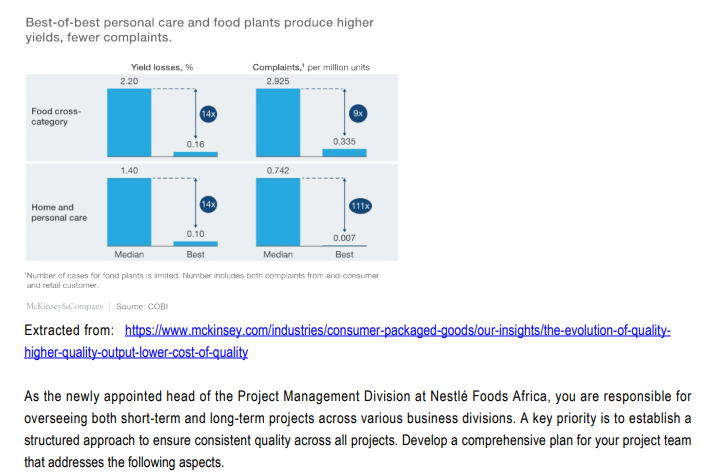
FORMATIVE ASSESSMENT 1 [100 MARKS} Read the case study below and answer ALL of the questions that follow THE EVOLUTION OF QUALITY: HIGHER QUALITY OUTPUT, LOWER COST OF QUALITY Disaster has a way of concentrating the mind. Massive recalls and lawsuitsover beverages, dairy products, detergents, beauty products, and othersbecome almost totemic reminders of what a lapse in quality can mean. And for companies everywhere, simultaneous increases in supply-chain complexity and media reach mean that the aftershock of a quality lapse is likely to be much larger than in the past. But despite their impact, these events are only part of the story. Indeed, as important as itis to keep rare disasters from happening, focusing too closely on them can distort an organization's understanding of what quality really means. Fundamentally, quality is about meeting or exceeding customer expectations: every day, every shipment, in each product and project, year after year. That's where the true value is, measured not only in higher revenues from greater customer satisfaction but also in higher operational efficiency and effectiveness due to increases in productivity and innovationand even employee engagement. Yet organizations face constraints. Rising margin pressures, particularly in consumer-oriented industries such as fast- moving consumer goods, limit how much companies can spend on quality practices. Organizations therefore cannot just be good at qualitythey need to be smart about it as well. To achieve the right balance, organizations must learn to think about quality systematically. At the very earliest stage of quality awareness, organizations start to hear the voice of the customer and project stakeholders more clearly while stabilizing their operating systems and promoting greater transparency about quality problems. As these practicas take hold, the next stage of maturity centres on strengthening cross-functional accountability and collaboration for qualitysuch as with new performance standards so that quality standards inform the design of products and the management of supply contracts. At the third stage, quality informs much of the organization's decision making, embedding itself so deeply that it becomes a part of the culture and essential to the company's value proposition. Finally, among a small group of the very highest performers, quality becomes the basis for their reputation. These exceptional organizations expand their perspective on quality to address customer problems in ways that push their businesses into new areas, building on behavioural research and process analytics to develop deeper solutions and customer relationships. Achieving these outcomes requires investment. But the good news is that the organizations whose quality practices are the most sophisticated are not necessarily the ones that spend the most on quality. Instead, these leaders prioritize so that what they spend on quality is highly effective. At each stage of maturity, the advantages build: from essentially non-existent to basic, from basic to average, from average to advanced, and from advanced to industry leading. For example, a major dairy manufacturer at a basic stage reduced its \"cost of poor quality"such as for warranty claims, yield losses, and reworkby about 35 percent. A mid-level food producer's facility reduced process deviations by more than 30 percent, while at the same time reducing the time to market by 30 percent. On average, the top personal-care and food plants produce dramatically better-quality results on factors such as yield and consumer complaints, both of which have significant cost implications (Exhibit 1). At every stage, therefore, companies across industries are achieving higher quality at competitive cost, building capabilities that prepare them for further stages of quality evolution. Best-of-best personal care and food plants produce higher yields, fewer complaints. Yield losses, % Complaints,' per million units 2.20 2.925 Food cross- 14x 9x category 0.16 0.335 1.40 0.742 Home and 11x personal care 0.10 0.007 Median Best Median Best Number of cases for food plants is limited. Number includes both complaints from end-consumer and retail customer. Mckinsey&Company | Source: COBI Extracted from: https:/www.mckinsey.com/industries/consumer-packaged-goods/our-insights/the-evolution-of-quality- higher-quality-output-lower-cost-of-quality As the newly appointed head of the Project Management Division at Nestle Foods Africa, you are responsible for overseeing both short-term and long-term projects across various business divisions. A key priority is to establish a structured approach to ensure consistent quality across all projects. Develop a comprehensive plan for your project team that addresses the following aspects.Question 1.5 (20 Marks) As outlined in the case study, quality plays a crucial role in organisational decision-making, becoming an integral part of the company's culture and value proposition. Identify and discuss FIVE (5) key project management principles that should be prioritised to enhance project quality for Nestl South Africa. Support your discussion with relevant frameworks and methodologies
Step by Step Solution
There are 3 Steps involved in it
1 Expert Approved Answer
Step: 1 Unlock
Question Has Been Solved by an Expert!
Get step-by-step solutions from verified subject matter experts
Step: 2 Unlock
Step: 3 Unlock
Students Have Also Explored These Related General Management Questions!










 Study Help