







Question: Formula: Effective Interest Rate (EIR)/Effective Annual Rate (EAR) If you Google 'define effective annual rate', you don't really get a straightforward answer. But it's
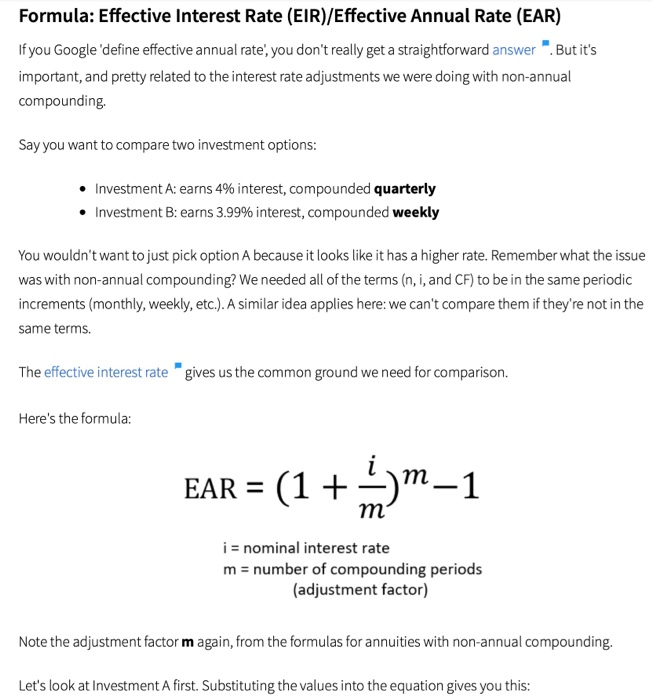
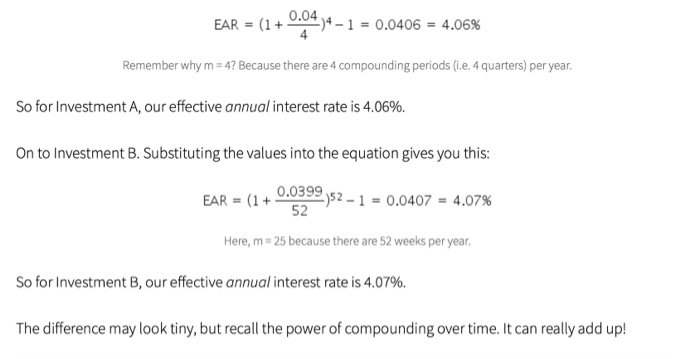

Formula: Effective Interest Rate (EIR)/Effective Annual Rate (EAR) If you Google 'define effective annual rate', you don't really get a straightforward answer". But it's important, and pretty related to the interest rate adjustments we were doing with non-annual compounding. Say you want to compare two investment options: Investment A: earns 4% interest, compounded quarterly Investment B: earns 3.99% interest, compounded weekly You wouldn't want to just pick option A because it looks like it has a higher rate. Remember what the issue was with non-annual compounding? We needed all of the terms (n, i, and CF) to be in the same periodic increments (monthly, weekly, etc.). A similar idea applies here: we can't compare them if they're not in the same terms. The effective interest rate gives us the common ground we need for comparison. Here's the formula: - EAR = (1 + )m_1 i = nominal interest rate m = number of compounding periods (adjustment factor) Note the adjustment factor m again, from the formulas for annuities with non-annual compounding. Let's look at Investment A first. Substituting the values into the equation gives you this: EAR = (1 + 0.04 )4 - 1 = 0.0406 = 4.06% Remember why m = 4? Because there are 4 compounding periods (i.e. 4 quarters) per year. So for Investment A, our effective annual interest rate is 4.06%. On to Investment B. Substituting the values into the equation gives you this: EAR= (1+- 0.0399 52-1 = 0.0407 = 4.07% 52 Here, m = 25 because there are 52 weeks per year. So for Investment B, our effective annual interest rate is 4.07%. The difference may look tiny, but recall the power of compounding over time. It can really add up! If your credit card has a quoted annual percentage rate of 15%, but is compounded weekly (m-52), what is the effective annual interest rate? Round to two decimal places.
Step by Step Solution
3.42 Rating (152 Votes )
There are 3 Steps involved in it
Sol It might seem natural to align the polar axis along w but the integration is easier ... View full answer

Get step-by-step solutions from verified subject matter experts
 Study Help