







Question: Formulate the following questions as a linear programming (I.P) problem according to procedures in the examples shown in the class slides and andio visual lecture
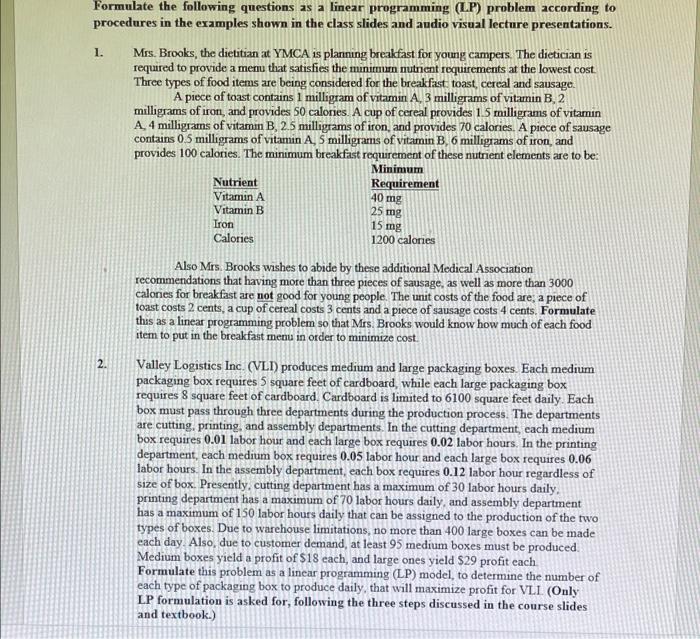
Formulate the following questions as a linear programming (I.P) problem according to procedures in the examples shown in the class slides and andio visual lecture presentations. 1. Mrs. Brooks, the dietitian at YMCA is planning breakfast for young campers. The dietician is required to provide a menu that satisfies the minimum nutnent roquirements at the lowest cost. Three types of food items are being considered for the breakfast toast, cereal and sausage. A piece of toast contains 1 milligram of vitamin A, 3 milligrams of vitamin B, 2 milligrams of iron, and provides 50 calories. A cup of cereal provides 1.5 milligrams of vitarmin A, 4 milligrams of vitamin B, 2.5 milligrams of iron, and provides 70 calories. A piece of sausage contains 0.5 milligrams of vitamin A, S milligrams of vitamin B, 6 milligrams of iron, and provides 100 calories. The minimum breakfast requirement of these nutrient elements are to be: Also Mrs. Brooks wishes to abide by these additional Medical Association recommendations that having more than three pieces of sausage, as well as more than 3000 calonies for breakfast are not good for young people. The unit costs of the food are; a piece of toast costs 2 cents, a cup of cereal costs 3 cents and a piece of sausage costs 4 cents. Formulate this as a linear programming problem so that Mrs. Brooks would know how much of each food item to put in the breakfast menu in order to minimize cost. 2. Valley Logistics Inc. (VLI) produces medium and large packaging boxes. Each medium packaging box requires 5 square feet of cardboard, while each large packaging box requires 8 square feet of cardboard. Cardboard is limited to 6100 square feet daily. Each box must pass through three departments during the production process. The departments are cutting. printing, and assembly departments. In the cutting department, each medium box requires 0.01 labor hour and each large box requires 0.02 labor hours. In the printing department, each medium box requires 0.05 labor hour and each large box requires 0.06 labor hours. In the assembly department, each box requires 0.12 labor hour regardless of size of box. Presently, cutting department has a maximum of 30 labor hours daily, printing department has a maximum of 70 labor hours daily, and assembly department has a maximum of 150 labor hours daily that can be assigned to the production of the two types of boxes. Due to warehouse limitations, no more than 400 large boxes can be made each day. Also, due to customer demand, at least 95 medium boxes must be produced. Medium boxes yield a profit of $18 each, and large ones yield $29 profit each. Formulate this problem as a linear programming (LP) model, to determine the number of each type of packaging box to produce daily, that will maximize profit for VII. (Only) LP formulation is asked for, following the three steps discussed in the course slides and textbook.)
Step by Step Solution
There are 3 Steps involved in it

Get step-by-step solutions from verified subject matter experts
 Study Help