Question: Formulate the mathematical models ONLY for the following problems: 5. The Pinewood Furniture Company produces chairs and tables from two resourceslabor and wood. The company
Formulate the mathematical models ONLY for the following problems: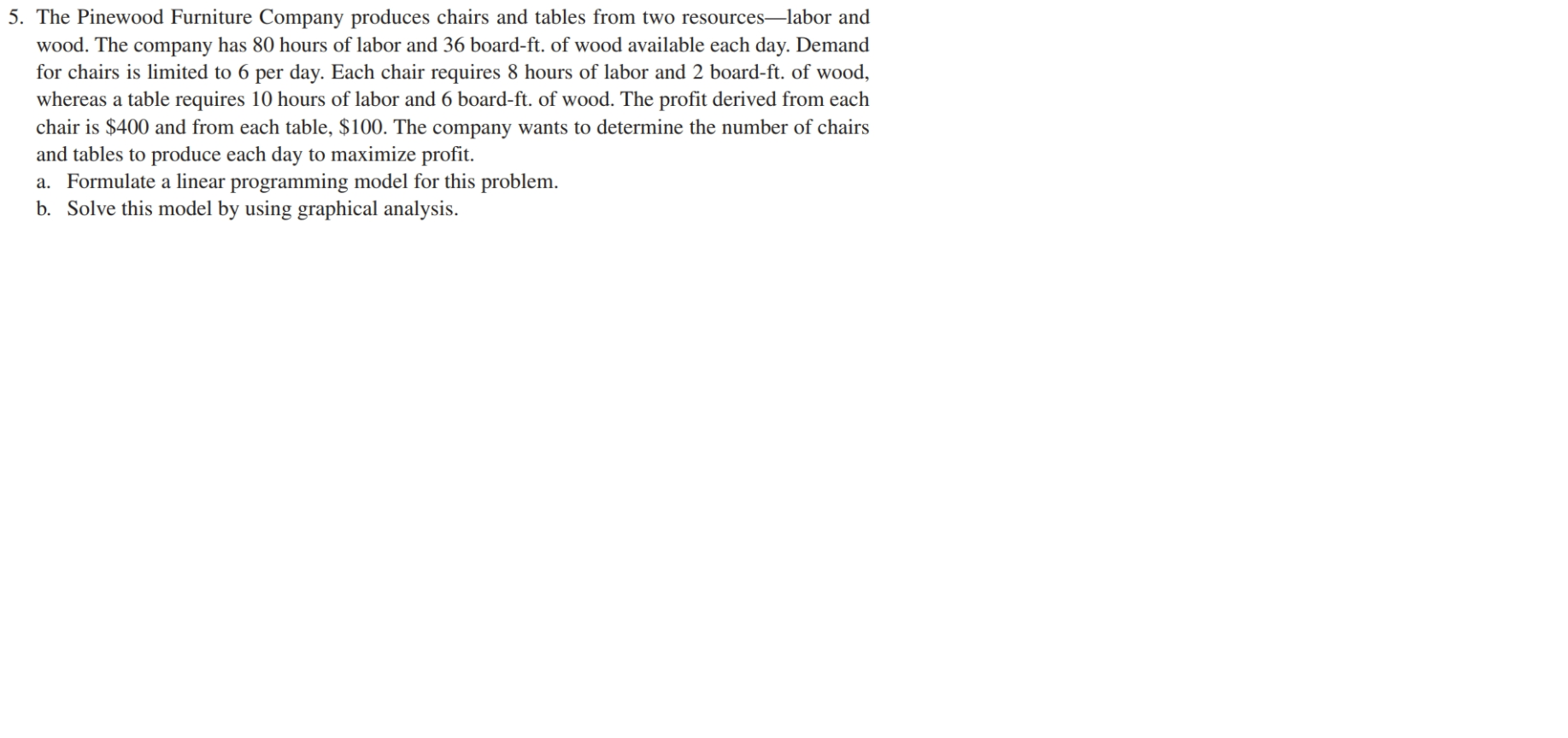
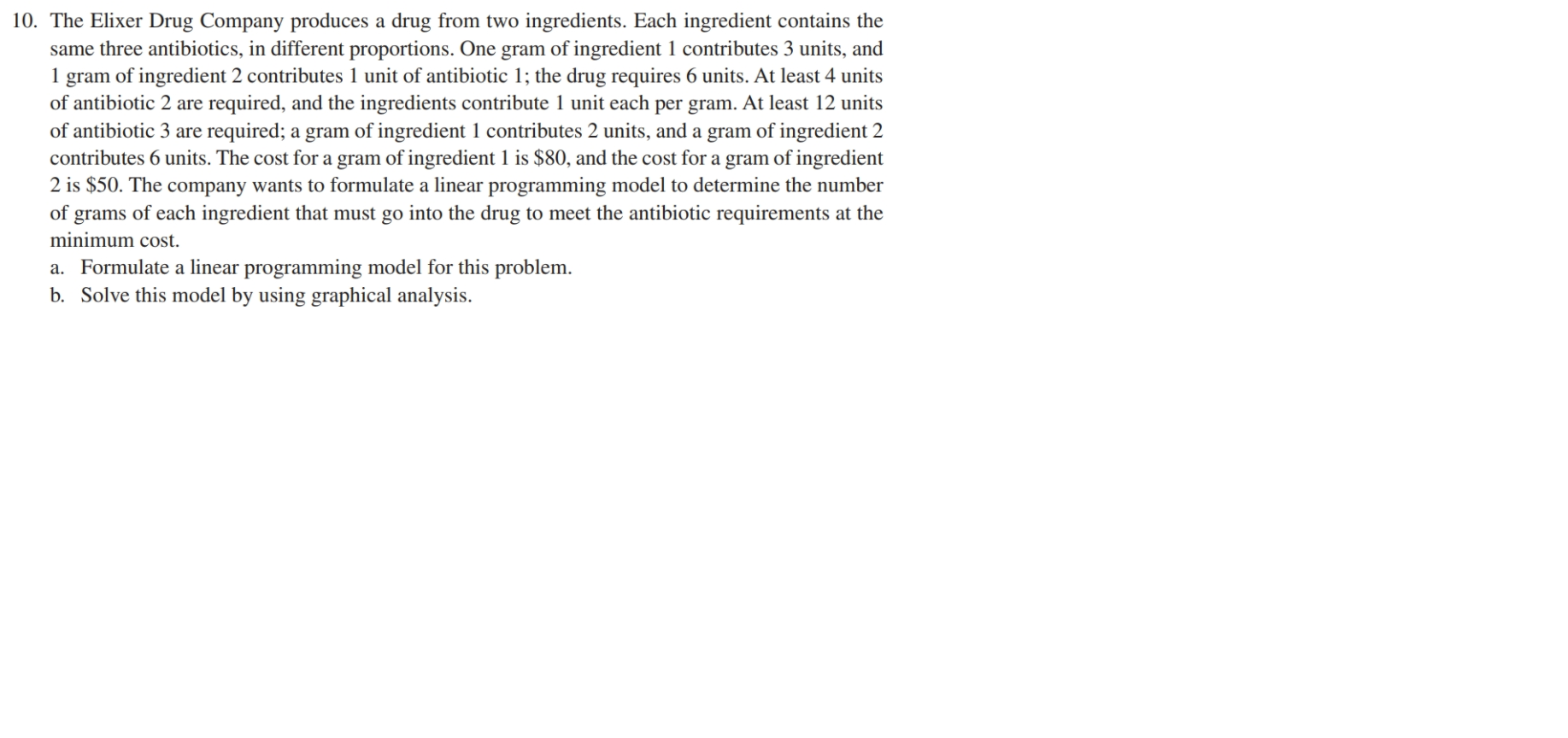
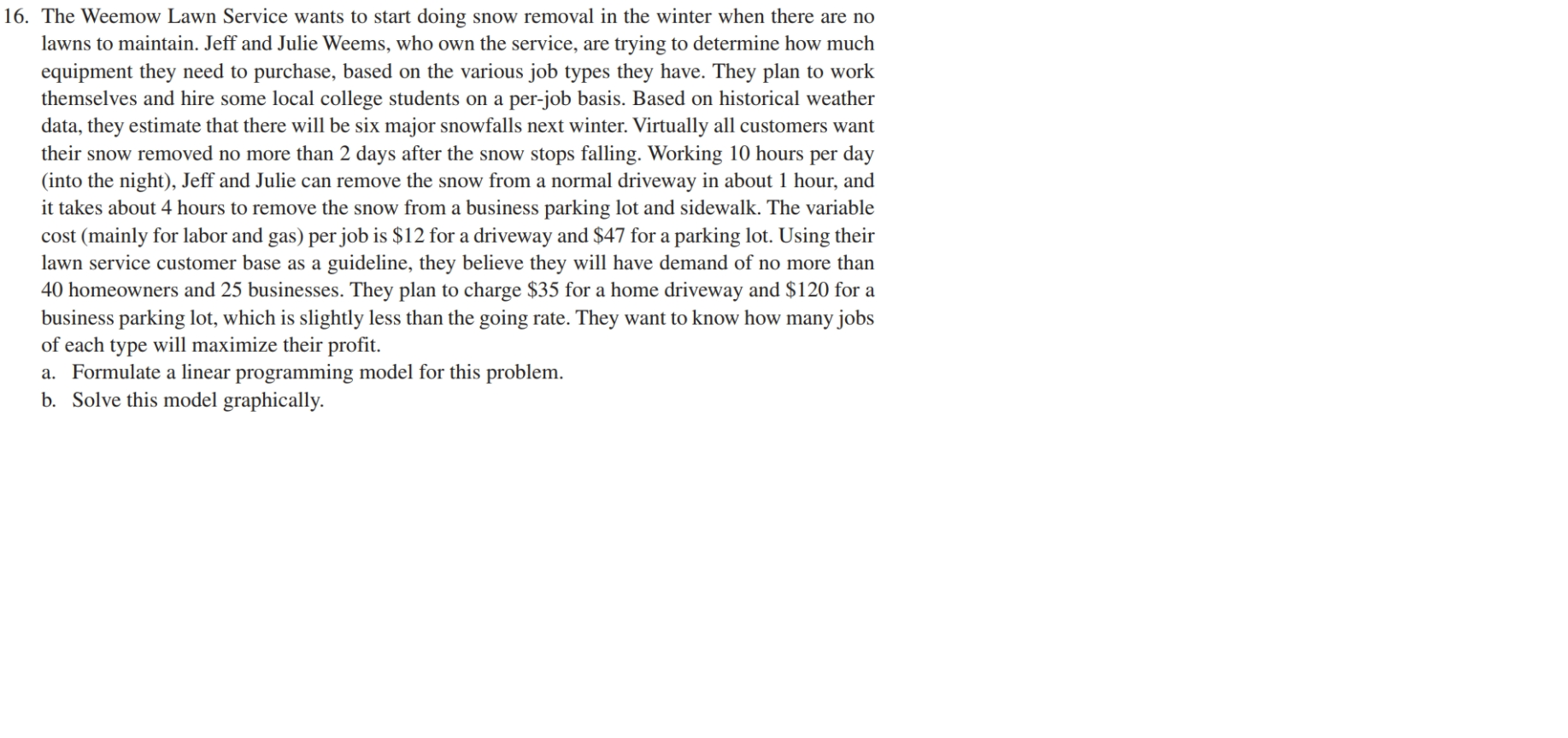
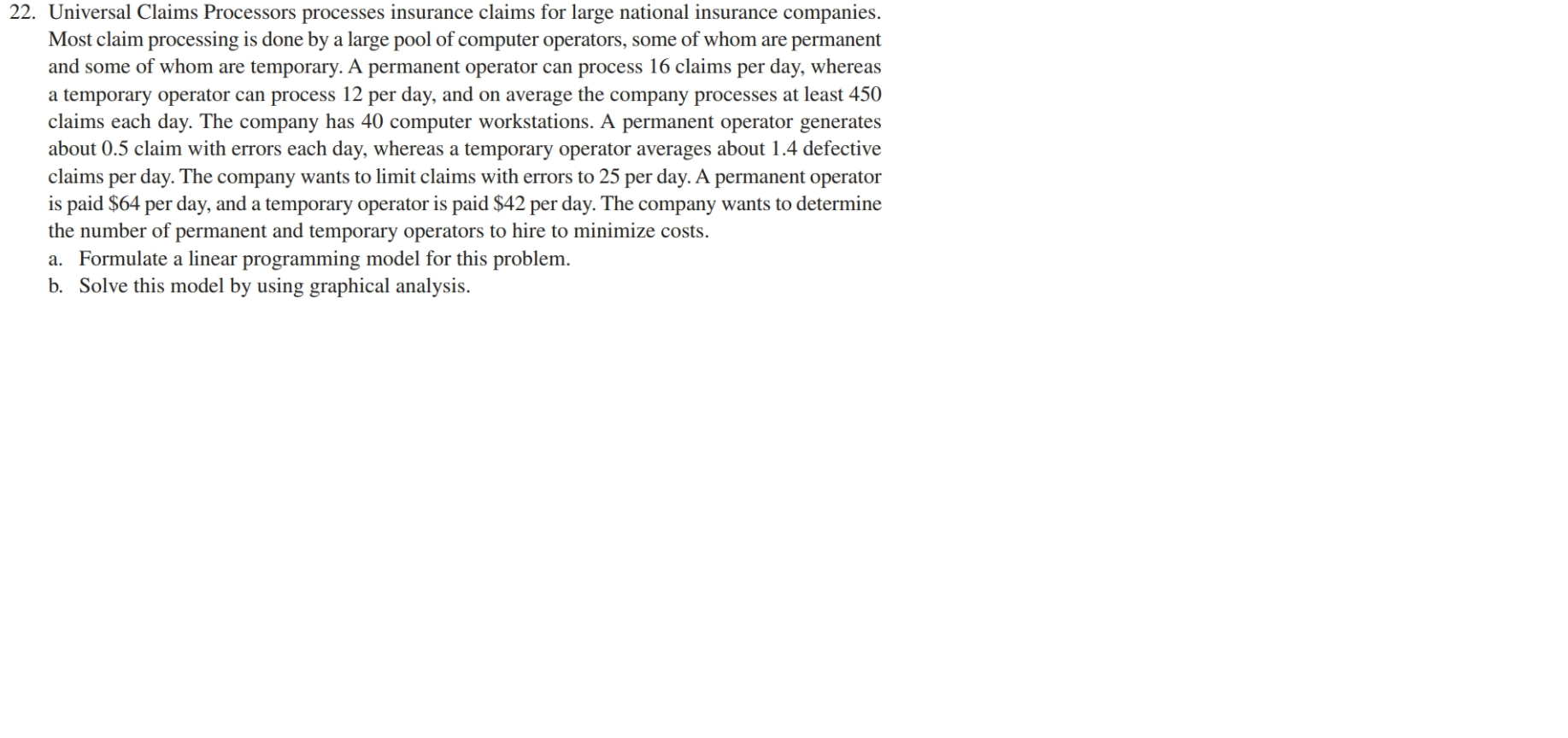
5. The Pinewood Furniture Company produces chairs and tables from two resourceslabor and wood. The company has 80 hours of labor and 36 board-ft. of wood available each day. Demand for chairs is limited to 6 per day. Each chair requires 8 hours of labor and 2 board-ft. of wood, whereas a table requires 10 hours of labor and 6 board-ft. of wood. The profit derived from each chair is $400 and from each table, $100. The company wants to determine the number of chairs and tables to produce each day to maximize profit. a. Formulate a linear programming model for this problem. b. Solve this model by using graphical analysis. 10. The Elixer Drug Company produces a drug from two ingredients. Each ingredient contains the same three antibiotics, in different proportions. One gram of ingredient 1 contributes 3 units, and 1 gram of ingredient 2 contributes 1 unit of antibiotic 1; the drug requires 6 units. At least 4 units of antibiotic 2 are required, and the ingredients contribute 1 unit each per gram. At least 12 units of antibiotic 3 are required; a gram of ingredient 1 contributes 2 units, and a gram of ingredient 2 contributes 6 units. The cost for a gram of ingredient 1 is $80, and the cost for a gram of ingredient 2 is $50. The company wants to formulate a linear programming model to determine the number of grams of each ingredient that must go into the drug to meet the antibiotic requirements at the minimum cost. a. Formulate a linear programming model for this problem. b. Solve this model by using graphical analysis. 16. The Weemow Lawn Service wants to start doing snow removal in the winter when there are no lawns to maintain. Jeff and Julie Weems, who own the service, are trying to determine how much equipment they need to purchase, based on the various job types they have. They plan to work themselves and hire some local college students on a per-job basis. Based on historical weather data, they estimate that there will be six major snowfalls next winter. Virtually all customers want their snow removed no more than 2 days after the snow stops falling. Working 10 hours per day (into the night), Jeff and Julie can remove the snow from a normal driveway in about 1 hour, and it takes about 4 hours to remove the snow from a business parking lot and sidewalk. The variable cost (mainly for labor and gas) per job is $12 for a driveway and $47 for a parking lot. Using their lawn service customer base as a guideline, they believe they will have demand of no more than 40 homeowners and 25 businesses. They plan to charge $35 for a home driveway and $120 for a business parking lot, which is slightly less than the going rate. They want to know how many jobs of each type will maximize their profit. a. Formulate a linear programming model for this problem. b. Solve this model graphically. 22. Universal Claims Processors processes insurance claims for large national insurance companies. Most claim processing is done by a large pool of computer operators, some of whom are permanent and some of whom are temporary. A permanent operator can process 16 claims per day, whereas a temporary operator can process 12 per day, and on average the company processes at least 450 claims each day. The company has 40 computer workstations. A permanent operator generates about 0.5 claim with errors each day, whereas a temporary operator averages about 1.4 defective claims per day. The company wants to limit claims with errors to 25 per day. A permanent operator is paid $64 per day, and a temporary operator is paid $42 per day. The company wants to determine the number of permanent and temporary operators to hire to minimize costs. a. Formulate a linear programming model for this problem. b. Solve this model by using graphical analysis









 Study Help