







Question: FORTRAN!!!! Permutations of n elements can be systematically generated using an integer n-element array, initialized to [1, 2, ,n, and systematically rearranging elements of this
FORTRAN!!!!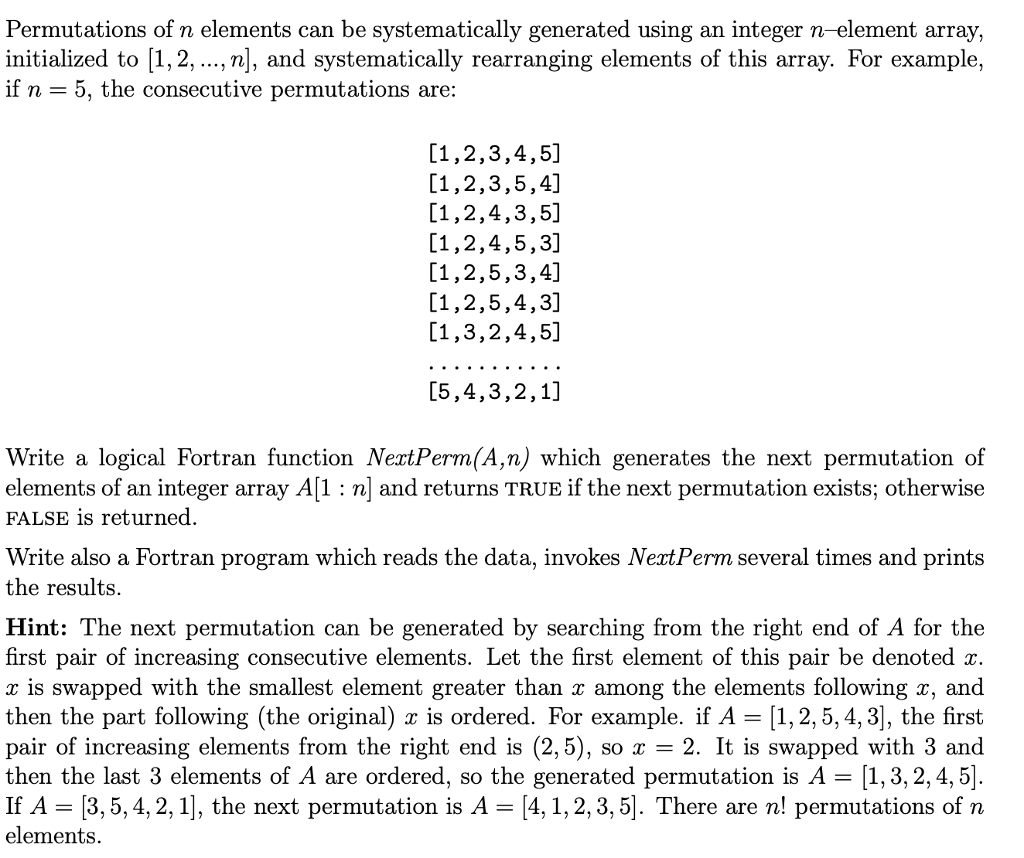
Permutations of n elements can be systematically generated using an integer n-element array, initialized to [1, 2, ,n, and systematically rearranging elements of this array. For example if n - 5, the consecutive permutations are: Write a logical Fortran function NertPerm(A,n) which generates the next permutation of elements of an integer array A1 :n] and returns TRUE if the next permutation exists; otherwise FALSE is returned Write also a Fortran program which reads the data, invokes NextPerm several times and prints the results Hint: The next permutation can be generated by searching from the right end of A for the first pair of increasing consecutive elements. Let the first element of this pair be denoted x. r is swapped with the smallest element greater than x among the elements following x, and then the part following (the original) x is ordered. For example. if A [1, 2, 5,4,3], the first pair of increasing elements from the right end is (2.5), so 2. It is swapped with 3 and then the last 3 elements of A are ordered, so the generated permutation is A [1,3, 2, 4,5 If A- [3,5,4,2,1], the next permutation is A- [4,1,2,3,5]. There are n! permutations of n elements. Permutations of n elements can be systematically generated using an integer n-element array, initialized to [1, 2, ,n, and systematically rearranging elements of this array. For example if n - 5, the consecutive permutations are: Write a logical Fortran function NertPerm(A,n) which generates the next permutation of elements of an integer array A1 :n] and returns TRUE if the next permutation exists; otherwise FALSE is returned Write also a Fortran program which reads the data, invokes NextPerm several times and prints the results Hint: The next permutation can be generated by searching from the right end of A for the first pair of increasing consecutive elements. Let the first element of this pair be denoted x. r is swapped with the smallest element greater than x among the elements following x, and then the part following (the original) x is ordered. For example. if A [1, 2, 5,4,3], the first pair of increasing elements from the right end is (2.5), so 2. It is swapped with 3 and then the last 3 elements of A are ordered, so the generated permutation is A [1,3, 2, 4,5 If A- [3,5,4,2,1], the next permutation is A- [4,1,2,3,5]. There are n! permutations of n elements
Step by Step Solution
There are 3 Steps involved in it

Get step-by-step solutions from verified subject matter experts
 Study Help