







Question: Four different samples of 10 students each from the same age group are given four types of riddles to solve every week for a period
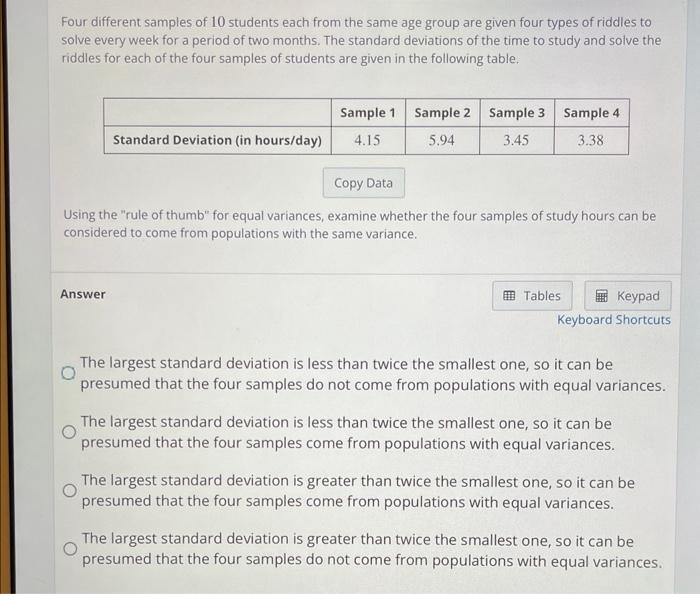
Four different samples of 10 students each from the same age group are given four types of riddles to solve every week for a period of two months. The standard deviations of the time to study and solve the riddles for each of the four samples of students are given in the following table. Sample 1 Sample 2 Sample 3 Sample 4 Standard Deviation (in hours/day) 4.15 5.94 3.45 3.38 Copy Data Using the "rule of thumb" for equal variances, examine whether the four samples of study hours can be considered to come from populations with the same variance. Answer Tables Keypad Keyboard Shortcuts The largest standard deviation is less than twice the smallest one, so it can be presumed that the four samples do not come from populations with equal variances. O The largest standard deviation is less than twice the smallest one, so it can be presumed that the four samples come from populations with equal variances. O The largest standard deviation is greater than twice the smallest one, so it can be presumed that the four samples come from populations with equal variances. The largest standard deviation is greater than twice the smallest one, so it can be presumed that the four samples do not come from populations with equal variances
Step by Step Solution
There are 3 Steps involved in it

Get step-by-step solutions from verified subject matter experts
 Study Help